In this era of rapidly changing global capital flows, stablecoins are no longer just jargon among industry insiders. Recently, BVNK, in conjunction with YouGov, Coinbase, and Artemis, released the "Stablecoin Utility Report 2026," a survey covering 4,658 stablecoin holders in 15 countries, providing invaluable insights from firsthand stablecoin users. Zhiwubuyan has translated and analyzed the report. The three key points are: • Stablecoins are no longer speculative tools; they are becoming the primary payment and receiving channel for hundreds of millions of people worldwide. The demand side is ready; the bottleneck lies on the supply side: insufficient merchant acceptance, poor UX design, and lack of consumer protection. Banks and Fintech are experiencing a historic window of opportunity—77% of cryptocurrency holders are willing to open stablecoin wallets within their bank apps.
01 | Holding: From the Margins to the Mainstream Wealth Allocation
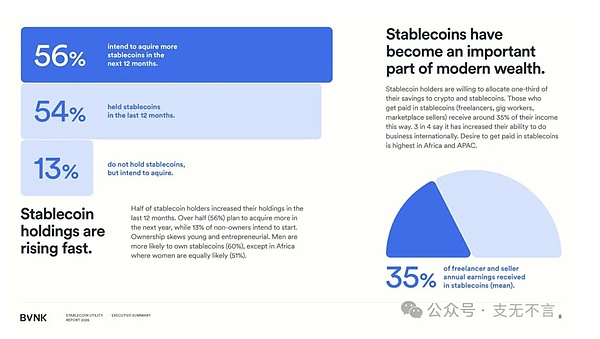
In the past 12 months, half of the cryptocurrency holders increased their stablecoin positions; 56% indicated that they would continue to increase their holdings in the next 12 months.
In the past 12 months, half of the cryptocurrency holders increased their stablecoin positions; 56% indicated that they would continue to increase their holdings in the next 12 months.
Position Holdings
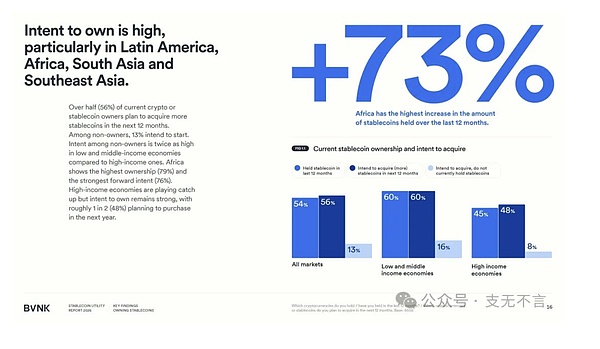
· In the global sample, 54% of respondents held stablecoins in the past 12 months.
· The holding rate is 60% in low- and middle-income economies and 45% in high-income economies.· Africa leads the world with a holding rate of 79%, and its willingness to increase holdings in the future is high.
76% of holders are willing to allocate about one-third of their savings to crypto and stablecoins. This is not an impulsive behavior, but a proactive portfolio decision.
· Average proportion of stablecoins in total savings: 34% globally, 36% in low- and middle-income economies, and 29% in high-income economies
· Maximum range: 48% of people are willing to allocate up to 1/4 of their savings
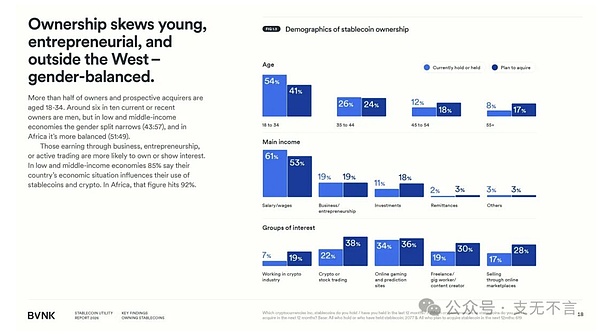
User profile
Flow Rate
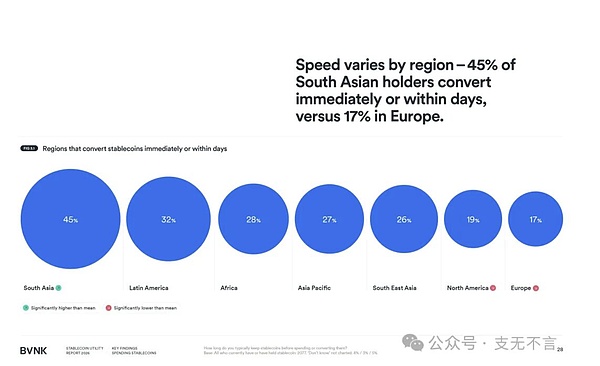
· Globally, 28% are spent or withdrawn within a few days; 23% within 1–3 weeks; 16% within 1–2 months
· Fastest withdrawals: South Asia 45%; Slowest: Europe 17%
Consumption Desire vs. Consumption Reality
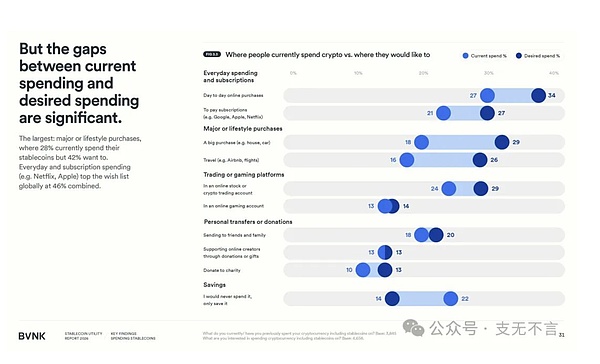
The scenarios with the largest gaps are: large-scale/lifestyle consumption (want to spend 42%, currently spending 28%); daily subscription consumption (want to spend a total of 46%, which is the scenario with the largest demand). · Everyday Online Shopping: Current 27% vs Expected 34% · Subscription Services (Netflix/Apple): Current 21% vs Expected 27% · Large Purchases (RVs): Current 18% vs Expected 29% · Travel (Airbnb/Flights): Current 16% vs Expected 26% Stablecoin Cards: Path of Least Resistance The image shown is located at [link to image]. The image shows that 89% of users in Africa and 80% in South Asia are willing to use stablecoins. Cards represent the shortest path to making stablecoins usable like regular money. · 71% of global consumers are willing to use linked debit cards to spend stablecoins · 78% of low- and middle-income economies; 60% of high-income economies · Merchant acceptance equals customer growth Merchants who accept stablecoins are not only serving existing customers, but also attracting new customers—this is the most direct commercial value of stablecoin payments for merchants. 52% of holders have specifically purchased stablecoins from a merchant that accepts them. · Low- and middle-income economies: 60%; High-income economies: 42% Countries with the highest spending rates Nigeria (92%/96%), India (84%/88%), and South Africa (80%/88%) lead the pack, while the UK and Germany lag behind, demonstrating a stark contrast between consumer demand and infrastructure maturity. "Stablecoin acceptance doesn't just convert customers, it creates them. It's a universal payment rail that works everywhere, local infrastructure doesn't." — Chris Harmse, co-founder of BVNK. On-chain data corroborates this. [Image of stablecoin supply and active addresses] B2B and card-based settlements are the two fastest-growing scenarios, with an annualized total exceeding $390 billion. Visa stablecoin settlements have grown from $1 billion to $3 billion this year.
04 | Payment Collection: The New Payment Infrastructure for Cross-Border Workers
For freelancers and online sellers, stablecoins are no longer just "supplementary income"—they account for an average of 35% of their annual income and are the core payment collection channel.
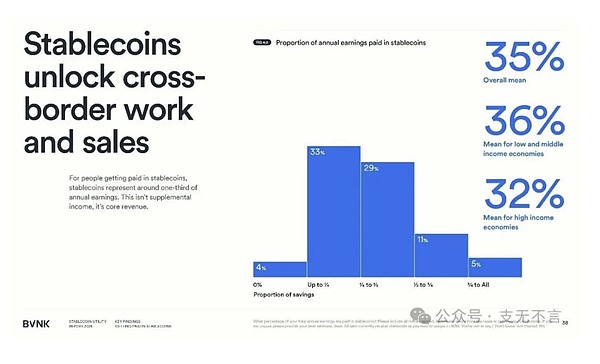
The average is 36% in low- and middle-income economies and 32% in high-income economies. The difference is not large, indicating that this is a widespread behavior driven by actual demand.
Substantial Improvement in Business Capabilities The cross-border fees and accessibility issues inherent in traditional payment methods are being directly bypassed by stablecoins. · 73% of freelancers/gig workers said stablecoins significantly improved their ability to work with international clients, with 46% considering the improvement "significant". · 76% of online sellers/landlords said their sales volume or customer base had improved, with 41% considering the improvement "significant". · The percentage willing to accept stablecoin payments from international clients in the future: 77%, with 44% "very interested". · Willingness to accept payments by region [Image URL: https://img.jinse.com.cn/7434785_image3.png] Africa (95%), APAC (87%), and South Asia (83%) rank in the top three. The EU has the lowest rate (60%), but still exceeds half. [Image URL: https://img.jinse.com.cn/7434785_image3.png] 05 | Experience: What users want is the feeling of ordinary payment. The main driving force behind stablecoin payments is practicality, not ideology. However, users' pain points are also specific: irreversibility, cumbersome procedures, and merchant non-acceptance. Why Choose Stablecoin Payments? The top three priorities are cost, security, and global accessibility. This order reflects the different priorities in different markets—low- and middle-income markets value cross-border accessibility more, while high-income markets value cost and technological trust more. Lower transaction fees: 30% • Better security: 28% • Cross-border usability: 27% • If more merchants accept it: 26% • Faster settlement time: 25% • Cost savings: 40% (the real figure) title="7434787" alt="0ttLzDXARd3R8qHYZ0Zg1XG58T7SWNQ0tPtXNP6Y.png">
World Bank data: The average fee rate for international remittances of $200 is 6.4%, exceeding 8% in sub-Saharan Africa. Stablecoins facilitate direct on-chain settlement, eliminating intermediaries.
Five things users really want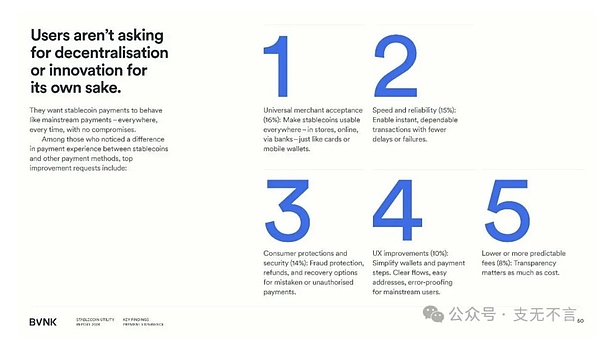
① Wide merchant acceptance (16%): Can be used in physical stores, online stores, and banks, just like swiping a credit card ② Speed and stability (15%): Instant arrival, no failures ③ Consumer protection (14%): Fraud prevention, supports refunds and accidental account recovery

 Weatherly