Terra Founder Do Kwon Faces Fraud Charges in SEC Lawsuit
The federal regulator established that the stablecoin issuer and its founder provided misleading information to investors.
 Catherine

Author: DeFi Investor Translator: Shan Ouba, Jinse Finance
It's no exaggeration to say that 2025 was a brutal year for most crypto professionals.
I myself did not anticipate such a devastating market crash at the end of the year. But as traders and investors, our responsibility is to adapt to the ever-changing market.
Inaction or refusing to accept reality is never a viable strategy. I would like to share some thoughts: why this cycle is so difficult to grasp, and my outlook for the future.
In 2017, there were only a few hundred projects in the crypto market. By 2021, this number had increased tenfold to several thousand.
And by 2025, thanks to zero-barrier token issuance platforms like Pump Fun, the number of tokens on the market had surged to millions.
As a large number of project teams flock to compete for market attention, liquidity is inevitably excessively dispersed across a massive number of tokens, leading to severe dilution of funds. At the same time, the predatory nature of token economic models has become increasingly prominent.
While the overall utility of tokens has improved in this cycle, which is a commendable improvement, almost all newly issued tokens in the past few years have followed the trend of "low circulating supply + high fully diluted valuation." Low circulating supply + high fully diluted valuation refers to a token having an extremely low circulating supply (usually no more than 10%) at issuance, but a very high fully diluted valuation. Low circulating supply artificially creates scarcity, reducing selling pressure in the early stages of TGE, thus pushing up the price. However, once the token unlocking rush arrives, a large influx of new supply into the market inevitably causes the price to collapse, resulting in huge losses for early investors. For many years, almost every newly issued token has succumbed to this fate.
The average return on investment for new tokens listed on Binance this year is only 0.25x.
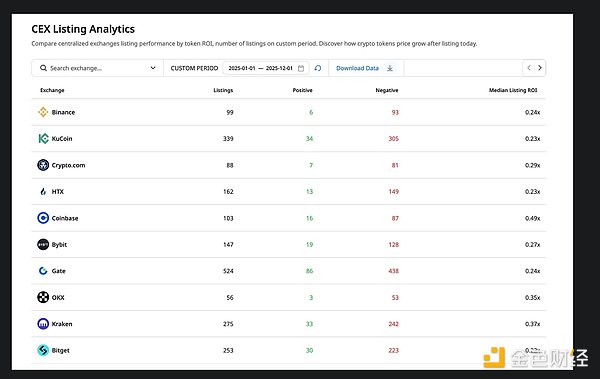
Data source: cryptorank.io
On the Bybit exchange, this figure is even lower, at only 0.11x.
This means that new tokens listed on these leading centralized exchanges in the past year have seen an average drop of 75%-89%! Clearly, one reason for this phenomenon is that startup failures are commonplace. However, I firmly believe that the core reason for the dismal performance of these tokens in their initial launch phase lies in the prevalence of points-based systems. Many projects that haven't yet issued tokens and lack quality products artificially create false demand through points-based systems in order to issue tokens at a high fully diluted valuation. Want to attract a large number of mining users and drive up TVL in the short term? Introduce a points-based system. Want to temporarily occupy the high ground in the crypto community's discourse? Launch a Kaito-related campaign. Of course, I'm not entirely against points or campaigns. If used properly, they can be excellent growth tools—for example, the Hyperliquid project successfully built a large user community through a points-based system. The problem is that many projects that haven't even launched a product – PMF – are also taking advantage of the points system to deliberately exaggerate their total locked value and trading volume, solely to sell at a high price when the token is listed. Before the token is issued, these projects lacking real value "successfully gain popularity" solely through the points system, but they haven't actually solved any real needs. Once the token is listed, mining users will withdraw en masse, most people will stop using the project's products, and the token price will plummet and gradually become worthless. This tactic repeatedly fleeces retail investors, ultimately causing them to completely lose interest in newly issued tokens – which is entirely understandable. To make matters worse, the collapses of FTX and Terra Luna in 2022 had already caused many people to lose trust in the crypto industry.
Every bull market has its own bubble sector.
In 2025, that bubble is artificial intelligence—just like cryptocurrency in 2021. Capital from all sides is rushing into AI companies at outrageous valuations, just to ride this wave of universal optimism.
In 2017 and 2021, everyone believed that cryptocurrency would revolutionize the world. In 2025, everyone believes that artificial intelligence will rewrite the future of humanity.
In my view, both industries undoubtedly have the potential to change the world.
But for now, the most direct impact on us is that many large investment institutions have lost interest in the crypto market and turned their attention to the artificial intelligence track.
To understand just how exaggerated the current AI bubble is, in the first quarter of 2025, 57.9% of venture capital flowed to AI companies. Meanwhile, venture capital flowing to blockchain companies has shrunk significantly in recent years. As capital shifts from the crypto market to AI, altcoins have lost the speculative premium they gained in the 2021 bull market. I'm not sure how the crypto industry can return to the spotlight and attract institutional and retail investors again. But it's clear that AI's dominance has negatively impacted cryptocurrency prices. In my opinion, it's the combination of these three factors that has made this market cycle particularly difficult. Next, I want to talk about my views on the market trend in the next few years, at least the direction I hope the industry can move in. The Way Forward Unfortunately, almost all altcoins fell by at least 50%-70% in 2025. Even so, if someone were to ask me now, "Is cryptocurrency dead?" my answer would still be absolutely not. Stablecoins and prediction markets are two prime examples; they have successfully integrated into the mainstream. Moreover, regulators are more welcoming to the crypto industry than ever before. In highly successful crypto sectors like stablecoins, projects that have achieved product-market fit and generated substantial revenue are likely to see significant valuation increases in the coming years. However, at the same time, I believe the market crash we've experienced in the past few months was, to some extent, inevitable. While there are indeed some high-quality projects with strong teams in the crypto market, there are many more "air projects" with valuations in the billions of dollars, yet lacking both revenue and product-market fit. What the crypto industry truly needs right now is more products that solve real-world problems for ordinary people (not just crypto natives). Most importantly, these products must generate stable revenue and be designed with sustainable token economic models that genuinely benefit token holders. Only then can crypto tokens become attractive investment targets again. In the past few years, the business model of most dApps has essentially been "selling their own tokens." But now, the speculative premium has faded, and capital flowing into the crypto industry is increasingly scarce. I believe the market will gradually return to fundamentals. You might think this vision sounds too idealistic and unattainable. But it is precisely a crash like this that could cause many products that rely on selling tokens to fail, leading to the demise of projects with no product or market fit, thus completing an industry reshuffle. Meanwhile, projects that have already achieved profitability have a much higher survival rate—after all, their revenue is enough to cover a significant portion (or even all) of their development costs. The logic is simple: a successful project must first and foremost be a profitable business. Otherwise, I would never consider its token as a long-term investment. Of course, there are always exceptions. For example, privacy coins, despite lacking a sound and sustainable economic model, have recently performed exceptionally well. Betting on current hot narratives (such as the current privacy concept) can potentially yield substantial profits, even ignoring fundamentals. But remember, most narratives have a lifespan of only a few months at most. Therefore, if you choose to participate in such transactions, be wary of becoming a bagholder after the hype dies down. Unfortunately, 99% of crypto projects will be unable to adapt to the new market environment and will eventually disappear. This is why investment decisions now require more careful selection than ever before. However, I firmly believe that there will still be plenty of opportunities for those who haven't left the market. The question isn't whether the cryptocurrency resurgence will happen, but when.
The federal regulator established that the stablecoin issuer and its founder provided misleading information to investors.
CatherineAave's community has voted to integrate Renzo Protocol and ezETH into the Ethereum ecosystem, enhancing the platform's lending capabilities and operational efficiency. This move reflects the community's commitment to offering innovative services and ensuring Ethereum remains at the forefront of DeFi networks.
 Weiliang
The proposed ban on crypto mining in Paraguay could have significant economic repercussions, highlighting the delicate balance between regulating the industry and maintaining a stable energy supply.
 Alex
AlexThe Solana ecosystem mining project "Ore" recently...
 Miyuki
Genuine Sheboshi tokens are distinguished by their pricing, which consistently features a string of non-zero digits and is observed trading at three-digit figures.
 Kikyo
KikyoIn 2018, British authorities confiscated more than £1.7 billion (equivalent to $2.2 billion) worth of Bitcoin assets.
KikyoThe Canadian government announces a $2.4 billion investment in AI, focusing on computing power, startups, workforce support, and regulatory enforcement.
WeiliangHashKey Group launches global trading platform, targeting international users with over 20 cryptocurrencies, stablecoins, and plans for futures trading.
AlexBeijing police uncovered a series of cases involving the illegal sale of citizen information using cryptocurrency, with transactions worth over $282 million.
MiyukiParaSwap's community has agreed to use treasury funds to compensate victims of the Augustus V6 contract vulnerability, highlighting the project's commitment to its users' security.
Weiliang