AI-Fi金融芯片与Openclaw奇点后的全球金融
AI Agent和Crypto智能合约封装的超智能金融资产和AI-Fi适配下一个时代的金融环境。
 JinseFinance
Author:Biteye Core Contributor Amelia
On February 15, 2026, OpenAI CEO Sam Altman announced on the X platform that Peter Steinberger, founder of OpenClaw, has officially joined the OpenAI team to lead the development of next-generation personal AI agents. OpenClaw, an open-source project that swept the globe in just one month, will be transferred to the foundation and will remain open-source and independent.
Founder Peter Steinberger is a veteran Austrian developer who founded PSPDFKit in 2011 and successfully exited the business for approximately €100 million, possessing 13 years of entrepreneurial experience.
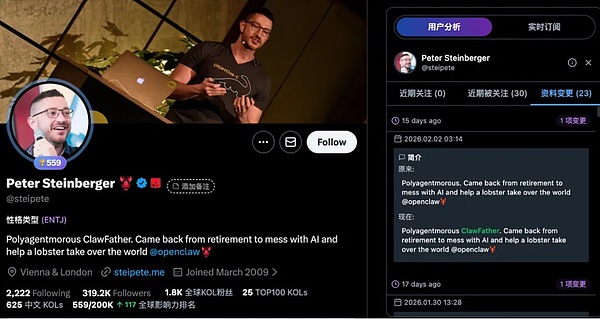
XHunt's global influence ranking is 559, and on February 2nd, a description of ClawFather was added to his profile.
XHunt's global influence ranking is 559, and on February 2nd, a description of ClawFather was added to his profile.
XHunt's global influence ranking is 559, and on February 2nd, a description of ClawFather was added to his profile.
Peter Steinberger
Before joining OpenAI, Steinberger faced several options.
According to TechCrunch, Meta attempted to acquire OpenClaw, but Steinberger rejected it. OpenAI also made an acquisition offer, which was also rejected.
His final choice was to join OpenAI, but not sell OpenClaw.
This means: Peter Steinberger joins OpenAI. OpenClaw is transferred to an independent foundation and remains open source. OpenAI commits to sponsoring, but not controlling. He can continue to serve as an advisor to OpenClaw. This arrangement is extremely rare in Silicon Valley. Usually, when large companies want an open-source project, they acquire it directly—like Microsoft acquiring GitHub and IBM acquiring Red Hat. But Steinberger insists on maintaining OpenClaw's independence. Why OpenAI? 2.1 "I've already played the startup game" In explaining his choice, Steinberger said: "I can totally imagine OpenClaw becoming a huge company. But that doesn't excite me. I'm essentially a builder. I've played the game of building companies, invested 13 years of my life, and learned a lot." Behind this statement lies the sober understanding of someone who has experienced a complete startup cycle. He knows how to raise funds, how to scale, and how to exit. He knew how to turn a tech project into a company valued at hundreds of millions of dollars. But he also knew the cost—burnout, loss of life, becoming a "dumping ground." More importantly, he knew that building a large company and changing the world are two different things. PSPDFKit is a successful company, but its impact on the world is limited. It made PDFs better on iOS, but that's far from enough. OpenClaw, however, has the potential to change the way humans interact with AI. 2.2 Shared Vision Leads to Greater Success In his blog, Steinberger mentioned that the more he communicated with the OpenAI team, the more he discovered that "both sides share the same vision." What is this vision? It is to make AI truly serve humanity, to make technology simple enough for anyone to use, and to combine open-source spirit with cutting-edge research. Partnering with OpenAI is "the fastest way to bring intelligent agents to everyone." This is not an ideological choice, but a pragmatic one. OpenAI possesses the most advanced models, the most powerful computing power, and the broadest user base. If he truly wants to "make intelligent agents accessible to mothers," OpenAI is the most realistic path. OpenAI has promised to transfer OpenClaw to an independent foundation, to sponsor but not control it, and to allow him to continue dedicating his time to maintaining the project. These promises are more compelling to a true builder than any financial terms. Why Web3 Failed to Take Over OpenClaw
Web3
There's an open secret in the industry: most projects' primary goal is to issue tokens, not to develop a product. This isn't criticism, it's a fact. In the Web3 fundraising logic, the token is central. You need to design a token economic model first, then raise funds, then develop the product, and finally exit through an exchange. This logic leads to a structural problem: the product exists to support the token price, not to solve user problems. Let's see how OpenClaw would evolve if it were a Web3 project: Hypothetical OpenClaw Web3 version: September 2025: Released a white paper, announcing its intention to create a "decentralized AI assistant". October 2025: Received $5 million in VC funding, valuing the company at $100 million. October 2025: Launched a testnet, airdropping tokens to early users. November 2025: Listed on an exchange as an alpha token, market makers pumped the price, causing a 10-fold increase, with FDV reaching $1 billion. December 2025: The community begins discussing "when to launch spot trading" January 2026: The team is accused of insider trading, and the coin price plummets February 2026: The project is abandoned, the token's market capitalization is less than $10 million, a drop of 99% This is not fiction, but the true trajectory of countless Web3 projects. In less than six months, the project went "to zero". 3.2 The Trap of the Attention Economy A unique phenomenon exists in the Web3 industry: attention is more important than the product. A project's success largely depends on its ability to attract the community's attention. And what's the best way to attract attention? Create FOMO (Fear of Missing Out). Airdrop expectations, listing rumors, KOL endorsements, price surges… all of these can attract a lot of attention in a short period of time. But this attention is speculative, not practical. Users care about "Can I make money?", not "Is this product useful?". OpenClaw's growth model is completely different. Its 150,000 GitHub stars come from: Developers genuinely finding it useful; word-of-mouth recommendations from the tech community; and its ability to solve real-world problems. There was no airdrop, no listing on exchanges, and no KOL endorsements.One of the core concepts of Web3 is "decentralization," but ironically, Web3 projects themselves are often highly centralized.
One of the core concepts of Web3 is "decentralization," but ironically, Web3 projects themselves are often highly centralized.
Let's compare the community culture of OpenClaw with that of a typical Web3 project:
OpenClaw Discord:
Discussing how to deploy to Raspberry Pi
Sharing custom skills
Conclusion: The Second Half of Web3, It's Time to Learn from "ClawFather"
Peter Steinberg's story reflects the divergence between two technological spirits:
On one hand is the builder's spirit: I want to change the world, so I want to make something useful and solve real problems.
On the one hand is the builder's spirit: I want to change the world, so I want to make something useful and solve real problems.
On the other hand, there's the spirit of speculators: I don't care what value the project provides; I only care about issuing a token, exiting the investment, and making quick money. OpenClaw wasn't born in Web3, not because Web3 technology was inadequate, but because Web3 focused too much on listing on exchanges, pyramid schemes, pump-and-dump schemes, and exploiting investors. True builders would choose to stay away, just like Steinberg wrote in the server rules: "No talking about finance or crypto." This is perhaps the most incisive criticism and the most sincere advice for Web3.AI Agent和Crypto智能合约封装的超智能金融资产和AI-Fi适配下一个时代的金融环境。
JinseFinanceStart cultivating a Claw. Not because it's easy—it's painful, and the tools are crude. But the people who put this into the work today are building something that grows with compound interest.
JinseFinancePeter Steinberger, founder of OpenClaw, a rising star in the AI world, ultimately rejected Meta and chose to join OpenAI.
JinseFinanceOpenAI, Artificial Intelligence: The father of OpenClaw joins OpenAI; Ultraman gets his hands on him! Golden Finance reports a major personnel change in the AI Agent industry.
JinseFinanceAn in-depth analysis of the asset repricing triggered by AI's shift from providing advice to autonomous execution: revealing the collapse of the value of old assets that rely on human labor, and exploring the systemic migration of funds to computing power, automated settlement protocols, and embodied intelligent hardware.
JinseFinanceMoltbooks are like dazzling fireworks, illuminating people's fantasies about AI-powered social interaction while also revealing the absurdity of current technology. But in the darkness after the fireworks have faded, OpenClaw is quietly building the future.
JinseFinanceThe various components of the AI-driven intelligent agent economy—payments, reputation, and identity—have been built up over the past few months. OpenClaw may be the platform through which they are connected.
JinseFinanceHow can a local AI "born to be lazy" become the master of your computer?
JinseFinanceOn the Base chain, a native ecosystem of AI agents called OpenClaw is rapidly taking shape.
JinseFinanceOrganised by DeFi platform ArrayFi, Bridge Web3 2023 was a three-day conference hosted on Phú Quốc island in Vietnam.
 Davin
Davin