Author: CoolFish Source: X, @kricspan
A company with 3,000 employees earns more than Citibank and Bank of America. It doesn't advertise, has no CEO, and doesn't have non-compete agreements. Its name rarely appears in the news until it appears in the dock.
On February 24, Terraform liquidators sued Todd Snyder, who sued high-frequency trading giant Jane Street, accusing it of using insider information to trade, illegally profiting, and ultimately accelerating the collapse of the Do Kwon crypto empire.
Although Jane Street denied the allegations, calling them baseless, the market's attention has already begun to turn to this company. At the same time, a Jane Street internship recruitment posting circulated on Twitter.
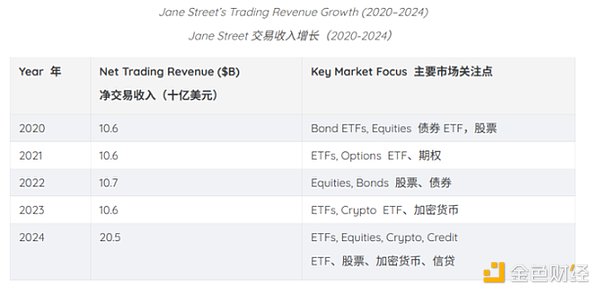
The screenshot shows that the company is recruiting quantitative trading interns with a 4-month contract and a base salary of $300,000. Crucially, it doesn't require a financial background or programming experience; it only asks one thing: Can you solve problems? Seeing the salary and requirements at first glance is truly surprising. Who exactly is this company? Are quantitative intern salaries really this high? How does it make so much money? What role does it play in the global financial market? These questions deserve serious answers. Because once you peel back the layers of secrecy and truly understand this company, you'll realize one thing: Jane Street's existence itself is an extreme experiment about information, speed, and the boundaries of rules. Its name rarely appears in the news until it appears in the dock. A small, windowless office and four gamblers. New York, 1999. Three traders who left Susquehanna International Group (SIG), plus a programmer who jumped ship from IBM, rented a small, windowless office and started a business that most people would scorn: ADR arbitrage. ADRs, American Depositary Receipts, are stock certificates of foreign companies traded on the U.S. market. Theoretically, their price should be consistent with the original shares listed in the home country, but time zone differences, exchange rate fluctuations, and information delays can create tiny gaps between the two. The four founders of Jane Street—Tim Reynolds, Robert Granieri, Michael Jenkins, and Marc Gerstein—targeted these gaps, trading algorithms and speed for profits. This business is almost devoid of color: it lacks grand narratives and disruptive ambitions, possessing only an extreme sensitivity to numbers and a morbid pursuit of execution. According to research firm Alphacution, the company may have initially registered as "Henry Capital," changing its name to Jane Street in August 2000. Externally, they maintain an almost obsessive low profile. This obsession seems to have been part of the company's DNA from the very beginning. Of the four founders, three came from the same company, leaving to start their own venture. Susquehanna even sued Jane Street for "stealing proprietary information and poaching key talent"—although the lawsuit ultimately fizzled out. This sensitivity may have profoundly influenced Jane Street's subsequent approach to its strategic secrets: no media interviews, no industry conference speeches, and no unnecessary exposure. They quietly worked on their problems in that small, windowless room. ETFs: The Bet That Changed Everything In the early 21st century, Jane Street made a decision that would later prove to be a game-changer: to focus its efforts on ETFs, a niche product at the time. ETFs (Exchange Traded Funds) were relatively marginal products in the early 2000s. They had low liquidity, few participants, and large institutions found them inconvenient to enter and exit, largely avoiding them. But it was precisely this "unpopularity" that made it Jane Street's ideal hunting ground. Market makers were the core logic of this game. Market makers simultaneously posted bids and asks, ready to trade with any counterparty and profit from the bid-ask spread. It sounds simple, but in practice, it requires accurate asset pricing at the millisecond level, managing massive inventory risk, and maintaining continuous operation in global markets. Jane Street achieved this with algorithms, and quickly and accurately. What followed was one of history's classic "choosing the right track" stories. ETFs experienced explosive growth over the next two decades, growing from hundreds of billions of dollars to trillions of dollars, with institutions, retail investors, and pension funds flocking in. Jane Street has become one of the most indispensable infrastructures in this market. 3,000 people, taking down Citigroup and Bank of America. Here are some figures that give you a clear sense of Jane Street's earning power: In 2024, Jane Street's net trading revenue was $20.5 billion. In the same year, Citigroup's trading division had net revenue of $19.8 billion. Bank of America's trading division had $18.8 billion. Jane Street won, surpassing Citigroup by $700 million and Bank of America by $1.7 billion. According to online data, Citigroup has approximately 220,000 employees worldwide. Bank of America has approximately 210,000 employees worldwide, while Jane Street has over 3,000 employees. This is an almost abnormal level of efficiency.
Source: MSTIMES
By 2025, the data is even more astonishing. According to Bloomberg and other reports, Jane Street's net trading revenue in Q2 2025 was $10.1 billion, surpassing all major Wall Street banks. Its total revenue for the first three quarters of 2025 was $24 billion, exceeding its total revenue for the entire year of 2024...
Comparing these figures to industry benchmarks: Citadel Securities' trading revenue in 2024 was approximately $9.7 billion, Virtu Financial's was approximately $2.9 billion, and Flow Traders' was approximately $500 million. Jane Street is at least twice as big as its competitors.
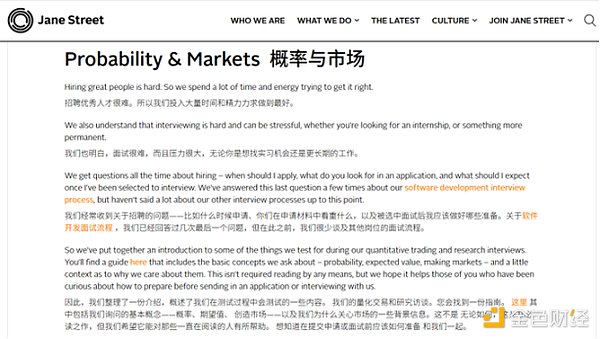
Beyond the scale figures, there are some market share data that can help you understand just how deeply this company has penetrated the market: In 2024, Jane Street held a 24% share of the primary market for listed ETFs in the United States, 41% of the trading volume of bond ETFs, and 17% of the secondary market for ETFs in Europe. Its average monthly stock trading volume reached $2 trillion, and it accounted for approximately 8% of all trading volume of Options Clearing Corporation in the US options market and over 10% of North American stock trading. In other words: every time you, your fund, or your pension fund buys or sells an ETF, there is a very high probability that the counterparty is Jane Street. And you might not even know it exists. OCaml, the Puzzle, and the Real War Machine Jane Street is headquartered at 250 Vesey Street in Manhattan's Financial District, New York. In the office, there's a genuine World War II-era Enigma encryption machine—the kind Nazi Germany used to encrypt communications. This machine isn't just decoration; it's a manifesto. This company loves encryption, loves puzzles, and loves building its world in a language only a select few can decipher. Jane Street's core trading system is programmed in OCaml. OCaml is a functional programming language known for its strong typing and logical rigor, but it's rarely used by other companies in the financial industry. As of 2023, Jane Street's OCaml codebase exceeded 25 million lines—the Financial Times points out, roughly half the size of the Large Hadron Collider's codebase. This choice seems unusual, but it has profound engineering logic: in financial trading systems, a single line of code bug can cause hundreds of millions of dollars in losses. OCaml's type system forces the elimination of a large number of potential errors during the compilation phase, making it harder to write runtime-crashing code than C++. A side effect is that engineers who have worked at Jane Street are often difficult for other companies to "swallow" because of their OCaml proficiency. As headhunters describe it: "People stay at Jane Street because they love it, but also because no one can poach you with their OCaml skills." This creates an unexpected moat: the technology stack binds talent. It's worth noting that Jane Street has no CEO. There is no hierarchical bureaucracy, no management levels, and no familiar financial industry titles like "Vice President" or "Managing Director." The Financial Times describes it as "an extremely profitable anarchic commune." The company is decided by 30 to 40 senior employees and operates through a management committee and a risk committee. These 40 individuals hold approximately $24 billion in equity and run various trading desks and business units, but they are not called "presidents"; they are simply—owners. All employee compensation is linked to the company's overall profits, not individual trading performance. This means no one will take excessive risks for their own bonus, because losses are shared by everyone, and wins are shared by everyone. In 2024, Jane Street paid $1.4 million in compensation to its approximately 3,000 employees. The screenshot of the Jane Street internship recruitment ad wasn't a marketing gimmick, but rather Jane Street's consistent self-perception: they weren't looking for financial experts, but rather "people who enjoy solving interesting problems." The interview process was notoriously difficult. Candidates were required to solve probability problems, game theory problems, and expected value calculations under pressure, testing their fundamental logical abilities rather than industry knowledge. According to the company, only a "very small percentage" of applicants were invited to the interview stage.
The company does not use non-compete agreements—a rare exception in the financial industry where signing non-compete agreements for departing employees is almost standard practice. Jane Street believes that its competitive advantage is not a particular algorithm, but rather the culture and capability density of the entire system, which cannot be easily replicated.
A senior hedge fund quantitative analyst pointed out that Jane Street is a haven for traders, while Citadel Securities is more suitable for quantitative analysts and developers.
A senior hedge fund quantitative analyst pointed out that Jane Street is a haven for traders, while Citadel Securities is more suitable for quantitative analysts and developers.
This story began with a lawsuit, which unexpectedly ignited an even larger crisis.
In February 2024, two traders at Jane Street—Douglas Schadewald and Daniel Spottiswood—abruptly resigned and jumped ship to hedge fund giant Millennium Management.
Jane Street subsequently filed a lawsuit against the two and Millennium in April, accusing them of stealing a "highly valuable" proprietary trading strategy.
What was the core of this strategy? A seemingly insignificant detail in court revealed to everyone that it was a short-term index options strategy specifically targeting the Indian options market—which generated over $1 billion in profits for Jane Street in 2023 alone.
More specifically, after two traders took this strategy to Millennium, Jane Street's profits in the Indian market plummeted by 50% in March 2024. Meanwhile, Millennium's Indian operations began a rapid expansion. In December 2024, the case was settled under a confidentiality agreement, the specific terms of which were not disclosed. However, Jane Street's disclosure of a "$1 billion Indian options strategy" in the lawsuit attracted the attention of the Securities and Exchange Commission of India (SEBI). Many Indian retail investors suffered heavy losses in options trading; why was a foreign company able to earn such enormous profits? On July 3, 2025, the SEBI issued a 105-page temporary injunction, announcing the conclusion of its investigation. SEBI's description paints a picture like this: On the expiration date of Bank Nifty options, Jane Street's algorithm buys a large number of Bank Nifty constituent stocks and stock index futures after the market opens (9:15-11:46), sometimes accounting for more than 20% of the total market trading volume, including core heavyweight stocks such as Kotak Bank, SBI, and Axis Bank. Simultaneously, Jane Street establishes a large short position in the options market: selling call options and buying put options. In the afternoon (11:49 to the close), Jane Street begins to reverse its strategy: selling a large number of stocks and futures bought in the morning, artificially putting downward pressure on the index. The closing price on the expiration date shifts lower, and the previously established short option positions profit significantly. On a particular day during SEBI's focused audit, Jane Street incurred a loss of approximately $7.5 million in spot and futures trading, but gained approximately $89 million in options trading. Net profit: $81.5 million. From January 2023 to March 2025, SEBI statistics show that Jane Street's total profits across all trading segments reached 365.0212 billion rupees (approximately $4 billion). Notably, Jane Street profited 432.8933 billion rupees in index and stock options trading, but incurred a net loss of 72.08 billion rupees in stock futures trading. SEBI's original statement: "This outrageous behavior, blatantly ignoring the explicit warning issued to it by the NSE in February 2025, clearly demonstrates that Jane Street is not a bona fide market participant like the vast majority of foreign institutions and is not worthy of trust." SEBI also added an unsettling context: the institution had previously conducted its own statistics showing that 93% of retail options traders in the Indian derivatives market lost money, with annual losses exceeding 1 trillion rupees. During the same period, professional trading institutions—represented by Jane Street—profited handsomely. On July 4, 2025, SEBI suspended Jane Street's trading qualifications in India, and its bank accounts were frozen, prohibiting any unauthorized deductions. On July 14, Jane Street deposited approximately 4.84 billion rupees (about $560 million) into an escrow account as required, applying to have its trading privileges reinstated. On July 21, SEBI allowed it to resume trading—on the condition that it continue to cooperate with the investigation. In an internal memo, Jane Street denied all allegations, calling the Securities and Exchange Commission of India's charges "highly inflammatory" and arguing that its activities involved arbitrage trading of underlying indices, "a core and pervasive mechanism for maintaining price consistency in financial markets," and filed an appeal. As of February 2026, the case was still pending. A New Footnote to the Luna Crash
In May 2022, TerraUSD and Luna collapsed. The UST algorithmic stablecoin plummeted from $1 to worthless, and Luna fell from $116 to near zero, wiping out $40 billion in value instantly.
Perhaps we didn't consider the culprit behind the collapse at the time, but four years later, this collapse has a new footnote.
On February 23, 2026, Todd Snyder, the liquidator of Terraform Labs, filed a lawsuit in Manhattan federal court against Jane Street.
At the heart of the lawsuit is a private chat group called "Bryce's Secret".
The group chat was created by Bryce Pratt, an employee of Jane Street. He was a former intern at Terraform before joining Jane Street, but his old network remained intact—the other two members of the group were a software engineer and a business development manager at Terraform. According to the lawsuit, this group chat was created in February 2022 and became an information conduit connecting Terraform internally with Jane Street. On May 7, 2022, at 5:44 PM, Terraform Labs quietly withdrew $150 million of UST from the Curve decentralized liquidity pool. This operation was not publicly announced, and no outsiders knew about it. Ten minutes later, a wallet associated with Jane Street withdrew $85 million of UST from the same liquidity pool. Terraform and Jane Street together withdrew a total of $235 million of UST from this liquidity pool, directly breaking through UST's liquidity support. UST began to decouple, and panic began to spread. Bloomberg quoted a key statement in the lawsuit: Jane Street's actions allowed it to "cover hundreds of millions of dollars in potential exposure in the hours before the Terraform ecosystem collapsed." Two days later, on May 9, UST had fallen to $0.8, and the collapse was irreversible. Bryce Pratt messaged Do Kwon and the Terraform team via group chat, indicating that Jane Street "could consider buying Luna at a significant discount." First, they moved the valuables out of the fire, then came back to ask the homeowner if they wanted to sell at a loss. The defendants named in the lawsuit, besides Pratt, include Jane Street co-founder Robert Granieri (the only one of the four founders still employed) and employee Michael Huang. Jane Street's response was concise: "A desperate lawsuit, transparent extortion." They added that the losses suffered by Terra and Luna investors stemmed from "billions of dollars in fraud" by Do Kwon and Terraform management, and they would fight back forcefully. They weren't wrong. Do Kwon did plead guilty and was sentenced to 15 years; Terraform did pay a $4.47 billion fine. However, "Do Kwon is guilty" and "everyone else is innocent" are not mutually exclusive. A building had a fatal structural flaw—that's a fact. The fact that someone emptied the most valuable items before it collapsed is a separate legal issue. What exactly is this company? The story of Jane Street is difficult to summarize in a single word. Its $20.5 billion net income in 2024 is enough to prove it as "one of the most profitable companies on Wall Street." It's also considered "the most elite talent selection machine"—its extremely low acceptance rate, the OCaml skill set that's not readily accepted by external markets, and its ultra-high-salary executives all point to this conclusion. The SEBI's 105-page ruling, Terraform's lawsuit, and Millennium's secret settlement all point to this conclusion, suggesting it is a "deep player in the gray areas of the rules." It may simultaneously be all of these. Information asymmetry always exists in financial markets. Jane Street's uniqueness lies in its ability to leverage this asymmetry at a systemic level. "At Jane Street, a good trader isn't a truly good trader unless they can explain why they are good." —Michael Lewis, *Going Infinite*. What is the true price of the market at any given moment? Where are pricing discrepancies? How to discover and trade faster than everyone else? Jane Street seems to be constantly solving these mysteries. The math questions in an interview can be a mystery, Terra's crash can be a mystery, and the disappearance of Bitcoin's "10 AM sell-off" after it was sued is also a mystery. Jane Street describes itself as "a collection of puzzle solvers." But when the market's attention begins to turn to Jane Street itself, it itself becomes a mystery.


 JinseFinance