The main theme of the crypto market in 2025 will no longer revolve around the technological cycle of a single public chain or the self-circulation of on-chain narratives, but will instead enter a deeper phase dominated by "external variable pricing and competition for financial entry points." Policy and compliance frameworks will determine the boundaries of long-term capital access, macro liquidity and risk appetite will determine whether trends can continue, and derivative leverage and platform risk control mechanisms will reshape volatility patterns and drawdown speeds at key junctures. More importantly, a main theme repeatedly validated by the market since 2025 is that price elasticity is no longer solely determined by the "strength of the on-chain narrative," but rather by the entry points through which funds enter, the investable targets they invest in, and how they exit under pressure. The combined forces of external variables and internal evolution have driven the transformation of the crypto industry in 2025 and further laid the foundation for two clear paths for the future development of the crypto industry.
Institutionalization Accelerates and Securitization Breakthrough: External Variables Dominate the Crypto Market in 2025
Financialization underwent a structural shift in 2025. Funding entry methods were no longer limited to native on-chain leverage, but diversified into multiple parallel and clearly layered channels. Crypto allocation expanded from a single "asset exposure (spot/ETF)" to a dual-track structure of "asset exposure + industry equity." Market pricing also shifted from a single-axis drive of narrative-position-leverage to a comprehensive framework of "institutional-capital flow-financing capacity-risk transmission."
On the one hand, standardized products (such as ETFs) incorporate crypto assets into the risk budget and passive allocation framework of investment portfolios; the expansion of stablecoin supply strengthens the on-chain dollar settlement foundation and enhances the market's endogenous settlement and turnover capabilities; and the Corporate Treasury (DAT) strategy directly maps the financing capabilities and balance sheet expansion of listed companies into a spot demand function. On the other hand, crypto companies, through IPOs, "securitize" their licenses, custody, trading clearing, and institutional service capabilities into listed company stocks, allowing institutional funds to purchase the cash flow and compliance moat of crypto financial infrastructure in a familiar way for the first time, and introducing a clearer benchmarking system and exit mechanism. IPOs play the role of "buying industry, buying cash flow, and buying compliance capabilities" in the capital structure. This path was rapidly opened up in 2025, becoming one of the preferred choices for leading crypto companies and an external variable for the crypto industry. For the five years prior, this path remained unclear. This wasn't because the public market had formally closed the listing process for crypto companies, but rather because listing in practice had long been characterized by "high barriers to entry, difficulty in pricing, and difficulty in underwriting." On one hand, **unclear regulatory definitions coupled with intense enforcement** meant that core businesses such as trading, brokerage, custody, and issuance required higher levels of legal uncertainty disclosure and risk pricing in prospectus materials (for example, the SEC's 2023 lawsuit against Coinbase, accusing it of operating as an unregistered exchange/broker/clearing house, reinforced the uncertainty of "the nature of the business potentially being retroactively determined"). On the other hand, **stricter accounting and auditing standards for the capital and liabilities of custody businesses** also increased compliance costs and barriers to institutional cooperation (for example, SAB 121 imposed stricter asset/liability reporting requirements on the accounting treatment of "custody of crypto assets for clients," which was widely considered to significantly increase the asset burden and audit friction for financial institutions conducting crypto custody business). Meanwhile, the combined impact of industry credit shocks and macroeconomic tightening has led to a contraction in the overall IPO window for US stocks. Many projects, even those wishing to utilize the public market, are more inclined to postpone or change course (e.g., Circle terminated its SPAC merger in 2022, and Bullish halted its SPAC listing plans in 2022). More importantly, from the perspective of primary market execution, these uncertainties are amplified into real "underwriting frictions": underwriters, during the project initiation stage, need to conduct stress tests through their internal compliance and risk committees on whether business boundaries might be retroactively identified, whether key revenues might be reclassified, whether custody and client asset segregation would introduce additional balance sheet burdens, and whether potential enforcement/litigation would trigger significant disclosure and compensation risks. If these issues are difficult to standardize and explain, it will lead to a significant increase in due diligence and legal costs, a longer prospectus risk factor process, and unstable order quality, ultimately reflected in more conservative valuation ranges and higher risk discounts. For issuing companies, this directly alters their strategic choices: rather than struggling to proceed in an environment of "high explanation costs, suppressed pricing, and uncontrollable post-listing volatility," it's better to postpone the IPO, shift to private equity financing, or seek mergers and acquisitions/other pathways. These constraints collectively determine that at that stage, an IPO is more like an "optional question" for a few companies, rather than a sustainable financing and pricing mechanism. The key change in 2025 is precisely the clearer "removal/easing" of these obstacles, restoring continuity to the listing path. One of the most representative signals is the SEC's issuance of SAB 122 and the repeal of SAB 121 (effective that month) in January 2025, directly removing the most controversial and "asset-heavy" accounting hurdle for institutions participating in custody and related businesses, improving the scalability of the banking/custody chain, and reducing the structural burden and uncertainty discount for related companies at the prospectus level. During the same period, the SEC established a crypto-asset task force and signaled its intention to advance a clearer regulatory framework, reducing the uncertainty premium associated with "whether the rules will change or be retroactive" at the expectation level. Meanwhile, legislative progress in the stablecoin sector in the middle of the year further provided "framework-level" certainty, making it easier for traditional capital to incorporate key aspects such as stablecoins, clearing, and institutional services into their valuation systems in an auditable and benchmarkable manner. These changes will rapidly propagate along the execution chain of the primary market: for underwriters, it becomes easier to transform compliance conditions from "unexplainable and unpriceable" to "discloseable, measurable, and benchmarkable"—things that can be written into the prospectus and compared horizontally by buyers. Underwriting syndicates can then more easily provide valuation ranges, control the issuance pace, and invest research coverage and distribution resources. For issuing companies, this means that an IPO is no longer just a "financing activity," but a process of engineering revenue quality, customer asset protection, internal control, and governance structure into "investable assets." Furthermore, although the US stock market doesn't have a clear "cornerstone investor" system like the Hong Kong stock market, anchor orders and long-term accounts (large mutual funds, sovereign wealth funds, and some crossover funds) in the book-building stage function similarly: when regulatory and accounting frictions ease and industry credit risks clear up, high-quality demand is more likely to return to the order book, helping to stabilize pricing and make issuance more continuous, thus making IPOs more likely to move from "occasional windows" to "sustainable financing and pricing mechanisms." Ultimately, marginal improvements in policy and accounting standards will be specifically mapped onto the rhythm of the market and the flow of funds throughout the year through the primary market and capital allocation chain. Looking at the year-on-year development from 2025, the above structural changes are more like a relay-style manifestation. In early 2025, the convergence of regulatory discounts led to a reassessment of institutional expectations, with core assets having clearer allocation paths benefiting first. Subsequently, the market entered a period of repeated confirmation of macroeconomic hard boundaries, and interest rate paths and fiscal policies made crypto assets more deeply embedded in the volatility models of global risk assets (especially US growth stocks). By mid-year, the reflexivity of DAT gradually became apparent: the number of listed companies adopting similar treasury strategies rose to the hundreds, with a total holding scale reaching hundreds of billions of dollars, and balance sheet expansion became an important source of marginal demand; at the same time, treasury allocation related to ETH heated up, so that the transmission of "balance sheet expansion - spot demand" no longer revolved solely around BTC. In the third and fourth quarters, with multiple channels operating in parallel and funds rebalancing across different entry points, the valuation center and issuance conditions of the public market began to more directly influence the allocation of funds in the crypto sector: whether the issuance was successful and whether the pricing was accepted gradually became a barometer for measuring "industry financing capabilities and compliance premiums," and indirectly transmitted to spot pricing through the redistribution of funds between "buying crypto/buying stocks." As exchanges like Circle provided "valuation anchors" and more companies advanced their IPO applications and preparations, IPOs further evolved from "pricing references" to core variables affecting the capital structure: ETFs mainly solved the problems of "whether to allocate and how to include in the portfolio," while IPOs further solved the problems of "what to allocate, how to benchmark, and how to exit," driving some funds from the high-turnover on-chain leverage ecosystem to longer-term industry equity allocation. More importantly, this "entry point competition" is not limited to the explanatory framework, but can be directly observed in capital data and market behavior. Stablecoins, serving as the on-chain USD settlement base, saw their supply increase from approximately $205 billion to the $300 billion range in 2025, stabilizing near the end of the year. This provided a thicker settlement and liquidity buffer for the expansion of on-chain transactions and the deleveraging process. ETF fund flows became an explicit pricing factor; despite macroeconomic fluctuations and institutional rebalancing disturbances, IBIT still achieved a net inflow of approximately $25.4 billion during the year, increasing the explanatory power of "net inflow/rebalancing rhythm" on price elasticity. The scaling up of DAT (Digital Assets and Technologies) allowed listed companies' balance sheets to directly influence the spot supply and demand structure. Uptrends may strengthen trend expansion, while downtrends may trigger reverse transmission due to valuation premium contraction and financing constraints, thus coupling the volatility of traditional capital markets and the crypto market. Meanwhile, IPOs provided another set of quantitative evidence: In 2025, a total of 9 crypto/crypto-related companies completed IPOs, raising approximately $7.74 billion, indicating that the public market financing window not only exists but also has the real capacity to support it.
Source: CoinMarketCap / ETF Funding Data for the Whole Year
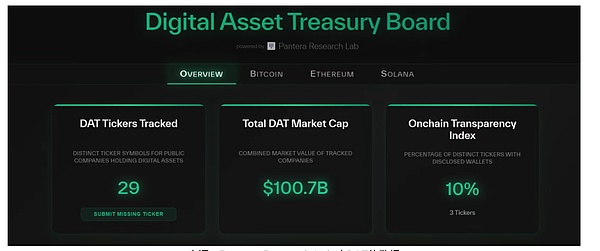
Source: Pantera Research Lab / DAT Data
Source: DeFiLlama / On-chain Perpetual Contract Trading Volume
For the industry, the competition in on-chain perpetual contracts in 2025 entered the "quality and resilience pricing" stage—trading volume can be amplified by short-term incentives, but the size of open interest, the sustainability of fees/revenue, and risk control performance under extreme market conditions better reflect the real fund retention and platform stickiness. Looking ahead to 2026.
Source: DeFiLlama / Forecast Market Data Overview
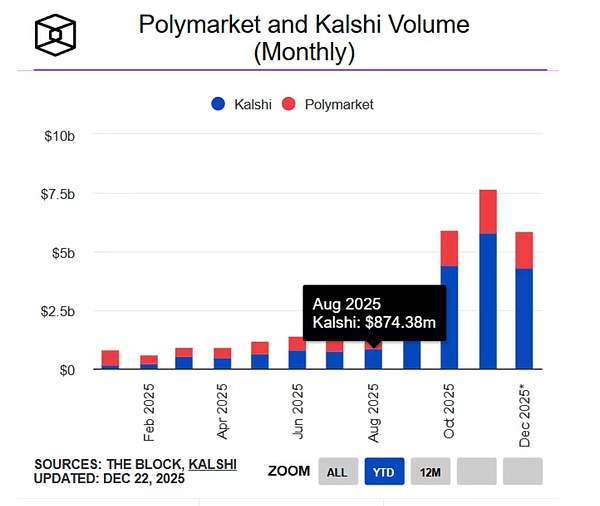
Source: theblock.co The trading volume of Polymarket and Kalshi markets, combined with the aforementioned changes in capital structure and the industry shifts brought about by crypto company IPOs, predicts a rapid upgrade in the market focus from "crypto startups" to "financial infrastructure/data assets": Kalshi completed a $1 billion funding round in December, valuing the company at approximately $11 billion, and about two months prior, completed a $300 million funding round at a valuation of approximately $5 billion; simultaneously, traditional market infrastructure providers are also beginning to enter the market with heavy capital investment, with ICE (the parent company of the NYSE) reportedly planning to invest up to $2 billion in Polymarket and give it a pre-money valuation of approximately $8 billion. The common implication of these transactions is that event contracts are not only seen as "trading products" but also as interfaces for integrating market data, sentiment indicators, and risk pricing. Looking ahead to 2026... In 2025, prediction markets are more likely to become one of the structural growth drivers with "higher certainty" in the crypto application layer: growth is driven by event density and information uncertainty, and commercialization is closer to a combination of "transaction fees + data products + distribution channels". If compliance paths, distribution entry points, and dispute resolution standards become clearer, prediction markets are expected to move from a periodic hit to a more normalized event risk trading and hedging tool; its long-term ceiling mainly depends on three hard indicators: **real depth (capable of handling large amounts), reliable settlement and dispute governance, and controllable compliance boundaries**. Looking back at 2025, the core characteristics of the crypto market are **externalization of pricing frameworks and deepening channel competition**: the entry point for funds has shifted from an endogenous cycle driven by on-chain leverage and narratives to one driven by ETFs, stablecoins with a USD base, corporate treasuries, and equity channels (US-listed crypto companies). The multi-channel system, comprised of IPOs and other IPOs, has expanded its channels, enhancing asset allocability and reinforcing macroeconomic boundary conditions—market trends are more reliant on the coordination of net inflows and financing windows, while pullbacks are more easily concentrated during deleveraging and liquidation. The structural evolution within the industry further confirms this shift: stablecoins have completed a stratification between the "cash layer" and the "efficiency tool," on-chain derivatives have entered a stage of large-scale carrying and market share competition, and prediction markets and event contracts have formed more independent trading scenarios. More importantly, the return of IPOs "securitizes" crypto-financial infrastructure into auditable, benchmarkable, and exitable equity assets, allowing mainstream funds to participate in a more familiar way and driving valuation systems towards "compliance moats, risk control governance, revenue quality, and capital efficiency"—this is the core basis for our optimism about this direction. Looking ahead to 2026... In 2023, the industry's trajectory is more likely to depend on three variables: the sustainability of institutional pathways, the sustainability of capital accumulation, and the resilience of leverage and risk control under stress scenarios. Among these, if US-listed crypto IPOs can maintain a more continuous and stable pace, it will continue to provide valuation anchors and financing flexibility, and strengthen the industry's shift towards sustainable pricing in the public market.


 Weatherly