Manipulation? Justin Sun Suspected To Be on The Run, TUSD Depegs
TUSD dipped below its peg around Jan. 15, at 11:00 am UTC, reaching as low as $0.984 by 11:15 pm.
 Alex
Alex

Author: Frank, MSX Research Institute
At the beginning of 2026, the world stood at a deeply divided crossroads.
On one hand, inflation was declining, AI was rapidly penetrating, and capital markets were stirring; on the other hand, geopolitical frictions were escalating, institutional uncertainty was rising, and there was widespread skepticism about whether the next round of growth truly existed. Against this backdrop, the globally influential technology and business podcast, *All-In Podcast*, released its ultimate annual prediction:
Led by renowned Silicon Valley angel investor (early investor in Uber and Robinhood) Jason Calacanis, the podcast featured three heavyweight guests: Chamath, the "King of SPACs"; David Friedberg, the "Sultan of Science"; and David Sacks, dubbed the White House's first "AI and Cryptocurrency Czar."
This group of top minds, controlling hundreds of billions of dollars and deeply versed in the logic of power and capital operations, engaged in a fiery debate surrounding the political, technological, investment, and geopolitical landscape—from California's wealth tax crisis to expectations of 6% GDP growth, from optimism about Huawei/market predictions to the startling hypothesis that SpaceX might merge with Tesla, and much more. Maiton MSX Research Institute has distilled the core viewpoints of their intellectual exchange for readers.
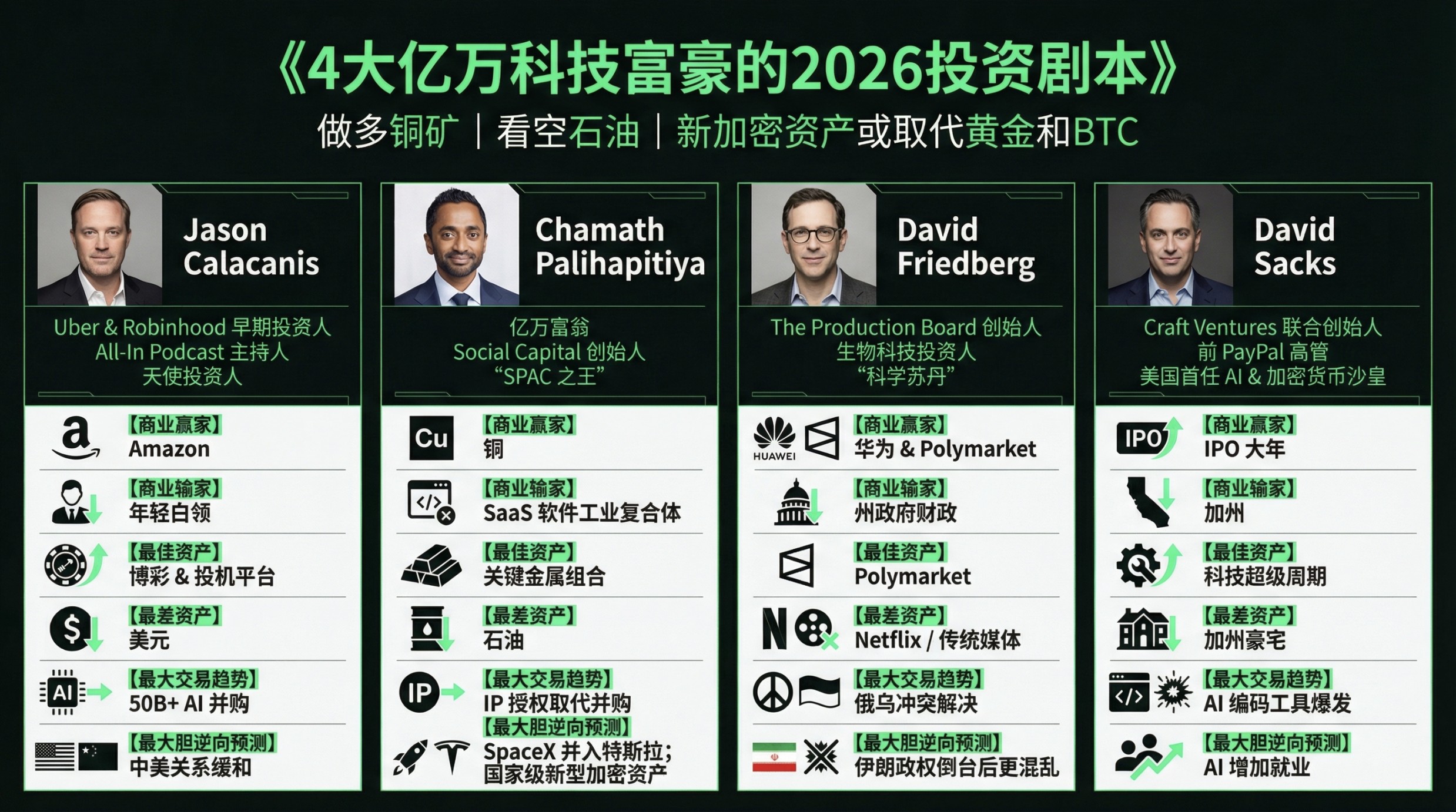
Source: AI-generated image
Regarding California's wealth tax and the risk of capital outflow, they respectively believe:
Chamath Palihapitiya: He has clearly chosen to leave California's elite circles, with a combined net worth of hundreds of billions of dollars, which constitutes a substantial impact on California's long-term finances;
David Friedberg: The proposal is unlikely to be implemented, but it has already exposed the structural pressures on local finances; David Sacks: A wealth tax was the direct reason I left California. Even if it doesn't pass in 2026, everyone expects some version to come back in 2028; Regarding the biggest business winners in 2026, they believe: Jason Calacanis: He is optimistic about Amazon, which will be the first to experience the "corporate singularity," becoming the first company where robots contribute more profit than humans. Its automated warehouses and logistics network have built a very high moat; Chamath Palihapitiya: He chooses copper, as geopolitics and supply chain security will cause a long-term supply-demand imbalance. At the current rate, by By 2040, the global copper supply will face a deficit of approximately 70%; David Friedberg: Bullish on Huawei and prediction markets (PM), the former continues to make breakthroughs in its technological system, while the latter is evolving from a peripheral product into a new type of infrastructure for information and price discovery, potentially experiencing explosive growth this year; David Sacks: 2026 will be a big year for IPOs, with the "Trump boom" restarting the capital market expansion cycle, resulting in a large number of successful IPOs and creating trillions of dollars in new market capitalization; He also agrees with Jason Calacanis's assessment of Amazon, but for different reasons (not elaborated); Regarding the biggest business losers in 2026, they respectively believe: Jason Calacanis: The most impacted will be young white-collar workers in the US, with recent graduates being prioritized for replacement by AI and automation; Chamath Palihapitiya: The "maintenance and migration" revenue model for enterprise SaaS will be systematically compressed under the impact of AI; David Friedberg: State government finances, pension debt and solvency issues will be exposed; David Sacks: In California, regulatory and tax uncertainties will continue to squeeze out capital and businesses; Regarding the most significant deal in 2026, they believe: Jason Calacanis: There will be an AI deal exceeding $50 billion. Mergers and acquisitions; Chamath Palihapitiya: Predicts that traditional mergers and acquisitions will give way to large-scale IP licensing collaborations, a type of transaction that will become more common and mature in 2026; David Friedberg: Geopolitical conflict resolution will be the "biggest deal," with the Russia-Ukraine conflict potentially resolved this year; David Sacks: Bullish on the growth of the coding assistants and tool use sectors; Regarding the boldest contrarian predictions for 2026, they believe: Jason Calacanis: A substantial easing of US-China relations will occur, and the two sides will reach a win-win working relationship; Chamath Palihapitiya: Two contrarian predictions: First, SpaceX will not IPO, but may instead merge into Tesla; second, central banks will build a completely new paradigm for sovereign cryptocurrencies (different from BTC); David Friedberg: If the Iranian crisis continues to deepen, it may exacerbate instability in the Middle East; David Sacks: AI will become a job expander, not a job-creating machine, and we are likely to see job growth; Regarding the best-performing assets in 2026, they believe: Jason Calacanis: Bullish on platform assets such as speculative investments. In an environment where the economy is poised for takeoff, interest rates may fall, and people have more disposable income, people will have more money to bet and speculate on. Chamath Palihapitiya: Continue to bet on a basket of key metals, including copper. David Friedberg: Prediction markets are replacing the functions of traditional media and markets and have huge potential. David Sacks: Opt for the technology expansion supercycle. Regarding the worst-performing assets in 2026, they believe: Jason Calacanis: The US dollar will continue to be under pressure. Chamath Palihapitiya: Judges oil prices to be in a long-term downward trend, potentially falling to $45 per barrel; David Friedberg: Bearish on Netflix and traditional media stocks; David Sacks: Bearish on California high-end real estate; Regarding the most anticipated trends for 2026, they respectively believe: Jason Calacanis: The IPO market will return to its former glory; at least two of the giants like SpaceX, Anthropic, or OpenAI will file for IPOs this year; Chamath Palihapitiya: Expects the expansion of "Trumpism," unilateralism, and economic resilience—a huge trend that will result in massive GDP growth. Growth; David Friedberg: The reshaping of the Middle East landscape brought about by the deepening situation in Iran; David Sacks: Auditing government spending at all levels requires normalizing the "decentralized DOGE (Department of Government Efficiency)" to let the public see where money is being spent; Regarding the biggest political winners of 2026: Jason Calacanis: Young left-wing politicians; Chamath Palihapitiya: Anti-waste and anti-bureaucratic political forces; David Friedberg: Democratic Socialists (DSA) are taking over the Democratic Party, and this trend will continue in 2026. The year is being consolidated; David Sacks: "Trump Prosperity," predicting a 75 to 100 basis point rate cut in June; Regarding the biggest political losers in 2026: Jason Calacanis: Democratic centrist; Chamath Palihapitiya: The Monroe Doctrine—because Trumpism has triumphed over it; David Friedberg: The tech industry, becoming a common target for both left and right populism; David Sacks: Democratic centrist; Regarding 2026 Forecast of US GDP growth rate for 2025: Chamath Palihapitiya: Lower limit is 5%, upper limit is 6.2%; David Friedberg: 4.6%; David Sacks: 5%; In conclusion, China also released its 2025 national economic performance report today, showing a GDP of 140.19 trillion yuan, a year-on-year increase of 5.0%, achieving its target as scheduled. If we broaden our perspective to a global scale and consider exchange rate factors over the next one to two years, we'll find that the GDP gap between China and the US (in dollar terms), which widened significantly in the previous two years, seems to be showing subtle signs of narrowing again at this juncture. This contrast is quite intriguing: on one hand, China is seeking high-quality growth through structural adjustments; on the other hand, as described in the *All-In Podcast*, the US is attempting to forcefully escape its period of mediocre growth through "Trump prosperity + AI singularity." It can be said that the world's only two major economies are simultaneously entering a re-competition phase centered on productivity and structural efficiency. It is against this backdrop that Chamath Palihapitiya's statement on the show appears particularly provocative: "Don't short the US economy; it's ready to take off. 6% GDP growth is not a pipe dream." But the prerequisite is that, in this year of accelerated reshuffling, you must be on the side of productivity, not on the side of being eliminated. Perhaps this is the most important issue in this cycle. Let us strive together.
TUSD dipped below its peg around Jan. 15, at 11:00 am UTC, reaching as low as $0.984 by 11:15 pm.
AlexThe platform will service 420 DApps and services, 45 governance partners, and over 450 Web3 resources.
 Davin
DavinExplore the dramatic story of a $9M Dogwifhat trade on Solana, its 60% loss due to slippage, and key lessons for cryptocurrency traders. Understand the risks and strategies in the volatile world of crypto trading.
 Weiliang
On April 15-16, the international forum Blockchain Life 2024 will be at the main event of the year in Dubai.
 Joy
JoyExplore the intriguing world of Telegram's Notcoin game. Understand its current status, the mixed messages from TON Foundation, and the speculation surrounding its future.
 Miyuki
Discover Binance's latest venture in the crypto world with the 44th Launchpool Project, introducing MANTA. Delve into the details of this significant launch, explore MANTA’s unique potential, and learn how it's set to transform the crypto trading landscape on Binance.
 Brian
BrianDiscover how Green Man Gaming is revolutionizing the gaming industry by accepting Bitcoin. Read about the implications of this pioneering move for gamers and the digital economy.
BrianExplore how Bitcoin, CBDCs, and stablecoins are reshaping global finance, challenging the US dollar's dominance, and heralding a new era of digital currency. Dive into insights on their impact, adoption, and the evolving regulatory landscape.
WeiliangExplore an in-depth analysis of the FDIC's allegations against Cross River Bank for 'unsafe' lending practices, and its implications for the finance and fintech sectors.
MiyukiAs per the study, Egypt has set its sights on introducing a digital currency, the E-Pound, issued by the Central Bank of Egypt, with a target launch by 2030.
Alex