Author: Jack Inabinet Source: Bankless Translation: Shan Ouba, Jinse Finance
Last week, the U.S. Securities and Exchange Commission (SEC) and the Commodity Futures Trading Commission (CFTC) jointly released landmark regulatory guidance. This long-awaited joint interpretation details under what circumstances and in what ways federal securities laws apply to crypto assets.
The crypto industry has long existed in a legal gray area, and this new framework attempts to eliminate some of the uncertainty with a token classification system, helping to define under what conditions digital assets will be considered securities.
Today we'll break down this joint guidance and speculate on how it will ultimately classify mainstream digital assets.
According to the SEC's definition and guidance, "digital goods" refer to crypto assets whose value derives from their functional role in the crypto ecosystem and from market supply and demand. This broad definition covers utility tokens on numerous mature blockchain networks. The SEC has explicitly listed 16 crypto assets that fall into this category, including: Aptos (APT), Avalanche (AVAX), Bitcoin (BTC), Bitcoin Cash (BCH), Cardano (ADA), Chainlink (LINK), Dogecoin (DOGE), Ether (ETH), Hedera (HBAR), Litecoin (LTC), Polkadot (DOT), Shiba Inu (SHIB), Solana (SOL), Stellar (XLM), Tezos (XTZ), and XRP. While the SEC did not explain why each of these cryptocurrencies was classified as a non-security digital commodity, the guidance emphasizes that they do not meet the legal definition of a "security" and therefore will not be automatically considered securities. The SEC states that its use of the term "digital commodity" is strictly based on economics and is used to describe the typical characteristics of a class of non-security digital assets. The guidance also points out that, apart from stablecoins that meet the requirements of the GENIUS Act, any crypto asset that meets the definition of a "commodity" under the Commodity Exchange Act can be considered a true commodity and thus subject to specific regulation by the CFTC. Popular tokens not mentioned by the SEC but potentially classified as "digital goods" also include: BONK: Solana ecosystem meme coin, which has gradually developed governance and various practical functions since its launch. CC: Canton blockchain native utility token used for trading, settlement, data synchronization, and asset transfer. EIGEN: EigenLayer ecosystem restaking utility token used to provide economic security. ETC: Ethereum's proof-of-work version, already recognized by the SEC as a non-security digital commodity. HYPE: Hyperliquid network native gas token. STX: Stacks Bitcoin Layer 2 network native gas and staking reward token. SUI: Sui network native gas and staking token. TAO: Bittensor network native token used to incentivize machine learning contributions in the decentralized AI market. TRX: Tron network native gas and staking token. XMR: Monero network native token, emphasizing privacy, used to pay transaction fees and maintain network security. alt="2u58iCrYkWPFAZ8bvUi6u7gDiJlfnpnIltYjyuua.png">
Digital Collectibles
Former SEC Chairman Gary Gensler was once asked by Congress whether tokenized Pokémon trading cards were securities. He did not give a clear answer at the time, only stating that more information was needed to determine this.
Now, the crypto industry seems to have finally received the long-awaited conclusion.
The SEC's latest proposed guidance indicates that tokenized Pokémon trading cards could be classified as "digital collectibles," but more information is needed before their non-securities status is formally confirmed.
This category applies to crypto assets intended for collection purposes, including assets representing or transferring artwork, music, videos, trading cards, in-game items, and rights related to memes as previously defined.
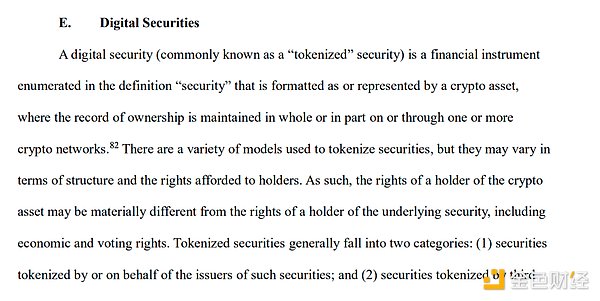
Similar to physical collectibles, digital collectibles do not grant holders any corporate ownership, even if the holder owns the commercialization rights to the underlying intellectual property, and are therefore inherently non-securities. The SEC explicitly classifies CryptoPunks, Chromie Squiggles, fan tokens, WIF, and VCOIN as digital collectibles. While the SEC categorizes memecoins as digital collectibles, it also specifically states that once these tokens become functional within the associated crypto ecosystem, they may be converted into digital goods. Furthermore, the SEC explicitly points out that, similar to physical collectibles, most fragmented collectibles are highly likely to constitute securities because buyers rely on third-party management. For example, providing physical custody of Pokémon cards for tokenized versions might constitute "management," thus triggering registration requirements under federal securities laws. Popular projects not mentioned by the SEC but currently potentially fitting the definition of "digital collectibles" include: Beeple's "The First 5000 Days": The most expensive NFT in history, valued for its cultural significance, artist reputation, and historical standing in the NFT market. PEPE: Internet cultural meme coins, valued for their community sentiment and reach. Pudgy Penguins and PENGU: Community-driven NFTs and token brands centered around the penguin IP. Quantum Cats: On-chain digital collectibles based on Bitcoin inscriptions, valued for their scarcity and status within the Bitcoin ecosystem. Saga Monkes: Featuring Solana Saga. Limited-edition NFTs linked to mobile phones possess collectible value due to their scarcity, early holder status, and ecosystem connections. Digital tools are crypto assets designed to achieve specific functions. They possess intrinsic utility value, and many are soulbound (SBT) in form, non-transferable, and permanently bound to a single user. Importantly, the SEC explicitly stipulates that digital tools cannot possess inherent economic attributes or rights, such as generating passive income, enjoying rights to future corporate revenue, profits, or asset distributions. The SEC listed various use cases for digital tools, including memberships, tickets, credentials, property documents, identity badges, etc., and categorized Ethereum Name Service (ENS) and CoinDesk's "Microcosms" NFT consensus conference tickets as digital tools. Other digital assets that may qualify as “digital instruments” include: FanDome NFT: Comic-themed NFTs distributed free to attendees at the 2021 DC Fan Virtual Convention. POAP: NFT digital badges proving participation in offline/online events. Propy NFT: On-chain digital certificate of legal ownership of real estate. VeeFriends: A series of NFTs created by Gary Vaynerchuk, usable to unlock exclusive access to events such as VCON. World ID: Soul-bound “proof of identity” credentials issued by the Ultraman Sam World project. The SEC's definition of non-security stablecoins is very concise and straightforward: Payment stablecoins as defined by the GENIUS Act, which will take effect next January, will be considered non-security stablecoins. Therefore, the SEC will not impose registration requirements on payment stablecoins that comply with the Act at the issuance and redemption stages (although these stablecoins will still be subject to full regulation by other U.S. regulatory agencies). The guidelines also clarify that, prior to the enactment of the GENIUS Act, **"covered stablecoins"** under the existing definition remain non-securities and not subject to SEC regulation. To meet this definition, stablecoin holders are not entitled to any interest, profits, or other returns, and the reserve assets must consist entirely of US dollars and/or other low-risk, highly liquid assets. While the SEC did not name specific currencies, the following dollar-pegged assets meet the definition of "covered stablecoins": PYUSD: A stablecoin issued by PayPal and custodied by Paxos. USAT: Tether's latest dollar stablecoin, designed to comply with the GENIUS Act. USDC: Issued by Circle, over-collateralized 1:1 with risk-free dollar assets. KlarnaUSD: A stablecoin initiated by Klarna, a buy-now-pay-later giant, and issued by Bridge, a subsidiary of Stripe. The most impactful, yet also the most ambiguous, part of the SEC guidance is the definition of digital securities. The SEC's stance is firm: any digital asset that fails the Howe test is a security. This determination has historically been accompanied by lengthy legal battles. The SEC also classifies tokenized versions of products already explicitly classified as securities, such as tokenized money market funds, stocks, and other structured investment products, as digital securities. However, this does not mean that all "wrapped" tokens are securities. The SEC explains that protocol mining, staking, and wrapping non-security crypto assets do not constitute the issuance or sale of securities; the guidance further clarifies that some airdrops do not meet the "money investment" requirement under the Howe test. Nevertheless, the SEC still cannot give a straightforward answer to under what circumstances a digital asset becomes a security. In each individual case, the specific facts and scenarios of how the project promotes the asset will determine whether it constitutes an investment contract (i.e., a security). Crypto assets that were originally non-security assets will be considered securities if they are issued or sold through an investment contract that meets the Howe test. Furthermore, even if a non-security crypto asset is initially issued in the form of an investment contract, it will not permanently be considered a security; when the original investment contract is fulfilled, or the project fails to deliver on its promised development and functionality, the asset can revert to its non-security status. The SEC did not specify which assets qualify as securities. However, it's worth noting that despite a court ruling that some of XRP's sales constituted illegal investment contracts, the SEC guidance still classifies it as a non-securities "digital commodity." While this guidance represents a step towards regulatory clarity, it actually reinforces the ambiguity regarding securities classification, merely extending existing federal securities laws to digital assets. This also exposes projects promising undeveloped features or future utility to renewed regulatory risks. Although digital commodities, digital collectibles, digital tools, and stablecoins are inherently non-securities, if issued or sold through investment contracts, the project developers are still subject to federal securities laws.


 JinseFinance


