Author: Eric, Foresight News
On the evening of March 30th, Beijing time, Aave V4, which had been in development since 2024, officially launched on the mainnet, bringing the first piece of good news since the Aave DAO governance debate began.

V4 can be considered a complete overhaul and redesign of Aave. The most fundamental change is the integration of the previously independent lending markets into a unified liquidity pool architecture: Hub and Spoke.
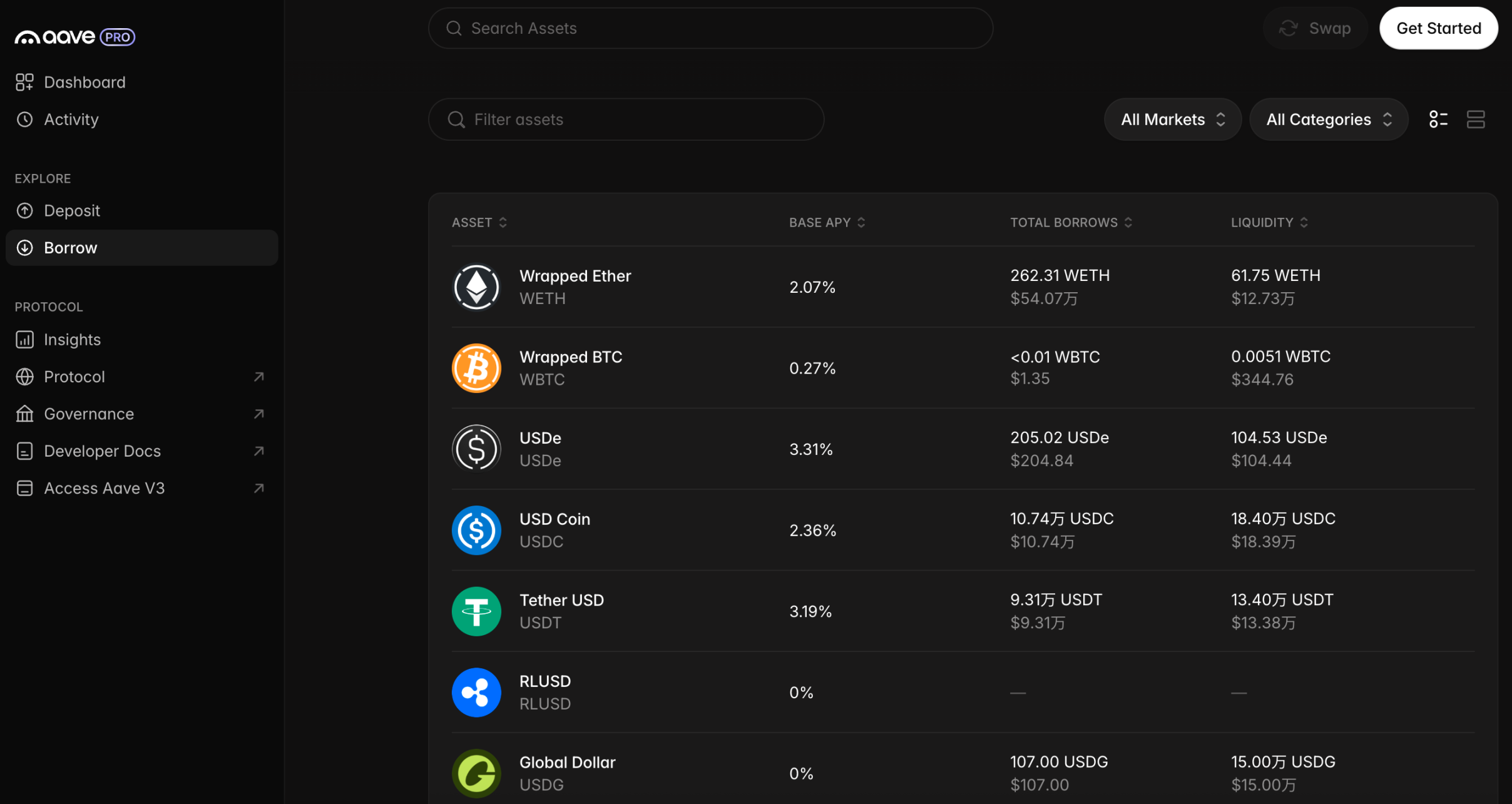
... In version V4, each chain or L2 instance has a unified liquidity hub (Hub). All user-deposited assets for lending are stored in a single liquidity pool. The Hub is responsible for overall coordination, credit limit control, system-level constraints (such as "total borrowing ≤ total supply"), and emergency suspension. The Hub does not directly interact with users but manages liquidity centrally in the background. It's important to note that each chain does not have only one Hub; different Hubs are designed based on different needs, essentially a form of risk isolation. For example, V4 currently features Core Hub, Prime Hub, and Plus Hub. Core Hub includes mainstream assets and is accessible to all users, while Prime Hub is designed for suppliers seeking more "controllable" collateral. Plus Hub is designed for strategic stablecoins, and its parameters are designed to consider the project's scale. As for Spokes, you can think of them as independent markets, each with its own lending and borrowing functions, risk parameters, and collateral rules. Within a Hub, users' assets reside in the same liquidity pool, and borrowers need to select different Spokes based on their needs. For example, as shown in the image above, users can deposit WETH as a borrowable asset, and borrowers can borrow WETH in the first four Spokes, but only the EtherFi Spoke allows collateralization of WETH. While the official explanation is that it can integrate fragmented liquidity, in practice, there is little difference for users who collateralize high-quality assets for lending. For example, if you want to collateralize ETH to borrow assets, the operation is the same in V3 and V4, as long as you ensure that the health factor is not too low. So, while V4 does offer more refined liquidity management than independent markets, it's not a qualitative leap. The real difference lies in Spoke's customized parameters and the new liquidation engine. In V4, borrowers' interest rates depend on the base rate and the risk premium. The base rate, like in V3, uses a utilization curve, rising slowly below optimal utilization and then steeply above it. The risk premium depends on the nature of the collateral. If the collateral is more stable assets like USDT, ETH, or WBTC, the risk premium will be small or even zero, but high-risk altcoins will have a high risk premium, preventing a situation where "good assets subsidize bad assets." For a simple example, in V3, interest rates depended entirely on supply and demand. While the loan-to-value (LTV) and liquidation threshold may differ when lending USDT, the interest rates for ETH and LINK collateral are the same under the same supply and demand conditions. However, LINK's volatility is clearly higher than ETH's. If the interest rates are the same, borrowers collateralizing LINK increase utilization, leading to a situation where borrowing costs for ETH collateralizes increase rather than decrease. V4 addresses this shortcoming: users who borrow by colluding with high-risk assets incur higher costs, while those providing funds receive higher returns. Simultaneously, higher interest rates limit borrowing demand, making the cost advantage more pronounced for users who collateralize high-quality assets. Regarding the liquidation mechanism, liquidators will only restore the health factor to Spoke's preset target value, with lower health factors resulting in higher liquidation bonuses. This design not only gives borrowers more room for maneuver but also reduces the overall platform's bad debt risk. Furthermore, the new liquidation engine adds a "dust prevention mechanism," meaning that when remaining debt or collateral falls below a threshold (e.g., $1,000), the liquidator must liquidate all positions to prevent small amounts of residual funds from accumulating and reducing capital efficiency. Finally, idle liquidity in the Hub can be automatically invested in governance-approved low-risk, high-yield strategies (such as short-term Treasury bonds, stablecoin LPs, and money market instruments), increasing both the income of funding providers and the DAO's income. This may be considered one of the few advantages of "unified liquidity." Overall, the advantages of Aave V4's unified liquidity in lending are not significant, and the so-called composability—that is, borrowers can uniformly manage positions on different Spokes—is not much more convenient than in V3. However, as the author stated in the title, V4 transforms Aave from a product into a financial infrastructure similar to a "bank." Leaving aside the various complex business operations, the core business of a bank is to accept deposits, retain a portion as reserves for users' daily payment and transfer needs, and then earn the deposit-loan spread through lending. As for idle funds, banks can also allocate them to different investments within their risk tolerance limits. The Bank of San Giorgio, founded in Genoa, Italy in 1407, is generally considered the world's oldest bank. This bank not only provided deposit and loan services but also handled government debt management, currency exchange, and fund transfers, meeting the commercial needs of Genoa as an important European trading center at the time. From the launch of ETHLend in 2017 to the release of Aave V4 in 2026, in less than 10 years, Aave has become what it initially called a bank. Of course, Aave and banks are quite different; this is just an analogy. Compared to P2P lending, the banking model, which has withstood centuries of trials and tribulations, is naturally a better choice, just as V4 is to V3. If you observe closely, you'll find that many "innovations" in the DeFi space have almost become history, such as the DeFi 2.0 craze of the second half of 2021. On the contrary, projects like Aave, with simple business models and logic matured in traditional finance for hundreds of years, have survived and thrived. After years of exploration, many DeFi projects have likely realized this: DeFi has a high ceiling, but the path taken by traditional finance cannot be skipped. Aave V4 centralizes liquidity, opening up numerous possibilities for future development. For example, assets idle for more than a certain period (e.g., a year) can be used for higher-risk investments, such as ETH/USDT LP on Uniswap, operating entirely like a commercial bank and gradually expanding to include other commercial banking services, such as credit cards (similar to the EthFi model of borrowing stablecoins for spending). Furthermore, Aave can expand into an "investment bank." For instance, it could launch an ICO platform, allowing users who deposit assets for interest to borrow USDT or USDC to participate in investments without needing to withdraw and sell their assets for stablecoins to participate in ICOs. This would allow Aave to collect fees from projects while simultaneously earning interest. While the Hub & Spoke mechanism doesn't offer significant innovation in lending itself, it lays the crucial groundwork for the next step.