California BitLicense: Another Wave of Crypto Firms Exit?
Navigating California's cryptocurrency regulation and anticipating potential industry consequences.
 Hui Xin

Source: NBC News, compiled by BitpushNews
On Thursday local time, more than 200 wealthy, mostly anonymous crypto people will travel to Washington to have dinner with US President Donald Trump.
According to data analysis by blockchain analysis company Nansen, the ticket price is not cheap, and these "winners" spent anywhere from $55,000 to $37.7 million on Trump's official cryptocurrency token $TRUMP.
Dinner organizers determine eligibility for seats by how many $TRUMP tokens are held at a specific point in time. Nansen found that these "winners" spent a total of $394 million on Trump's official cryptocurrency, although some of them sold some or all of their holdings after the competition ended. Of course, the difference in spending is huge: the top seven spent more than $10 million each, while the bottom 24 spent less than $100,000 each.
The study showed that one-third (67) of the "winners" spent more than $1 million, and the average cost per "winner" was $1,788,994.42.
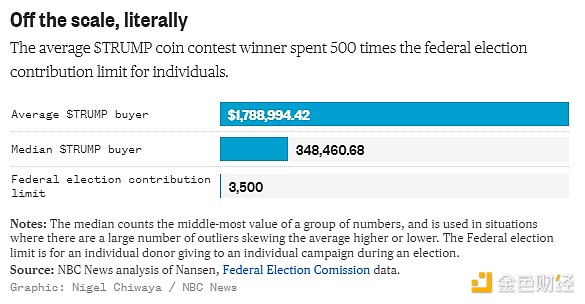
According to CoinMarketCap, which tracks cryptocurrency prices, like many meme coins, the value of $TRUMP fluctuates wildly, and Nansen tracked how much each "bidder" spent when buying $TRUMP.
The 220 buyers were invited to a dinner at Trump National Golf Club in Washington, D.C., and while the contest website states that Trump “attended as a guest and did not solicit funds for the dinner,” it also points out that 80% of the $TRUMP token project is owned by two Trump-related companies, CIC Digital and Fight Fight Fight LLC.
The personal cryptocurrency and related bidding, which ended last Monday, is another example of Trump appearing to use his presidency for personal gain.
His business interests are held in a trust controlled by his son, Donald Trump Jr., and he has intertwined many of his family businesses with his presidential activities, including hosting events at his social clubs (such as the crypto dinner) and making exclusive political statements on his social media app Truth Social.
Trump’s cryptocurrency also generates revenue for his affiliated companies through trading. Each $TRUMP token transaction incurs a transaction fee. Another cryptocurrency research firm, Chainalysis, estimates that $TRUMP tokens generated nearly $900,000 in transaction fees in the first two days after the contest was announced. Dan Weiner, director of the Elections and Government Project at the Brennan Center for Justice, told NBC News that while most federal employees are prohibited by law from using their positions for financial gain, the president is largely exempt.
“The president is not subject to the broad conflict of interest prohibitions that apply to nearly every other federal government employee,” said Dan Weiner. “Overall, this was pretty crazy even by the standards of the first Trump administration, when all kinds of people were doing business at the president’s hotels. This is way beyond that, but it doesn’t necessarily mean he’s breaking the law.”
“The president is working to get a better deal for the American people, not for himself,” White House spokeswoman Anna Kelly said in a statement. “President Trump is only acting in the best interest of the American public — which is why they overwhelmingly re-elected him to this office despite years of lies and false accusations about him and his businesses from the fake news media.”
Even the bottom-ranked winners spent far more than the $3,500 limit that U.S. citizens can legally donate directly to political candidates.
On Tuesday, the top spender was revealed to be crypto entrepreneur Justin Sun, who told Forbes in March that he had become a citizen of the small Caribbean island nation of St. Kitts and Nevis. Sun was previously sued by the U.S. Securities and Exchange Commission (SEC), but the case has been suspended during the Trump administration.
Most of the other contest winners remain unidentified, known only by their pseudonyms and cryptocurrency wallet addresses. However, according to an analysis by independent crypto researcher Molly White, most of the attendees appear to be foreign nationals. Molly White tracked the transactions of each winning wallet across different cryptocurrency exchanges and noticed that the holders appeared to use exchanges that U.S. citizens are not legally allowed to use.
Molly White told NBC News that of the 220 wallets associated with the winners of the bid, 158 (72%) appeared to be foreign wallets.
A New York Times investigation reported that the list of winners included representatives of cryptocurrency businesses from Singapore and Australia.
Dan Weiner noted that the high percentage of non-U.S. citizens among the winners is noteworthy because it is generally illegal for non-U.S. citizens to donate to U.S. political candidates.
“It’s an incredible contrast,” he said. “We have very strict laws against foreign nationals making campaign contributions. So the great irony here is that many of the people who are buying this currency would not be eligible to donate $100 to a presidential campaign. We have a whole series of laws designed to prevent this from happening, and this is actually a legal thing that both parties agree should be avoided. And yet this is happening.”
Navigating California's cryptocurrency regulation and anticipating potential industry consequences.
Hui XinAptos Resumes Network After 5-Hour Outage
 Aaron
AaronChainalysis doubts reports on terrorists using cryptocurrency, with concerns about exaggerations following the recent Hamas attack in Israel.
 Jasper
The newly launched T wallet is a blockchain-based mobile app and provides access to CryptoQuant's on-chain analysis tools.
 Alex
AlexArtificial intelligence (AI), represented by ChatGPT and similar platforms, was initially designed to boost productivity. However, it has unwittingly discovered a new role that's sending shockwaves through the cybersecurity world. This article delves into the alarming double life of AI, one that even cybersecurity experts did not foresee.
 Joy
JoyThis follows an investigation stage initiated in October 2021, and a proposal outlined in June 2023.
 Brian
BrianMember states are expected to implement the rules by December 31, 2025
 Clement
The decline in newcomer developers can be attributed to fewer new individuals venturing into crypto, which is likely a response to the bearish market conditions currently plaguing the crypto markets.
 Davin
DavinThis revelation has sparked concern and caution among investors, primarily due to the ongoing challenges posed by inflation and market volatility. Despite these substantial unrealised losses, the bank still manages to maintain high-profit margins thanks to its attractive interest rates.
JasperIn an awe-inspiring feat of technology and gaming fusion, a skilled Pokémon Red player has leveraged the potent capabilities of Reinforcement Learning to teach artificial intelligence (AI) to conquer the captivating world of Pokémon. In a digital age marked by constant advancement, the convergence of AI and video games is a natural progression. AI has already showcased its creative talents in art and music, and now it embarks on the quest to become a gaming maestro.
Joy