On January 29, 2026, according to Coingecko data, the total market capitalization of tokenized gold and silver once exceeded $6 billion, setting a new historical high. As of press time, the total market capitalization of tokenized gold was $5.822 billion, with a 7-day increase generally exceeding 15%; the total market capitalization of tokenized silver was $480 million, with a 7-day increase generally exceeding 27%. This article reviews some noteworthy tokenized gold and silver.
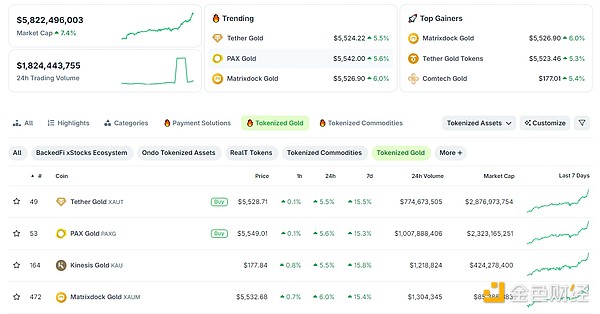
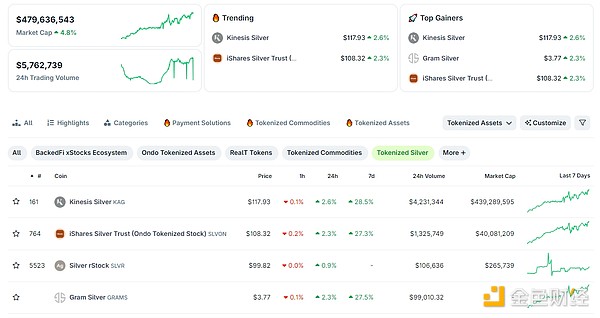
This article reviews some noteworthy tokenized gold and silver.
I. What is Tokenized Gold?
Tokenized gold represents a digital version of physical gold, minted on the blockchain.
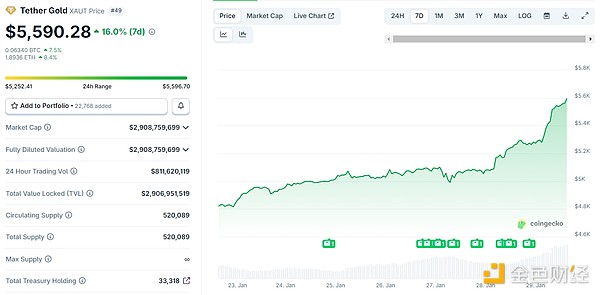
These tokens are backed by an equivalent amount of real gold held in custody by the issuing institution. Gold tokenization converts physical gold into digital tokens on the blockchain, with the issuer holding real gold as the backing of the tokens. Holders can typically redeem their tokens for physical gold according to the issuer's terms and conditions. Tokenizing gold increases its accessibility, allowing for partial ownership, easier trading, and applications in decentralized finance. Tokenized gold can be stored in crypto wallets and traded on exchanges. Investors can purchase tokenized gold according to their investment capabilities. This effectively eliminates entry barriers such as minimum purchase amounts, as users can purchase less than a gram of gold. Gold tokenization involves using physical gold stored in vaults as backing, employing smart contracts to manage the minting and redemption process, and having third-party auditors verify that the gold holdings match the token supply. The following is the operational process of gold tokenization: Gold Acquisition and Storage: The issuing institution purchases physical gold and stores it in highly secure vaults. Token Minting: The issuer uses smart contracts to mint digital tokens on a selected blockchain, equivalent in value to the amount of gold held. This typically uses fungible token standards such as ERC-20. 1:1 Backing and Pegging: Each token corresponds to a specific amount of physical gold (1 x AUT = 1 troy ounce). Transparency and Proof: Issuers regularly publish audit reports, publicly demonstrating that the value of the gold in their vaults matches the circulating token supply. This information is usually available on the issuer's website. Distribution and Trading: Tokens can be sold directly or listed on centralized exchanges (CEXs) and decentralized exchanges (DEXs), supporting 24/7 trading with fiat currencies, stablecoins, or other cryptocurrencies. Tokenization of gold increases its accessibility, allowing ordinary investors to participate in the gold market. II. What are some examples of tokenized gold? 1. Tether Gold (XAUT) Tether Gold (XAUT) is launched by Tether. Each token corresponds to one troy ounce of physical gold stored in a Swiss vault. Each token can be subdivided into units as low as 0.000001 XAUT. Since its launch in 2020, XAUT's market capitalization has grown to over $806 million. In 2025, XAUT began to enter the mainstream market and gain attention. On October 1st of last year, XAUT surpassed a market capitalization of $1 billion, making it a mainstream gold token. Its current market share is approximately 60%. As of the end of 2025, the issuer disclosed holding 520,089.350 troy ounces of gold that meet the LBMA's "Good Delivery" standard, corresponding to 520,089.300 XAUT tokens, maintaining a 1:1 full backing. By the end of 2025, Tether will rank among the top 30 gold holders globally, with holdings exceeding those of countries like Greece, Qatar, and Australia. Tether CEO Paolo Ardoino stated that XAUT aims to "eliminate uncertainty at a time when confidence in the monetary system is weakening." XAUT is minted on the Ethereum blockchain as an ERC-20 standard token and on the Tron network as a TRC-20 standard token.
2. PAX Gold (PAXG)
Paxos Gold (PAXG) is one of the earliest tokenized gold tokens, launched in September 2019. Paxos is regulated by the New York State Department of Financial Services (NYDFS), and its gold reserves are audited monthly by KPMG.
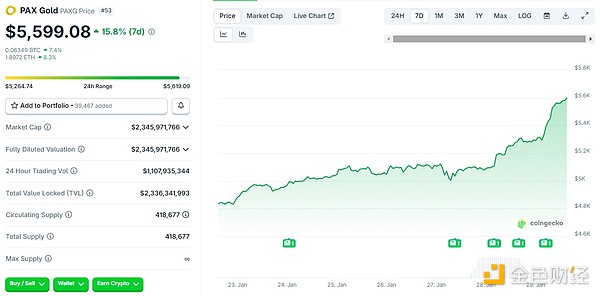
PAXG, backed by physical gold stored in London's LBMA vaults, raised over $248 million in new funding in January, giving it a market capitalization exceeding $2.2 billion, second only to Tether Gold (XAUT). Each PAXG token is pegged to one ounce of gold and is issued on Ethereum as an ERC-20 token. Because PAXG tokens can be subdivided to 18 decimal places, users can choose to purchase extremely small token shares based on their investment capacity (but the minimum purchase amount through Paxos is 0.01 PAXG).
3. Kinesis Gold (KAU)
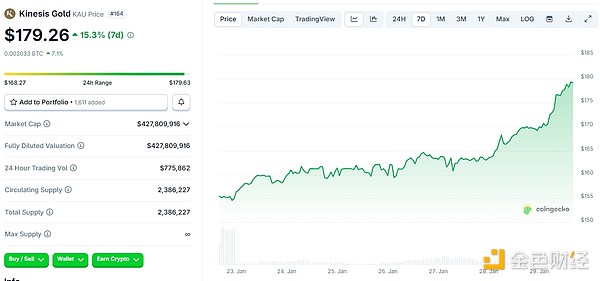
Kinesis Gold (KAU), launched by Kinesis Money, combines physical gold with digital assets to create a globally tradable and payable currency. Each KAU represents ownership of 1 gram of physical gold, which is stored in an insured vault, while users have a corresponding asset record digitally.
KAU has achieved a certain scale in the tokenized gold market, but its market depth still lags slightly behind more mature products such as PAXG and XAUT.
KAU has achieved a certain scale in the tokenized gold market, but its market depth still lags slightly behind more mature products such as PAXG and XAUT.
KAU has achieved a certain scale in the tokenized gold market, but its market depth still lags slightly behind more mature products such as PAXG and XAUT.
4. Matrixdock Gold (XAUM)
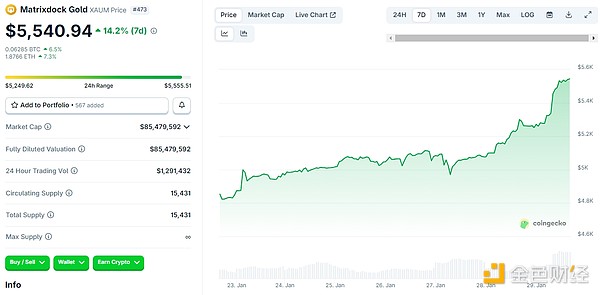
Matrixdock Gold (XAUm) is launched by Matrixdock. On September 16, 2024, Matrixdock officially launched XAUm as its on-chain gold asset product. Each XAUm token represents 1 troy ounce of physical gold with a purity of at least 99.99%, conforming to the London Bullion Market Association (LBMA) standards.
4. Matrixdock Gold (XAUm)
III. Tokenized Silver
1. Kinesis Silver (KAG)
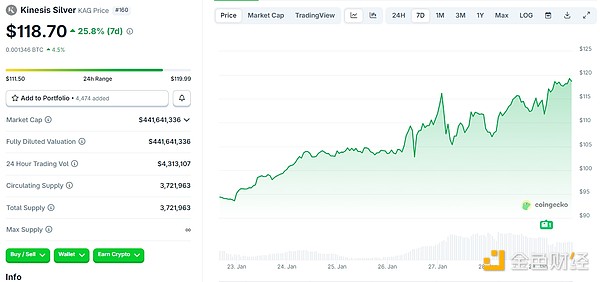
Kinesis Silver (KAG) is launched by Kinesis Money. Each KAG is backed by the same amount of investment-grade physical silver (minimum purity 999), and each silver bar has a clear refinery mark and serial number to ensure that ownership is genuine and verifiable.
2.iShares Silver Trust (Ondo Tokenized Stock) (SLVON)
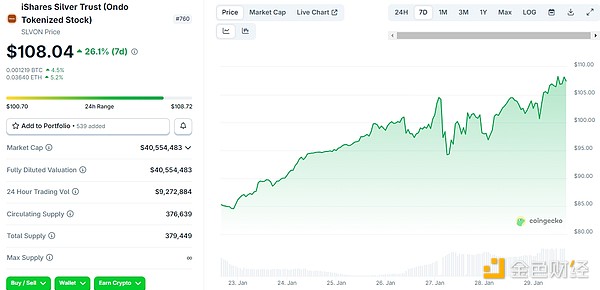
SLV is one of the world's largest and most popular silver ETFs, managed by iShares (a subsidiary of BlackRock), which tracks silver price performance by holding physical silver or related assets. SLVon transfers this economic interest in the silver market to blockchain assets.
Each SLVON token is backed by an equivalent value of SLV ETF shares, which are in turn backed by silver assets managed by iShares.
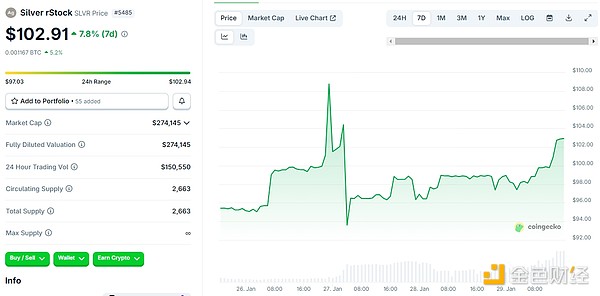
3. Silver rStock (SLVR)
Silver rStock (SLVR) is a tokenized commodity token created by the blockchain project Remora Markets within the Solana ecosystem.
Unlike other tokenized silver, it is more like a token product that puts the value of silver or related assets on-chain. Its specific asset-backed mechanism may rely on contract design and the project team's silver reserve arrangements, rather than having a clear precious metal storage audit system like a physical storage repository.
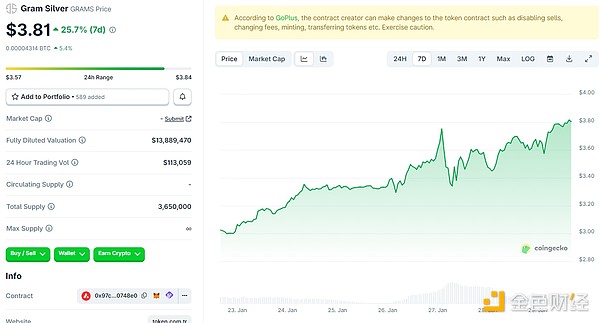
4.Gram Silver (GRAMS)
Each GRAMS token corresponds to 1 gram of physical silver, backed 1:1, and is backed by the corresponding silver reserves held by Token Teknoloji Anonim Şirketi.
IV. What are the benefits of tokenized precious metals?
1. Lowering the investment threshold
Traditional precious metal investment suffers from high purchase prices, high physical delivery and storage costs, and the ability of precious metal holders to properly safeguard their metals is also a major issue. After tokenization, investors can purchase small amounts of gold or silver without the need for self-management. Precious metal investment can shift from an institutional investment product to an everyday investment product for ordinary investors.
2. Improve the Liquidity of Precious Metals Precious metals are inherently high-value, low-liquidity assets. Tokenization allows them to simultaneously possess the attributes of crypto assets: real-time trading on exchanges, rapid settlement, and participation in various DeFi activities. With these crypto asset attributes, gold and silver become investment tools. 3. Become Safe-Haven Assets in the Crypto Market The crypto market suffers from high volatility. In an uncertain market environment, tokenized gold and silver can act as "safe-haven assets." When mainstream crypto assets like BTC and ETH experience significant volatility, investors can turn their attention to tokenized precious metals. 4. Promote the Maturation of the RWA Track Gold and silver are the most easily understood tokenized assets by investors. Increased acceptance of tokenized precious metals paves the way for tokenized government bonds, stocks, and other assets. Conclusion James Harris, CEO of the Tesseract Group crypto yield platform, once pointed out: “The increasing popularity of tokenized gold enhances its utility, especially in terms of transferability and divisibility, while Bitcoin continues to behave more like a risk asset during periods of macroeconomic uncertainty. Blockchain infrastructure expands the application scenarios of gold, making it no longer limited to simple storage. Tokens can be used as collateral in decentralized finance (DeFi) protocols, for cross-border payments, and for instant settlement, thus avoiding the friction of physical gold transactions.” With the current soaring prices of gold and silver, this may be the opportune time for tokenized precious metals. As regulations continue to improve and investment acceptance increases, tokenized precious metals may become an important part of global asset allocation.


 JinseFinance
