This isn't that AI is ineffective. This is that relying entirely on AI for content creation has reached a dead end.

In March 2026, BuzzFeed released its full-year 2025 financial report.
The company suffered a net loss of $57.3 million for the year, nearly 70% higher than in 2024. The cumulative loss has reached $680 million.
In March 2026, BuzzFeed released its full-year 2025 financial report.
2023, All in AI
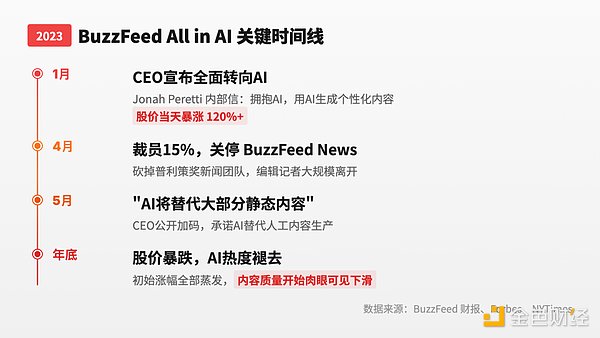
In early 2023, BuzzFeed CEO Jonah Peretti sent an internal letter to all employees, the core message of which was: We must fully embrace AI.
The news made Wall Street happy. The stock price surged more than 120% that day—the story investors love to hear, "AI + layoffs = profits."
How long did the rise last? Less than a month later, it fell back down.
But Peretti didn't stop. In April 2023, BuzzFeed laid off 15% of its staff and shut down its BuzzFeed News division. What was this division like? It had just won the Pulitzer Prize in 2021 and was a team that had done in-depth investigative reporting. It was shut down. A month later, Peretti added publicly, "AI will replace most of the static content on websites." In short: editors and reporters are too expensive, AI is cheap, so switch. At the time, many thought this was a natural move, an "embracing of technological change." After all, ChatGPT had just become popular, and everyone wanted to jump on the bandwagon. But looking back now, this wasn't embracing change; it was selling its soul.
Vicious Cycle
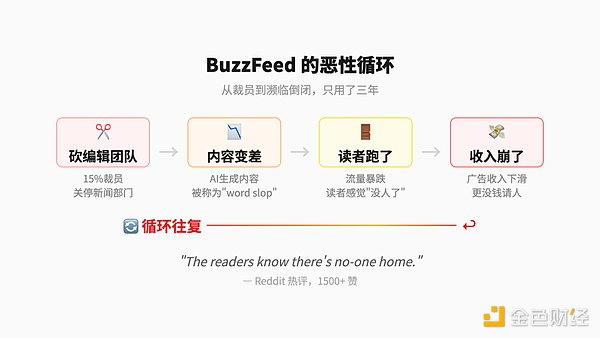
What happened at BuzzFeed after they cut their editorial team?
First step: Content deteriorated.
Previously, it was written by humans. Editors would select topics, verify facts, and add their own judgment and tone to the articles. Now it's all AI-generated—topics are templated, the writing is bland and predictable, and it reads like a fill-in-the-blank exercise.
A popular comment on Reddit bluntly stated, "3 years after switching to AI word slop, BuzzFeed is going out of business." This comment garnered over 15,000 likes. The second step: readers left. The term "word slop" is particularly apt—it describes that feeling of something being off, but you can't quite put your finger on it. Readers aren't stupid; they can tell what's genuinely written by a human and what's just machine-generated content. BuzzFeed's traffic began to decline steadily. The third step: revenue collapsed. The decline in traffic directly impacted advertising revenue. Advertising revenue in 2025 was nearly $3 million less than in 2024. Not much, but enough to make things even harder for an already loss-making company. The fourth step: even less money to hire staff. Declining revenue means even less money to hire editors to improve content quality, creating a vicious cycle—the more money saved, the worse the content; the worse the content, the fewer readers leave; the fewer readers leave, the less money is made. A reader left a comment on Reddit that I think perfectly encapsulates this cycle: "The readers know there's no one home." 2026, the numbers don't lie. [Image of a PNG file] So, what are the real statistics? In 2025, the company reported a net loss of $57.3 million, a 68% increase from $34 million in 2024. Its stock price has fallen 77%, from $3 three years ago to $0.70 now. The accumulated losses have reached $680 million. Most intriguingly, BuzzFeed itself is hesitant to provide a 2026 earnings forecast. The financial report essentially states, "We don't know if we'll survive next year." This isn't just a single misstep; it's the collapse of an entire narrative of "replacing humans with AI." AI is not the soul. AI can help you write faster, but it cannot replace the person behind the screen. BuzzFeed's mistake wasn't using AI—it used AI to eliminate that person. The correct approach is never "AI replacing humans," but rather "AI enhancing humans." Humans make the judgments, AI performs the execution. Humans write the soul, AI writes the length. What does this mean for us? BuzzFeed has fallen, but the lessons it learned are worth remembering. First, content is more than just "information." Information can be quantified, but trust cannot. Readers aren't buying two thousand words; they're buying "the person who wrote this article is worth my five minutes." Second, AI is leverage, not a substitute. Using AI to help you research, polish your work, and create headlines is leverage. But letting AI make topic selection decisions, express opinions, and build relationships with readers for you is suicidal. Third, the cost of "efficiency" may be underestimated. Peretti thought he could save a lot of money by laying off 15% of his staff, but he didn't consider the losses in readership, trust, and brand value. Short-term financial statements look good, but the long-term foundation is rotten. BuzzFeed may struggle for a while longer; its financial report says it's "exploring strategic options," and it doesn't rule out being sold or acquired. But it taught everyone a lesson: You can use AI to do anything, but don't use AI to replace your value as a human being. Readers aren't there to read content; they're there to "feel another person." Without that person, even the best content is just an empty shell.


 Weatherly