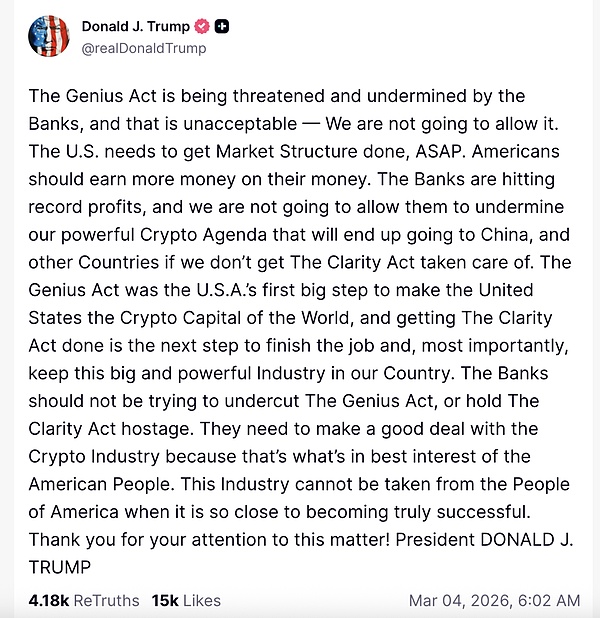
2026YearMarchMonthMarchMarchOn the evening of the 3rd, Trump posted a tweet on Truth Social with four words:"Unacceptable". Following this, he posted several more messages accusing large banks of monopolizing the market, creating record-high profits, and now obstructing encryption. His son, Eric Trump, also spoke out, saying that the banks had been harming consumers for years. What appears to be a simple business dispute actually conceals a power struggle that has been ongoing for four months—a power battle concerning the future of American finance. The core of this controversy boils down to one word: stablecoin yields. Stablecoins are digital assets pegged 1:1 to the US dollar, such as USDC and USDT, with a total scale exceeding $300 billion. Issuers primarily invest their reserve funds in short-term US Treasury bonds, with an annualized yield of approximately 4.2%-5.0%. For over a decade, American savers have become accustomed to a reality: banks pay almost no interest. Demand deposits have long offered returns close to 0%, meaning that keeping funds in banks essentially provides cheap liquidity to the financial system. But stablecoins have changed that. Starting in 2025, crypto platforms such as Coinbase and Kraken began offering users stablecoin yields of approximately 5%. The same amount of US dollars, held in an on-chain account instead of a bank, yielded returns hundreds of times higher. This raises the question: if the US dollar can yield higher returns outside the banking system, will people still keep their money in banks? This is precisely the scenario that traditional finance fears most.
From Regulatory Disagreements to Power Conflicts
Phase 1: Invisible Competition (2025)
2026 text="">1The fourth stage: power confrontation (2026Year3Month1日-3
JPMorganCEOJamie DimonIn a public hearing,"If you want to be a bank, then be a bank. But if you don't, don't do things that only banks can do.
Power Transfer Rather Than Technological Revolution
Why Are Banks So Panicked?
The banks' panic stems not from security, but from survival.
The banks' panic does not stem from security, but from survival.
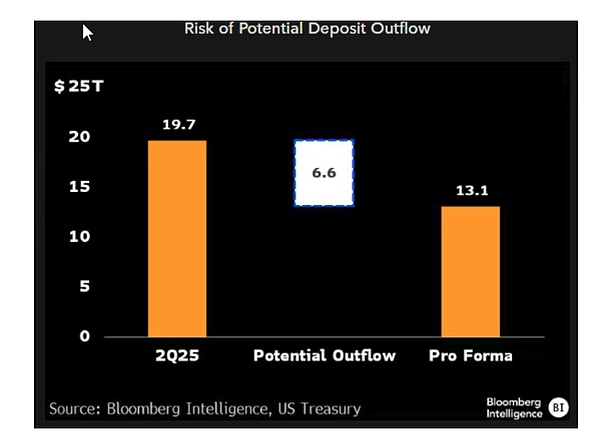
The core business model of banks is called "interest rate spread": attracting deposits at extremely low costs and lending at much higher interest rates. For example, a deposit cost of 0.01% + a loan yield of 5% ≈ 4.99% profit has supported the salaries of millions of employees, loan expansion, and the operation of the entire financial system. But what if deposits flow massively into stablecoins? More notably, in March 2026, Kraken Financial, the banking arm of Kraken, the second-largest cryptocurrency exchange in the United States, received approval from the Federal Reserve Bank of Kansas City for a limited-purpose master account. This allowed cryptocurrency institutions to, for the first time, bypass traditional banks to some extent and directly access the Federal Reserve's core payment system. This move marks a breakthrough in the industry's long-standing exclusion by banks and could potentially prompt other crypto institutions to follow suit. If stablecoins can offer returns close to bank deposits, and crypto institutions gain access to payment channels similar to banks, then banks' two core advantages—funding sources and settlement channels—will face competition. Jamie Dimon, CEO of JPMorgan, once said: "If you want to be a bank, then be a bank. But if you don't, don't do what only banks can do." On the surface, this is about fair rules, but it actually reflects a fear of the shift in financial power. Banks will no longer have low-cost funding sources. They are forced to raise deposit interest rates to compete, increasing costs. Simultaneously, lacking affordable funding, they are forced to raise loan interest rates. Ultimately, financing costs rise across society, and economic growth slows. This threatens not only the banks themselves but also the entire financial system. Why is crypto so anxious? The crypto industry's desire for stablecoin yields seems simple: let users earn more money and attract more users to the ecosystem. But the actual motivations are more complex. First, there are direct economic interests. The Trump family holds a 38% stake in World Liberty Financial, which issues the USD1 stablecoin. The larger the stablecoin's scale, the more active its trading and ecosystem activities, and the higher the fees and financial returns the issuer can obtain. This means that the expansion of the stablecoin market is inherently closely tied to the interests of project teams and investors. Second, there is the institutional status that the crypto industry has long sought. Crypto platforms, exemplified by Coinbase, have been trying for years to escape the gray area of regulation. If stablecoin-related businesses can be explicitly incorporated into the legitimate financial framework, crypto institutions will no longer be merely objects of regulation, but will become formal participants in the financial system. This not only means an expansion of market space, but also an opportunity to move from the periphery to the core of the financial structure. The Next Key Moment (h2 style="text-align: left;">According to forecasting market data, 71-73% of people believe the Clarity Act will be passed in 2026 (Polymarket data, as of [date]). March 5, 2026 (Year/Month/Day). This means encryption has a slight advantage, but the situation is constantly changing, and every piece of news could change it. The truly crucial juncture is the Senate Banking Committee vote in mid-to-late March. Once the draft is submitted, both banks and cryptocurrencies will be forced to take a stand. If the vote passes, cryptocurrencies will gain a huge boost; if it is blocked, this game could be delayed until the next Congress. If regulation ultimately favors the crypto industry, stablecoins will be allowed to offer returns to users in some form. This means that for the first time, the US dollar can generate interest returns on a large scale outside the banking system. This would be a historic victory for the crypto industry. Stablecoins would no longer be just trading tools, but would become a true alternative to savings accounts. Alternatively, the banking system could successfully exert pressure. If stablecoin returns are strictly limited, the US financial system will remain unchanged in the short term. Banks will retain their deposit base and their core profit structure. However, this also leads to another possibility: some users may turn to DeFi—a less regulated and riskier area—potentially pushing funds into a more uncontrollable market. Therefore, a growing number of voices within Washington are turning towards a third path: compromise. This involves allowing platforms to offer transaction rewards or usage incentives, but prohibiting purely stablecoin models that simply offer "hold and earn interest." This is currently considered the most likely outcome: stablecoins will remain attractive, but will no longer be enough to massively absorb bank deposits; banks will lose some of their monopoly power, but will avoid systemic shocks. The Future of the Dollar On the surface, this controversy concerns stablecoin yields. But what's truly being redefined is the very nature of the dollar itself. For the past century, the dollar has operated solely through the banking system. Savings, payments, credit, interest—all financial activities must occur within bank accounts. Stablecoins have broken this structure for the first time. The dollar is beginning to break free from banks and enter the internet's native system. It can circulate 24/7, settle globally, and generate yields without bank involvement. The root of the conflict is not the 5% interest rate itself, but rather the reshaping of the power boundaries of the US financial system after the dollar leaves the banks. The crypto industry is fighting not just for the right to generate returns, but for the on-chain dollar to become a legitimate part of existence. Regardless of the final form of the CLARITY Act, one thing has changed—for the first time, the US needs to decide whether to allow its currency to grow outside the traditional financial system. This is why the US Treasury Secretary has made statements, the President has intervened, banks have lobbied, and the crypto industry has collectively spoken out. Because what they are fighting for is not a regulatory provision, but control over the next generation of financial infrastructure.


 Catherine

