1 Introduction
On March 17, 2026, the U.S. Securities and Exchange Commission (SEC) and the Commodity Futures Trading Commission (CFTC) jointly issued the final rule and interpretation guidance on the application of federal securities laws to certain types of crypto assets and related transactions (hereinafter referred to as the "Guidance"). This 68-page document is a systematic framework document jointly issued by the two federal regulatory agencies on the legal characterization of crypto assets.
For observers who have long followed the direction of U.S. crypto regulation, the significance of this event goes far beyond the text itself. Since 2017, U.S. regulation of crypto assets has been in a cycle of vague rules, case-by-case enforcement, and market testing.
Regulators have been defining boundaries through a series of enforcement actions against market players such as Ripple, Coinbase, and Binance, essentially patching existing rules. Market participants, meanwhile, have been constantly testing the waters amidst regulatory uncertainty, seeking out regulatory gray areas. This game of cat and mouse has not only driven up compliance costs but has also led to some innovative projects and capital flowing out to jurisdictions with clearer regulatory frameworks. The newly released "Guidelines" represent a rule restructuring by regulators in this game of cat and mouse, defining clearer boundaries for the market. It signifies a shift in regulatory bodies from relying on ex-post enforcement to clarifying the legal definition of crypto assets through proactive rule-making. 2. The Deep-seated Problems and Policy Shifts of a Decade of Enforcement and Supervision 2.1 From the DAO Report to the Era of Enforcement and Supervision In 2017, the SEC released the DAO Report, which for the first time explicitly included crypto assets in the analytical framework of "investment contracts," recognizing that tokens issued by DAOs constitute securities. This report established the basic paradigm for the SEC's handling of crypto asset issues for the next decade: using the Howey Test, established by the Supreme Court in SEC v. W.J. Howey Co. in 1946, as an analytical tool, to determine whether a specific crypto asset constitutes a security on a case-by-case basis. However, this case-by-case approach has many problems in practice. The Howe Test comprises four elements: monetary investment, joint venture, reasonable expected profit, and profit derived from the efforts of others. When applied to diverse and multifunctional crypto assets, the conclusions often heavily rely on specific factual details, lacking certainty. Therefore, the SEC primarily relies on enforcement actions to gradually define boundaries—filing lawsuits against Telegram's TON project, Ripple's XRP, and Coinbase's trading services, attempting to clarify the rules through judicial precedent. This "enforcement-based regulation" approach is, in fact, not conducive to the SEC developing a regulatory framework that can accommodate crypto asset innovation and adapt to industry development. Former SEC Commissioner Hester Peirce has criticized this approach in numerous public statements, arguing that regulatory agencies should provide clear guidance rather than "legislate" through enforcement actions. 2.2 A Shift in Policy Motivation 2025 is considered a turning point for US crypto regulatory policy. In January, Acting Chairman Mark T. Uyeda announced the formation of the "Crypto Task Force," aimed at providing clearer regulatory guidance for the crypto asset market. Following this, the task force held a series of roundtable discussions, collecting over 300 written comments from market participants. In July 2025, the U.S. President's Working Group on Financial Markets released a report titled "Strengthening U.S. Leadership in Digital Financial Technologies," explicitly recommending that the SEC and CFTC "use existing powers to provide sufficient regulatory clarity to keep blockchain-based innovation within the United States." That same month, Congress passed the GENIUS Act, establishing a dedicated regulatory framework for payment stablecoins issued by permissioned payment stablecoin issuers, explicitly excluding their securities attributes. Also that year, SEC Chairman Paul S. Atkins launched the "Project Crypto" initiative, aimed at modernizing and reforming the rules under federal securities laws based on the recommendations of the President's Working Group. In his speech, Atkins explicitly stated that the immediate priority is to clarify regulatory rules for crypto entrepreneurs, enabling them to determine whether their projects need to comply with securities laws. In January 2026, Atkins and CFTC Chairman Michael S. Selig announced that the project would be advanced as a joint action by the two regulatory agencies to coordinate federal regulation of the crypto asset market. The above policy trends indicate that the introduction of the new regulations is actually a product of a systemic shift in US federal-level crypto regulatory policy. Regulators have recognized that continuing to rely on case-by-case enforcement is no longer suitable for the rapid development of the market, and that clear rules are needed to guide market participants. 3. The Framework Established by the Guidance For the US crypto market, the significance of the guidance lies in establishing a systematic classification framework for crypto assets. This framework divides crypto assets into five categories, defining their legal attributes respectively.
3.1 Five asset classification systems
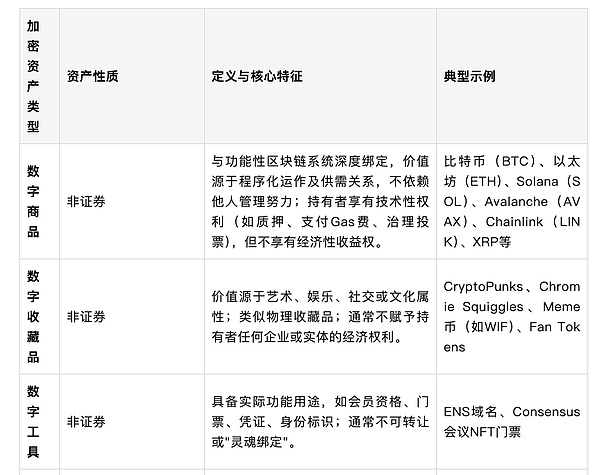
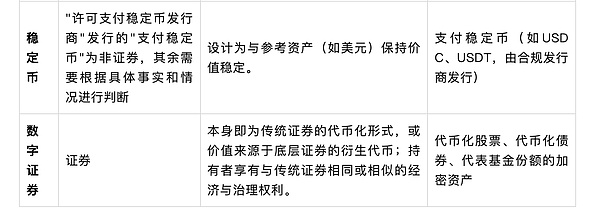
3.2 "Investment Contracts" and "Stripping Mechanism"
If the classification system answers the question of "whether a certain asset class belongs to securities", then investment contracts and stripping mechanisms answer the dynamic question of what becomes a security under what conditions. This is the most innovative part of the Guidelines.
3.2.1 Binding of Investment Contracts to Securities
The Guidelines clearly state that a non-securities crypto asset (such as digital commodities) can become the subject of an investment contract, thus falling under the scope of securities regulation.
The key condition for this transformation is that when selling the asset to investors, the issuer, through explicit or implicit statements or promises, induces investors to form a reasonable expectation that the issuer will undertake essential managerial efforts to generate profits for investors. The Guidelines refine the criteria for judging reasonable expectations. If the issuer, through white papers, official websites, social media, or other channels, promises investors to develop specific features, achieve specific milestones, and build a complete ecosystem, and provides detailed business plans, timelines, staffing, and funding sources, then investors' expectation of profit is reasonable. Conversely, if the issuer's statements are vague and lack specific plans, it is difficult to constitute a reasonable expectation. 3.2.2 How to Separate from Securities: The Separation Mechanism The Guidelines clarify that a non-securities crypto asset, after being issued as the subject of an investment contract, can be separated from the corresponding investment contract under specific conditions. Afterward, trading of this asset in the secondary market will no longer be considered securities trading. In other words, such assets do not transform into securities simply because they were once the subject of an investment contract; what truly changes is whether the asset remains bound by the legal relationship of the investment contract linked to the issuer's commitment. The conditions for separation fall into two categories: First, the issuer has completed its promised key management efforts. For example, when the issuer completes the milestones promised in the white paper, such as software development, mainnet launch, and open-source code, it is considered to have fulfilled its commitment. Subsequently, even if the issuer continues to provide non-critical operational support, it does not affect the fact that the assets have been stripped. At this point, the investment contract itself no longer exists, and subsequent asset transactions are naturally no longer governed by securities laws. Secondly, the issuer explicitly waives and announces that it will no longer fulfill its commitments. If the issuer is unable to fulfill its commitments during the development process for various reasons and publicly announces its abandonment of project development in a widely disseminated and unambiguous manner, the assets are also stripped from the investment contract. However, the document also warns that the issuer may still bear anti-fraud liability under securities laws for failing to fulfill its commitments in this case. The stripping mechanism provides a legal path for crypto projects from compliant financing to decentralized operation. Project teams can raise funds through securities issuance in the early stages to complete core development. Once the system matures and achieves decentralization, its native token can circulate freely, no longer subject to the strict constraints of securities laws on the secondary market. 3.3 Legal Characterization of Specific On-Chain Activities The Guidelines also provide clear legal characterizations for three common types of on-chain activities: 3.3.1 Protocol Mining and Protocol Staking The Guidelines clarify that mining (proof-of-work mechanism) and staking (proof-of-stake mechanism) activities conducted on public, permissionless blockchain networks do not constitute securities issuance. Protocol mining includes both self-operated mining and joining mining pools. Even if mining pool operators charge fees, it does not change its nature, because these activities are administrative or transactional actions, not core management efforts. Protocol staking includes four forms: (1) Self-operated staking; (2) Direct self-custody staking with a third party: The user retains control of the assets and entrusts a third-party node operator to verify them; (3) Custody arrangement: The user entrusts the custodian to pledge the assets on their behalf. The custodian acts only as an agent, does not decide the timing or amount of staking, and may not use the deposited assets for other commercial purposes; (4) Liquidity staking: The user receives staking receipt tokens to maintain liquidity. The staking service provider acts only as an agent and does not guarantee returns. Due to their administrative or transactional nature, the above activities do not constitute a securities issuance. 3.3.2 Wrapping
Wrapping refers to the act of depositing a crypto asset with a custodian or cross-chain bridge and generating wrapped tokens that can circulate on another chain at a 1:1 ratio. The Guidelines clarify that if the underlying asset is a non-security asset and is not in an investment contract state, and the wrapping process does not involve any returns, profit opportunities, or additional goods/services, then the wrapped token itself does not constitute a security. The wrapped token is considered a "receipt" of the underlying asset, and its value derives entirely from the underlying asset, not from any effort made during the wrapping process.
3.3.2 Wrapping
Wrapping refers to the act of depositing a crypto asset with a custodian or cross-chain bridge and generating wrapped tokens that can circulate on another chain at a 1:1 ratio.
在管辖权协调方面,新规通过联合发布的形式,明确了两大监管机构的协调立场:数字商品归CFTC管辖,数字证券归SEC管辖,支付稳定币另有专项立法。CFTC将以与本解释一致的方式管理《商品交易法》,并确认某些非证券加密资产可能符合《商品交易法》下的商品定义(见《指引》原文第9页)。 This means that crypto assets classified as digital commodities, such as Bitcoin and Ethereum, will fall explicitly under the CFTC's regulatory scope, and their derivatives trading will be subject to the regulatory rules of the commodity futures market. This reduces regulatory uncertainty for market participants. 4.2 Profound Market Impact The new regulations have a multi-dimensional impact on the market: they eliminate long-term uncertainty surrounding mainstream assets and reshape the trading logic of the secondary market; they foster new compliant business models and create conditions for the United States to once again become a center of crypto innovation. The most direct market impact of the new regulations lies in eliminating long-term uncertainty surrounding mainstream crypto assets such as Bitcoin and Ethereum. The document explicitly classifies these assets as digital commodities and states that they are not securities. This means that secondary market trading of these assets no longer faces the risk of being classified as securities trading. Traditional financial institutions, previously hesitant due to regulatory uncertainty, can now more confidently include these assets in their portfolios; exchanges can more clearly categorize listed assets and formulate corresponding compliance rules. The establishment of the stripping mechanism fundamentally changes the secondary market logic for crypto assets. Before the new regulations, after an early-stage project raised funds, the secondary market trading of its tokens always faced uncertainty regarding whether it constituted securities trading. The new regulations clarify that once a project completes its core commitments and strips, its subsequent trading no longer constitutes securities trading. Project teams can raise funds through compliant early-stage financing, complete core development, and then achieve free circulation of tokens through stripping. This path provides a clear business model for legal launch, compliant financing, and eventual decentralization. For investors, during the pre-stripping stage, they enjoy protection under securities laws; after the stripping, investors can trade in a freer secondary market. This phased protection arrangement protects early investors without hindering the subsequent circulation of assets. The new regulations provide legal certainty for business models in these areas by clearly defining infrastructure services such as mining, staking, encapsulation, and cross-chain bridges. The document explicitly states that these activities do not constitute securities offerings, and participants do not need to register as securities or seek exemptions. This definition reduces compliance risks for service providers and promotes the professionalization and scaling of the industry. For example, liquidity staking service providers can operate with greater certainty without worrying that their issued staking receipt tokens will be classified as securities—provided the underlying assets are non-securities and have been stripped away. Cross-chain bridge and encapsulation service providers can also operate within this clear regulatory framework. The release of these new regulations may reverse the previous trend of talent and capital outflow caused by regulatory uncertainty. The document explicitly cites the report of the Presidential Task Force, emphasizing the policy objective of keeping blockchain-based innovation within the United States. Compared to the EU's Crypto Asset Markets Regulation (MiCA) and the regulatory frameworks of several Asian jurisdictions, the US has previously been at a disadvantage in regulatory competition due to the ambiguity of its rules. The new regulations, by providing a systematic classification framework and a clear compliance path, are expected to enhance the US's competitiveness in the field of crypto regulation. 5. Implications for Various Market Participants 5.1 For Project Teams and Developers The Guidelines provide a clear framework for designing financing paths for project teams. Project teams can choose to raise funds through compliant securities issuance in the early stages, while clearly planning their divestiture path—when key development is completed, when decentralization is achieved, and when commitments are publicly announced. This path ensures that tokens eventually achieve free circulation as non-securities, while avoiding the continuous compliance burden of secondary market trading. Project teams need to be highly vigilant about core management effort promises made during the marketing process. The new regulations clarify that if an issuer promises specific development milestones, business plans, or profit expectations to investors through white papers, websites, social media, or other channels, these promises may constitute core elements of the investment contract. Project teams should ensure that after divestiture, they clearly declare that the promises have been fulfilled, or adjust marketing statements to avoid creating excessive profit expectations. In addition, project teams should consider embedding divestiture into their technical architecture. This can be achieved through multi-stage development plans, progressive decentralized roadmaps, and transparent milestone disclosure mechanisms to provide clear evidence for future divestitures. 5.2 For Investors The Guidelines provide investors with a new investment analysis framework. For assets explicitly classified as digital goods, the investment logic is primarily based on fundamental factors such as network effects, supply and demand, and technological development. For project tokens that have not yet been divested, investors need to pay attention to the issuer's ability to fulfill its obligations and legal risks, and enjoy investor protection under securities laws. Investors also need to pay attention to the divestiture status of the project to accurately determine the legal attributes of its transactions and the corresponding protection mechanisms. For activities such as airdrops, staking, and mining, investors should distinguish whether they constitute transactions with consideration. Free airdrops are not within the scope of securities regulation; however, new assets obtained through labor, services, or capital input may constitute securities issuance and fall under SEC regulation. 5.3 For intermediaries and service providers, a classified listing mechanism needs to be established to distinguish different categories such as digital goods, divested assets, digital securities, and payment stablecoins, and corresponding compliant trading rules should be formulated. For assets not yet divested, the issuer's securities registration or exemption status must be confirmed; for divested assets, a verification mechanism must be established to confirm the establishment of the divestiture. Pledge and custody service providers should clearly define their business as non-securities administrative services, but should be aware of compliance risks related to business boundaries. If the service involves revenue commitments, revenue sharing, or underlying assets that are digital securities, it may trigger securities regulation. Service providers should clearly define their agency role in the business agreement to avoid being identified as undertaking key management efforts. For legal, tax, and accounting service providers, the issuance of the Guidelines will create new demands for professional services. Project owners will need professional services such as divestiture path design, compliance review, and information disclosure; exchanges will need asset classification and trading rule design; and investors will need assessments of the legal status of their investment targets. The implications and impacts of the new regulations on the three types of participants are essentially interconnected. The compliance path design of project teams determines the level of protection available to investors, while the classification and verification mechanisms of intermediary institutions are the key infrastructure connecting the two. The significance of the new regulations lies in providing a predictable and collaborative rule framework for these three types of participants. 6 Summary and Outlook The release of the "Guidelines" marks a significant turning point in the regulation of crypto assets in the United States, moving from ambiguity to clarity and from case-by-case enforcement to rule-based pre-implementation. It reclaims the power of definition through a clear rule framework, guiding market innovation towards the development of truly functional, decentralized blockchain networks, rather than remaining at the level of short-term arbitrage models focused on issuance, financing, and narrative. However, the codification of rules does not mean the end of the game. While defining boundaries, the new regulations may also create new arbitrage opportunities: First, the manipulation of the timing of stripping away security attributes. The guidelines allow project teams to strip away security attributes after completing core management efforts. How to define completion—whether it's mainnet launch, open-sourcing the code, or achieving a certain decentralization metric—may be open-sourced in practice. Project teams may attempt to gain access to the secondary market, which is not regulated by the SEC, as quickly as possible while obtaining financing convenience by formally completing the process but retaining control. Second, the marketing boundaries of non-security assets. The guidelines emphasize that non-security assets are not securities themselves, but if they induce investment through promises of management efforts at the time of issuance, they constitute an investment contract. Project teams may attempt to package their commitments as visions, community roadmaps, or non-binding plans to avoid being identified as core governance efforts. Third, the financialization of staking and yield products. The guidelines define protocol staking itself as not being a security, but staking receipt tokens may become securities due to the nature of the underlying assets. The market may design more complex structured products, attempting to find new gray areas between non-securities staking activities and securitized yield products. Fourth, the boundaries between stablecoin payments and yields. The GENIUS Act explicitly states that payment stablecoins are not securities, but prohibits the payment of interest. The market may design combined products such as stablecoins plus staking, stablecoins plus lending, and stablecoins plus reward points, providing products that are essentially yield-like under the guise of compliant payment stablecoins. In the future, the interaction between regulation and the market will continue. The focus of regulation will shift from qualitative to enforcement—how to supervise projects to ensure they truly fulfill their divestiture commitments, how to handle jurisdictional issues in multinational projects, and how to address the new structures resulting from the integration of artificial intelligence and crypto technology. These issues will gradually unfold over the next few years. Regardless, the release of the guidance has already propelled US crypto regulation into a new phase. For market participants, the clearer rules reduce compliance costs; the challenge lies in seeking innovation within the boundaries of the rules. For regulators, while gaining the power to define, they must also face new challenges arising from the new rules. This new regulation is the first step taken by the committee to build a clearer regulatory framework for crypto assets, and its subsequent evolution will be jointly shaped by the continued interaction between regulation and the market.


 JinseFinance


