In the wave of blockchain and decentralized autonomous organizations (DAOs), Stakeholder Capitalism is becoming a key concept to redefine organizational governance and value creation. Traditional shareholder supremacy is no longer suitable for the distributed nature of DAOs, and Stakeholder Capitalism provides a theoretical basis for the sustainable development of DAOs by balancing the interests of shareholders, members, communities, partners and the environment. This article will explore the core concepts, historical evolution and application of Stakeholder Capitalism in DAO governance, and reveal why it is an indispensable guiding principle for the DAO ecosystem.
1. The core concept of stakeholder capital theory
Theoretical background
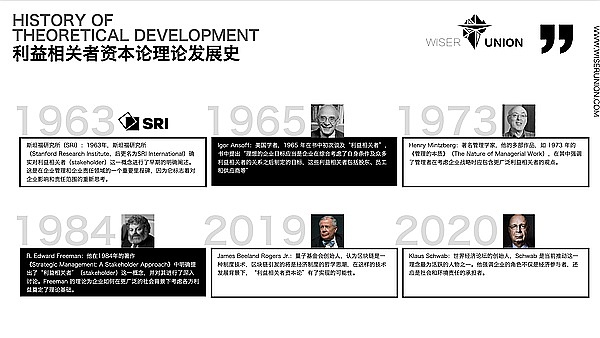
Stakeholder theory originated from management science, emphasizing that enterprises not only create value for shareholders, but also need to meet the needs of stakeholders such as employees, customers, suppliers, communities and the environment. In 1963, Stanford Research Institute (SRI) first proposed that stakeholders are necessary for the survival of enterprises, which goes beyond the traditional perspective of focusing only on shareholders. In 1984, R. Edward Freeman systematically expounded this theory in "Strategic Management: Stakeholder Approach", defining stakeholders as "individuals or groups that can influence or be influenced by the goals of an organization."
Stakeholder capitalism is in sharp contrast to shareholder capitalism. The latter focuses on maximizing economic returns to shareholders, while the former advocates that enterprises have a positive impact on the economic, social and environmental levels and achieve sustainable development. Its core features include:
Expanded accountability: Decisions take into account the impact of all stakeholders, not just shareholders.
Long-term focus: Emphasis on long-term sustainability rather than short-term profits.
Social responsibility: As an integral part of society and the environment, enterprises must assume the responsibility of making positive contributions.
Balancing interests: Coordinate the interests of all parties in a way that is beneficial to both the organization and society.
Stakeholders in DAO
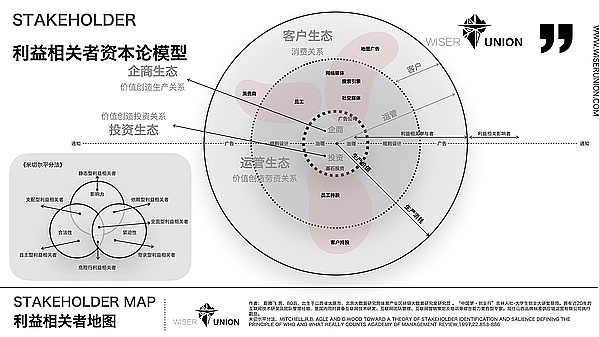
In the context of DAO, stakeholders cover a wider group, including token holders, community contributors, developers, users, partners, and external participants in the on-chain ecosystem (such as cross-chain protocols, regulators). Chakham (1992) divides stakeholders into contractual (token holders, developers) and public (community, regulators); Clarkson (1994) divides stakeholders into active (core developers, major token holders) and passive (ordinary users) based on risk-taking. Carroll (1996) further proposed the classification of core, strategic and environmental stakeholders, providing a detailed perspective for DAO governance.
The decentralized nature of DAO makes stakeholder management more complicated, but it also provides a technical basis for balancing the interests of all parties, such as smart contracts and governance tokens.
II. Historical evolution of the theory
The evolution of stakeholder capital theory has gone through several stages, which has established its important position in modern governance:
In 1963, Stanford Research Institute: First proposed the concept of stakeholders, emphasizing the necessity of employees, customers, communities, etc. for the survival of enterprises.
In 1965, Igor Ansoff: Introduced "stakeholders" in Corporate Strategy, advocating that corporate goals need to balance the interests of shareholders, employees, suppliers and other parties.
In 1973, Henry Mintzberg: In The Nature of Management, emphasized that managers need to consider the dynamic balance of a wide range of stakeholders.
In 1984, R. Edward Freeman: Systematically proposed the stakeholder theory, advocating that corporate decision-making be integrated with ethics and social responsibility.
In the 1990s, Peter Drucker: Advocated that companies go beyond profit goals and focus on social responsibility and moral values.
Contemporary, Klaus Schwab: Promote stakeholder capitalism through the World Economic Forum, emphasizing the role of enterprises in society and the environment.
In addition, John Elkington's (1997) "triple bottom line" theory and Michael Porter's (2006) "shared value" concept further enriched this theory, providing an interdisciplinary perspective for DAO governance.
III. Application of stakeholder capitalism in DAO
Stakeholder perspective of DAO governance
The decentralized governance of DAO naturally fits the stakeholder capitalism. Through smart contracts and token mechanisms, DAO can achieve transparent decision-making and profit distribution, and meet diverse interests. The role of stakeholders in DAO governance is mainly reflected in the following aspects:
Informal influence: Community members influence the strategic direction of DAO through forums, social media or proposal lobbying.
Specialized assets: Core developers and token holders obtain residual claim rights and participate in governance through technical contributions or capital investment.
Supervision and pressure: The community and external regulators play a supervisory role and promote governance optimization through public opinion or compliance requirements.
Relationship governance: DAO forms a governance mechanism between the market and the organization through on-chain voting and consultation to balance the interests of all parties.
Specific Strategies
To integrate stakeholder capitalism into DAO governance, the following strategies can be adopted:
Implementation steps
Clear vision: Define the long-term goals of the DAO and balance economic and social values.
Identify stakeholders: Categorize core (token holders, developers), strategic (partners) and environmental (regulators) stakeholders and analyze their needs.
Cultural change: Promote the concept of decentralized governance through community activities and education.
Process adjustment: Optimize the on-chain governance mechanism to ensure transparency and efficiency.
Transparent communication: Publish governance reports regularly and accept community feedback.
Continuous improvement: Iterate the mechanism according to the governance effect to improve participation.
IV. Long-term benefits and challenges
Long-term benefits
Sustainability: By balancing the interests of all parties, DAO can reduce governance risks and enhance ecological resilience.
Brand and reputation: Fair governance enhances community trust and attracts more users and developers.
Member participation: Transparent benefit distribution mechanism enhances members' sense of belonging and stimulates contribution motivation.
Eco-cooperation: Establish long-term partnerships with cross-chain protocols, communities, etc. to promote ecological prosperity.
Challenges
Definition dilemma: How to accurately define the stakeholders of DAO and their priorities?
Participation path: How to design incentive mechanisms to ensure broad and effective participation?
Performance evaluation: How to quantify governance effects and evaluate the contributions of stakeholders?
Institutional adjustment: Do the existing on-chain governance rules support complex interest balances?
The response strategies include strengthening community education, designing flexible governance mechanisms, using data analysis to optimize decision-making, and working with regulators to ensure compliance.
V. Future Outlook
With the deepening of blockchain technology and global attention to sustainable development, stakeholder capitalism will play a more important role in the DAO ecosystem. Future trends include:
ESG integration: DAO will pay more attention to environmental, social and governance (ESG) indicators to attract sustainable investment.
Data-driven governance: Use AI and big data to optimize stakeholder management and improve decision-making efficiency.
Global and local balance: DAO needs to find a balance between the global ecosystem and the needs of the local community.
Co-creation model: Through open governance, encourage the community and partners to innovate together.
Regulatory coordination: Work with regulators to develop rules that support decentralized governance.
VI. Conclusion
Stakeholder capitalism provides DAO with a governance framework that goes beyond traditional shareholder supremacy. By balancing the interests of token holders, developers, users and communities, DAO can not only realize economic value, but also promote the sustainable development of society and ecology. In the blockchain era, adopting this model is not only a strategic choice, but also the key to DAO's success in the competition. Decision makers should actively embrace this concept and build a more resilient and influential decentralized ecosystem through transparent governance and innovative mechanisms.
The future of DAO lies in collaboration and co-creation, and stakeholder capitalism is the bridge between technology and value.
Further reading
In 1971, Professor Klaus Schwab founded the European Management Forum (EMS) and held its first meeting in Davos.
Participants discussed Schwab's "stakeholder theory", that is, companies should serve all stakeholders, not only shareholders, but also employees, suppliers and the wider community. Today, the stakeholder concept is the guiding principle of the Forum.
In 1973, the Annual Meeting adopted the Davos Manifesto, a code of ethics for business leaders, which was updated in 2020 to explain the mission of companies in the Fourth Industrial Revolution, a concept proposed by Professor Schwab in his 2016 book.
In 1974, politicians were invited to the Davos Forum for the first time, and in 1987, the EMS was renamed the World Economic Forum, aiming to provide a platform for public-private cooperation to address the pressing issues of the day.
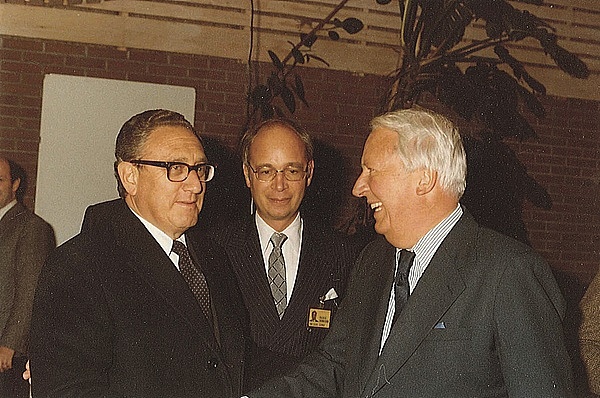
In 1980, former US Secretary of State Henry Kissinger, Klaus Schwab and former British Prime Minister Edward Heath appeared in Davos.


 Joy
Joy


