Investors generally believe that quantum computing is still in the science fiction stage, but a recent research report from Barclays points out that this "too early" illusion may cause you to miss the most crucial trend in the next 12 months.
Barclays' analyst team recently released a research report titled "Quantum Computing: Correcting Investors' Biggest Misconceptions."
Barclays' analyst team recently released a research report titled "Quantum Computing: Correcting Investors' Biggest Misconceptions."
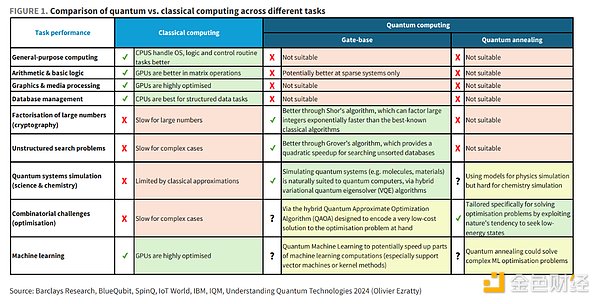
Misconception 2: Quantum computing is coming, replacing classical computing, and Nvidia is finished?
This is the biggest cognitive bias in the market. Research reports point out that many people believe that quantum computers are too powerful and will replace current CPUs and GPUs. Barclays refutes this: This is not a replacement relationship, but a "strongest support" relationship.
The Future "Mass Production Dark Horse"—Silicon Spin: This is the direction Intel is currently pursuing. Although its performance is currently mediocre, it can be manufactured using existing semiconductor factories, and once a breakthrough is achieved, it will be the easiest to mass-produce.
Winning by Quantity—Neutral Atoms: It has a natural advantage in the number of stacked qubits. Barclays concluded: "Our tests show that ion traps are currently in the lead… but the scalability of silicon spin deserves long-term attention." [Image of a GIF image] Misconception Four: Passwords About to Be Cracked? Barclays poured cold water on the panic that "quantum computers will crack bank passwords tomorrow": "You're overthinking it; the computing power isn't enough yet." To crack current RSA encryption, thousands of perfect logical qubits would be needed, while the most advanced devices available to humanity currently only have a few dozen. Barclays bluntly states: "Quantum computers are not powerful enough...not yet at the point where modern encryption standards are threatened." Misconception Five: Quantum-themed investments are "only available in two or three companies." The market often believes that investment targets in this field are scarce, limited to a few well-known companies. However, Barclays has analyzed the entire industry chain, identifying 45 publicly listed companies and over 80 private enterprises. The main areas of focus are: 1) Quantum processors (system sales or QCaaS cloud access) 2) Quantum supply chain (cryotherapy, laser/optics, control electronics, materials, etc.) 3) Quantum chip design and manufacturing (overlapping with traditional semiconductor manufacturing) 4) Ecosystem enablers (cloud, data center infrastructure, quantum simulators, quantum-classical integration: GPU/CPU/servers, etc.) The report's framework leans more towards "risk pricing": in the short term, "higher revenue exposure" often corresponds to "higher technological risk." It roughly categorizes technological risk into high (single route), medium (few routes), and low (route-independent) based on whether the business model is tied to a single path. This also explains why the quantum narrative easily "focuses only on pure quantum hardware stocks": their revenue exposure is the most direct, but the path uncertainty is also the greatest; while the supply chain, semiconductor equipment and EDA, cloud and data centers, and hybrid integration links may be better able to transmit the "quantum progress → capital expenditure and supporting needs" transmission.


 Weiliang

