Tether Co-founder Prediction: Who will be the next ETF?
While Wall Street’s interest has boosted the entire crypto market, William Quigley said it also comes with risks.
 JinseFinance

Author: flowie, ChainCatcher
Last week, Tether released its Q2 2024 financial report. Tether's Q2 net operating profit reached $1.3 billion, and its profit in the first half of 2024 was as high as $5.2 billion, a record high.
The profit of $5.2 billion in half a year is equivalent to nearly $30 million a day, which is beyond the reach of many listed companies. But Tether, which has made a lot of money, may not be as glorious as the financial report shows.
On June 31, the new EU "MiCA" law came into effect, which means that Tether's stablecoins are officially facing mass delisting in Europe. Crypto exchanges such as Binance, OKX, Uphold, and Bitstamp have announced the delisting of almost all USDT trading pairs in Europe due to the law.
While competitor Circle has obtained the "MiCA" legal license to sell its two stablecoins, USDC and EURC, in Europe.
Europe is the region with the largest scale of crypto adoption. According to a study recently released by CoinWire, Europe's cumulative cryptocurrency trading volume accounts for 37.32% of the global market.
Circle is taking away a significant market share from Tether. According to a CCData report, after the European regulations came into effect, the trading volume of USDC trading pairs on centralized exchanges increased by more than 48%.
Since its establishment in 2014, Tether, which has experienced many crypto-currency storms and regulatory FUD, has now grown into a behemoth. Will Tether be "too big to fail" in the future, or will it still be difficult to escape the risk of "being out"?
As the bull market begins, the market value of stablecoins continues to grow. According to the latest report released by CCData Research, as of the end of July, stablecoins have risen for 10 consecutive months.
USDT, as the largest stablecoin by market value, is also growing, dominating nearly 70% of stablecoin transactions. But one signal that cannot be ignored is that USDC, USDT's current biggest rival, has also seen a significant increase in market value and trading volume in 2024, especially in terms of trading volume, which has exceeded USDT for many times, since its monthly trading volume exceeded USDT for the first time in December 2023.
Data jointly released by Visa and Allium Labs showed that on March 24, 2024, USDC's trading volume at the close of the week was almost five times that of USDT. On April 21, 2024, USDT's weekly trading volume shrank to $89 billion, while USDC increased to $455 billion.
According to Kaiko's report analysis, the reason why USDC is becoming more and more popular may be that users are increasingly adopting and preferring regulated stablecoins.
USDC's relatively compliant and regulated attributes also make it the first choice for large institutional clients to enter the crypto field.
This year, BlackRock launched the tokenized fund BUIDL, which is pegged to the US dollar at a 1:1 ratio. Holders can obtain a "security" that is similar to an interest-bearing stablecoin. In order to ensure that investors can purchase/redeem stablecoins 24/7/365, BlackRock chose to cooperate with Circle to establish a smart contract-controlled USDC liquidity pool for investors.
After the European regulations came into effect in July, USDC trading volume surged again. CCData data shows that after centralized exchanges removed the European USDT trading pairs, the trading volume of USDC trading pairs increased by 48.1% to US$135 billion, a record high.
In addition to the growth opportunities in centralized exchanges, the growth of USDC on some active public chains this year cannot be ignored.
In August last year, Circle received a stake and support from Coinbase, which announced that it would launch it on 6 new chains.
On the Coinbase-affiliated Base public chain, USDC accounts for 91% of the total stablecoin supply. Base does not support USDT. Data from June 18 showed that the supply of USDC on the Base chain increased by more than 1,000% in the past 90 days.
On the Solana chain, Bankless shared a set of data on the X platform, "USDC accounts for about 70% of the total stablecoin supply on the Solana chain, and the trading volume of USDC and USDT on Solana this week is 19:1."
Bankless said that the reason why USDC dominates Solana is that Circle and Solana Foundation's strategy of incentivizing developers and promoting the integration of trading platforms.
For example, platforms such as Solend Protocol and Superteam in the Solana ecosystem provide developer rewards in the form of USDC, as well as the Cross-Chain Transfer Protocol (CCTP) launched by Circle on Solana and Circle's Web3 service rewards, which are all driving the growth of USDC on the Solana chain.
The FUD of Tether due to regulatory compliance issues has never stopped.
In addition to the European "MiCA" bill, the "Lummis-Gillibrand Payment Stablecoin Act" proposed by US senators in April this year has also been pointed out by many institutions as a threat to Tether.
The "Lummis-Gillibrand Payment Stablecoin Act" requires the issuance of stablecoins with a volume of more than US$1 billion to implement the same strict supervision as banks, and encourage more banks to participate in the stablecoin market.
Rating agency S&P Global pointed out that most of the current issuers of US dollar stablecoins, including USDT, which has the highest market share, are not subject to US regulations. However, if the bill is finally passed, it may prompt more banks to enter the stablecoin market and affect Tether's dominance.
A recent report from JPMorgan Chase also showed that the US's cryptocurrency regulation has been strengthened in recent months. Before the upcoming presidential election, the payment stablecoin bill is most likely to be passed, which will benefit compliant US stablecoins and threaten Tether's dominance.
The Deutsche Bank report also questioned Tether's operational stability and transparency.
Although Tether's trading activities mainly occur in emerging markets outside the United States, the United States is still one of the most important markets in the crypto field. If Tether does not respond, it may miss the market.
It may be based on an understanding of the trend of regulatory compliance or based on competitive considerations. This year, many founders of crypto companies have also warned that the next regulatory hammer may fall on Tether.
In May this year, Ripple CEO Brad Garlinghouse revealed on a podcast that since the collapse of FTX and the imprisonment of former CEO SBF, as well as the recent conviction and sentencing of former Binance CEO Zhao Changpeng (CZ), the next regulatory target of the US SEC is Tether.
Brad was subsequently counterattacked by Tether's CEO Paulo Ardoino, and the two were involved in a "war of words" for several days.
Ripple also announced the launch of a stablecoin pegged to the US dollar this year. Paulo believes that Ripple, as a competitor, is maliciously slandering Tether.
But Brad insisted that it was not a deliberate attack. He believes that the US government has made it clear that it wants to strengthen control over issuers of stablecoins backed by the US dollar. Therefore, Tether, as the largest participant, is among their targets of attention.
In March this year, after Arthur Hayes' family office Maelstrom invested in the new stablecoin protocol Ethena, Arthur Hayes also published a long article on his personal blog to discuss why the Federal Reserve, the US Treasury and large US banks with political connections want to destroy Tether.
Arthur Hayes believes that Tether's full reserve banking model runs counter to the Federal Reserve's stated goal of reducing the amount of bank reserves to curb inflation.
And Tether is too big. Tether is now one of the largest holders of U.S. Treasury bonds. The growth of Tether and similar stablecoins serving the cryptocurrency market poses risks to the U.S. Treasury market.
In addition, Tether is too profitable and will attract competition from banks.
A speculative balance sheet and income statement prepared by Maelstrom analysts for Tether shows that Tether's revenue per employee is $62 million, and the eight "too big to fail" banks in the United States, represented by JPMorgan Chase, are unlikely to match Tether's profitability.
It is expected that in the next year, in addition to the United States, important crypto regions such as Hong Kong, Singapore, Japan, the United Kingdom, and the United Arab Emirates will successively introduce comprehensive stablecoin regulatory rules.
After global regulatory laws and regulations are gradually implemented, it may be difficult to determine whether Tether is really facing the risk of being eliminated.
Some people believe that the US government has no reason to trouble Tether.
Checkɱate, an analyst at Glassnode, said that the USDT issued by Tether is essentially equivalent to the US CBDC. He believes that the existence of Tether has been tacitly approved by the US government. "USDT absorbs the US government's treasury bonds, thereby supporting the US finances."
In dealing with the relationship with government supervision, Tether CEO Paulo once refuted Brad and said that Tether has been cooperating with law enforcement agencies in different countries.
In the past three years, 339 requests have been blocked, of which 158 were in cooperation with US law enforcement agencies. ”
Some people believe that, like the US dollar, how USDT is abused has little to do with the issuing institution. As long as Tether cooperates with law enforcement agencies to freeze it, the danger is not as high as imagined.
Tether has not yet made a clear and specific statement on how to deal with the withdrawal of the European Union and potential threats from other regions. But Tether may be trying to get rid of the unilateral control of the United States.
In June this year, Tether made a strategic investment of 18.75 million US dollars in the compliant blockchain financial institution XREX Group.
XREX Group founder Huang Yaowen revealed in a media interview that after this investment, Tether and XREX will launch XAU1 in cooperation with the Unitas Foundation.
XAU1 is a unit currency that is excess-reserved by Tether Gold (codenamed XAUt) and pegged to the value of the US dollar. It provides a robust financial alternative for stablecoin users and is also a hedge against inflation.
The launch of XAU1 The purpose is to maintain the dollar pricing that everyone is used to, while gradually making the dollar neutral and not subject to unilateral control by the United States. "Because Tether knows clearly that the money earned through the interest on US debt is controlled by the Federal Reserve, not itself, so 80% to 85% of the money earned is used to buy gold from the Swiss gold mine. ”
In addition, Tether is also seeking business growth beyond stablecoins, expanding into multiple fields such as Bitcoin mining, AI and education.
Perhaps in response to regulatory pressure, Tether is also increasing lobbying expenses. Data from the nonprofit OpenSecrets shows that Tether's parent company iFinex increased its lobbying spending by more than 150% in 2023.
In addition to the hidden dangers of supervision, Tether has never lacked challengers.
At the beginning of last year, BUSD, which had been firmly sitting on the third largest stablecoin, withdrew from the stage of history overnight due to regulatory pressure from the US SEC. But the stablecoin market soon welcomed a number of replacement players.
Web2 payment giant PayPal launched the stablecoin PYUSD, and the stablecoin FDUSD, which is regarded as Binance's replacement for BUSD, also quickly emerged. In addition, old blue-chip DeFi such as Curve, Aave , Frax are actively launching native stablecoins; some new forces of interest-bearing stablecoins have also emerged, leveraging LSD and RWA.
This year, BlackRock, mentioned above, launched a tokenized fund similar to interest-bearing stablecoins, BUIDL, which to some extent also took a fancy to the profitable business of stablecoins.
In addition, some innovative stablecoin protocols are still rising strongly this year. Ethena's USDe is a new type of stablecoin supported by Ethereum derivatives. It was launched on the mainnet in February. In half a year, its market value exceeded US$3 billion, making it the fourth largest stablecoin after Dai.
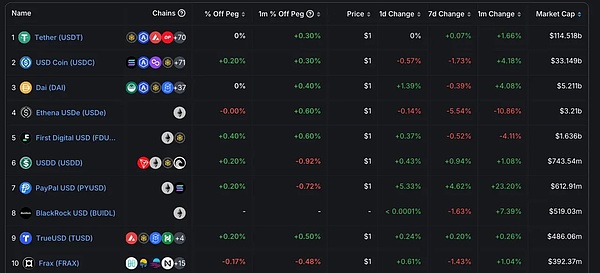
The investment institutions behind Ethena are like a novel. In February of this year, Ethena It received $14 million in financing led by Dragonfly, Brevan Howard Digital and Maelstrom, the family office of BitMEX founder Arthur Hayes, and participated by PayPal Ventures, Franklin Templeton, Avon Ventures, Binance Labs, Deribit, Gemini and Kraken, with a valuation of $300 million. In July last year, Ethena also received $6.5 million led by Dragonfly.
This may also explain that some market players and capital believe that although Tether and Circle currently occupy almost most of the stablecoin market, the stablecoin landscape still has huge adjustments, providing subversive opportunities for latecomers in terms of compliance, centralization risks, and how the benefits are distributed to users.
While Wall Street’s interest has boosted the entire crypto market, William Quigley said it also comes with risks.
JinseFinanceBitmain has taken the step of suspending employee salaries, both performance-based and basic wages, in response to ongoing financial difficulties and setbacks in its mining operations.
 Kikyo
KikyoThe cryptocurrency industry's workforce has surged by 160% since 2019, with most employees in small to medium firms.
 Beincrypto
The FSC plans to complete the revision in the second half of the year, requiring details such as type of crypto assets held, date of acquisition, quantity, and amount.
BeincryptoFTX previously purchased an Australian company to bypass the financial services license process.
Beincrypto
With the market falling off a cliff, there will be big losses to claim on your taxes, right? Well, let’s break it down in detail.
 Cointelegraph
With a peso-backed stablecoin, Tether is essentially “recreating the foreign exchange market with a Tether product,” Ardoino said.
CointelegraphThe Federal Revenue of Brazil wants investors to pay taxes on cryptocurrency trading profits, even if there is no exchange for Brazil's national currency.
CointelegraphThe Broncos' next owner could be a humble DAO organized by a group of professionals who may end up paying the highest ever fee for a North American sports team.
Cointelegraph