Bitboy's Battle: Ben Armstrong's Legal War Over Stolen Assets
Ben Armstrong, AKA Bitboy, sues former colleagues, alleging Lamborghini theft, racketeering, and a harrowing tale of intimidation and betrayal.
 Alex
Alex

Author: Jito Labs CEO/Co-founder Lucas Bruder
Original Title: Solana's Napster Era Is Over
Compiled and edited by: BitpushNews
Solana is a masterpiece. But what's built on top of it doesn't deserve that title.
I'm not saying this lightly. My team has been working on Solana's infrastructure layer for four years. We've witnessed every stage of this chain's growth: crashes, recoveries, explosive growth in activity, and the maturation of the validator network. We've watched transaction volumes grow from a few thousand to millions, to numbers that make traditional exchanges uneasy. I believe in this chain more than anyone else.
But infrastructure isn't what people experience. People experience the applications.
Now, almost nothing on Solana is built for users who are already there and deserve a better experience, let alone the millions coming soon. How did we get here? This mirrors the trajectory of the internet. The first large-scale applications of the internet were pirated MP3s and pornography. I was six when Napster launched in 1999, and within two years it had 80 million users sharing pirated Metallica albums. Early internet engineers thought they were building the future of communication, but the first wave of users emerged for the most "degenerate" possibilities. This wasn't a failure of the internet, but rather proof that the "pipeline" was working. It just took a few more years before Amazon, Google, or the iPhone emerged on the same infrastructure. Solana has been in its Napster era. Its infrastructure is indeed world-class. The entire developer ecosystem revolves around "shortest-handling with the latest tokens": more token issuance platforms, more dashboards tracking memecoin price movements. All development targets the same set of wallets, and all optimizations are designed to help people get in and out as quickly as possible, not to help them trade better. Supporters have consistently argued that memecoin was crucial for developing and stress-testing Solana's engineering capabilities. They are right, but that argument belongs to the past. Dogecoin brought us here, but it's not the destination. Whether the ecosystem is ready or not, the Napster era is ending.
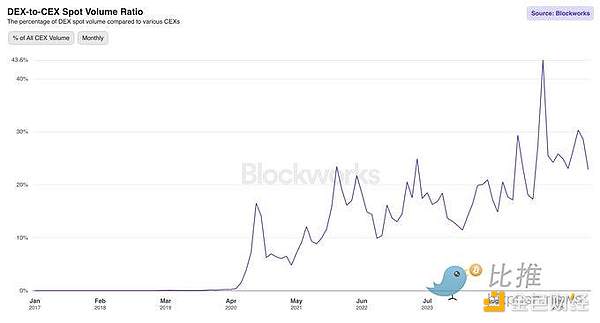
DEX vs. CEX Spot Volume Ratio (Source: Blockworks Analytics)
The world's largest fintech companies are racing to bring users on-chain.
Coinbase acquired Vector.fun last year as part of its massive acquisition spree, and now any Coinbase user can trade virtually any Solana token directly from the Coinbase App. Solana's DEX trading volume surpasses $1 trillion by 2025.
Robinhood is building its own blockchain to support tokenized stocks and perpetual futures, and you can already buy Solana tokens directly in your Robinhood wallet. These companies, with hundreds of millions of users combined, are no longer building standalone crypto products but weaving on-chain trading into the same experience people have when buying stocks and ETFs. The walls between CEXs (centralized exchanges) and DEXs (decentralized exchanges) are crumbling. And they chose Solana's infrastructure because it's the best. The next wave of 100 million users isn't a myth; they already have Coinbase and Robinhood installed on their phones. The question is, what will they find when they arrive? Currently, using many Solana apps feels like walking into a flea market. It's noisy everywhere, there are no labels, and you're unsure what's real and what's fake. There might be some good deals, but the environment doesn't give you any reason to trust it. In contrast, Robinhood and Coinbase have clean, uncluttered interfaces and intuitive controls; the whole experience makes you feel like someone anticipated your needs before you even had to. That's the difference. And that's exactly how the next wave of users will measure Solana.
Look at what Hyperliquid is doing: less emphasis on memes and a growing focus on real-world assets. Daily trading volume for oil perpetual contracts reaches $1.7 billion; S&P 500 contracts surpassed $100 million on their first day. The protocol generates over $600 million in annualized fees, and its token HYPE is up 50% this year, while most tokens have performed poorly. They've proven that when you build a serious trading experience, real trading volume follows. And they're doing it on their own L1, without Solana's advantage. We don't have technical problems; we have experience problems. Imagine what it's possible when someone develops at this level on top of the fastest infrastructure in the cryptocurrency space. The three dimensions of the experience gap: The first dimension is trust. People are used to apps that are intuitive and easy to use from the moment they open. Robinhood, Cash App, Apple Pay. You don't need to read manuals or decode interfaces. Everything works as expected, and when something goes wrong, the app tells you why in plain language. That's the baseline. Now think about what happens when these users first enter a Solana app. The experience immediately feels untrustworthy—not because of smart contracts or the escrow model, but because the interface doesn't look designed for them. The colors and the three vertical trend bars are practically a slot machine. No one explained what happened or why. They closed the tab within 30 seconds and went back to where they were. They weren't churned; they were never given a reason to stay. Trust is the feeling you get within the first three seconds of using a product—that feeling that "the developer respects your time and intelligence." Most products in this ecosystem are designed for people who already understand cryptocurrency. This works when all users are crypto natives; but it doesn't work when fintech companies are about to reach millions of people who don't even know what a mnemonic phrase is. The second dimension is craftsmanship. Craftsmanship is the result that developers truly "care" about. It's not just about speed of delivery, but about every detail from when you click to trade to settlement. How does the interface respond under network pressure? Does the loading status convey progress or just spin? Does the confirmation screen tell you the core information or bury it? Craftsmanship is a feeling: every interaction, every extreme situation, is anticipated by someone who understands your intentions. The Solana ecosystem has always moved too fast, so most teams have chosen to optimize delivery speed rather than this dedication. In the growth phase, that was the right choice; but the next phase requires different standards. The third dimension is durability. Most projects in the crypto space are optimized for the current cycle. Teams launch quickly, grab attention, follow the narrative, and leave when the narrative shifts. The entire ecosystem operates on a "hype and abandonment" rhythm. Users can feel this. They've been hurt too many times; they've developed an instinct. They can distinguish what's built for long-term existence from what's for short-term arbitrage. The truly important applications on Solana are those projects that teams see as a decade-long opportunity, not a cyclical trade. They are the applications that survive three, five, or ten years later, through bear markets and shifting landscapes. Traders know the difference. Nobody's going to spend time configuring a tool they think will disappear next year. In conclusion, Solana is at a turning point, and most in the ecosystem haven't realized it yet. The debate about infrastructure has settled. Solana is fast, cheap, and reliable. That's now the ticket, not a differentiating advantage. The next phase of competition isn't between chains, but between the applications built on top of them. And right now, the application layer doesn't match the ambition of its underlying infrastructure. The Napster era proved the chain viable. Millions of transactions daily, billions of dollars in volume, it withstood real pressure. That argument has won. What's next is harder: it requires building the next wave of applications that 100 million users truly want to use. The experiences that Coinbase and Robinhood are willing to proudly showcase to their customers. These experiences should make Hyperliquid's success on its own L1 look like a glimpse into the infinite possibilities of Solana, rather than a accusation that we failed to build anything good. The chain has grown. Now, it's time for everything on top of it to catch up.
Ben Armstrong, AKA Bitboy, sues former colleagues, alleging Lamborghini theft, racketeering, and a harrowing tale of intimidation and betrayal.
AlexA recent survey by Seedly and Coinbase unveils that 57% of financially savvy Singaporeans own cryptocurrency, with nearly half expressing optimism for its future. While crypto adoption is on the rise, concerns around market volatility and regulation persist among non-crypto users.
 Joy
JoyPolymarket prediction markets indicate Trump leads 2024 U.S. Presidential Election odds, reflecting dynamic public sentiment and financial speculation in the evolving landscape of political forecasting.
 Anais
AnaisBinance launches the Inscriptions Marketplace, revolutionizing crypto trading by enabling users to buy, sell, and mint tokens, backed by strategic partnerships and a focus on innovation.
 Weiliang
NYCB's acquisition of Signature Bank led to initial gains, but a $260M Q4 loss and dividend cuts reflect deeper challenges, sparking debates over crypto's role.
 Miyuki
South Korean crypto exchanges successfully stopped cybercriminals from stealing over $82 million through romance scams. Their secret weapon: abnormal transaction detection systems that actively spot and block fraudulent activities, providing a robust defence against online scams.
JoyLugano pioneers digital finance by integrating Bitcoin, CBDCs, and stablecoins, showcasing a future where diverse digital currencies coexist, transforming traditional economic structures.
AlexPixelmon transitions from an NFT debacle to a promising crypto project with a $8M raise, strategic partnerships, revamped games, and a community-driven future with the MON token.
 Brian
BrianIndia's RBI cautiously progresses on its digital rupee, balancing innovation with privacy and regulatory prudence, while showing openness to cryptocurrency taxation adjustments and startup collaborations in CBDC development.
WeiliangValkyrie partners with BitGo as custodian for its Bitcoin ETF, heralding industry-wide custodial diversification and intensifying the competitive landscape of spot Bitcoin ETFs.
Miyuki