Mt. Gox Creditors Will Soon Receive Repayments, End In Sight
These long-awaited reimbursements will be financed through the sale of Mt. Gox's remaining assets, including 142,000 BTC, 143,000 BCH, and 69 billion yen (about $625 million)
 Davin
Davin

Author: Chen Mo
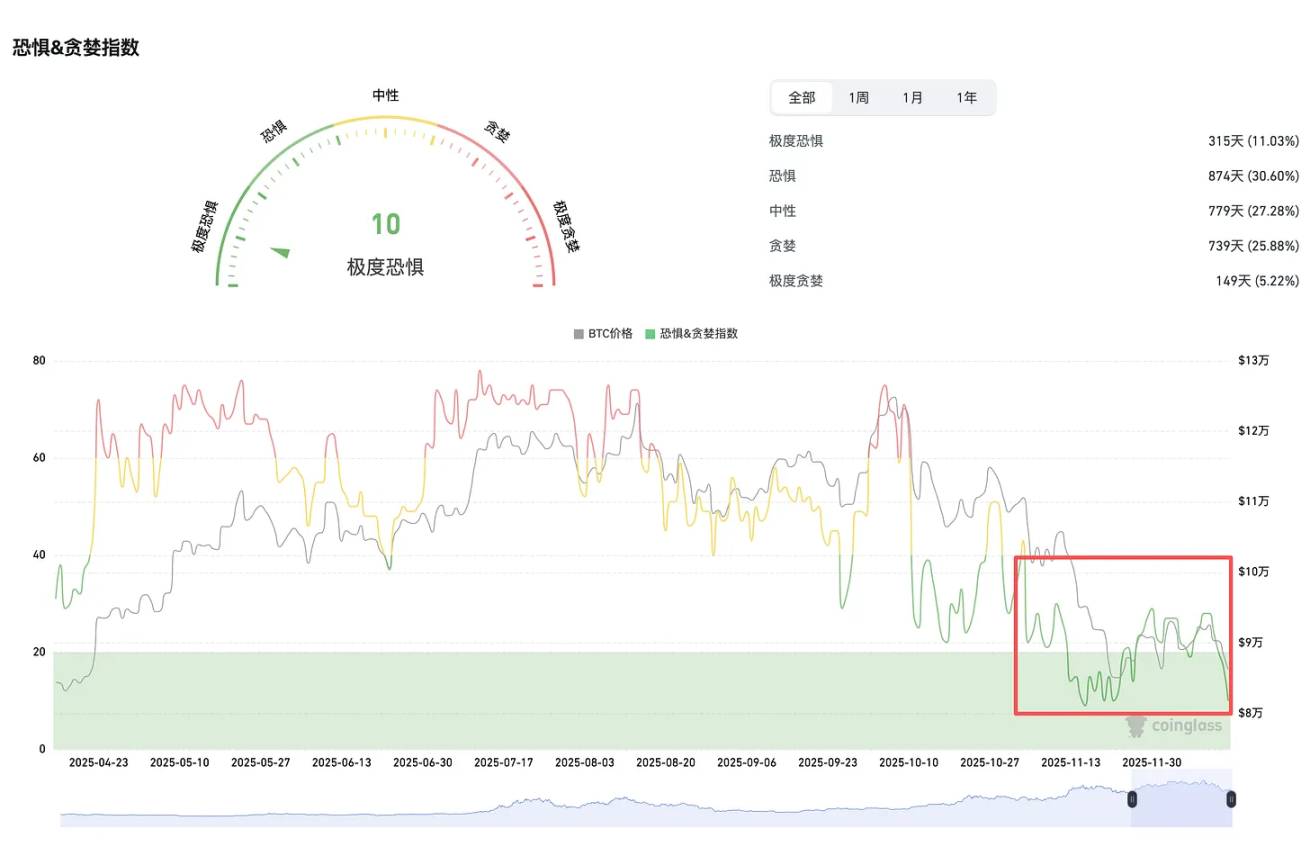
From a market sentiment perspective, the general consensus is bearish. In groups focused solely on chart analysis, prices have already fallen below 50,000. Research analysts are also very pessimistic, generally believing that it's difficult for any truly innovative projects to emerge, and that attention and capital are being heavily drained by the AI sector.
The strategy discussed last week was to abandon most altcoins and shift to mainstream assets, primarily focusing on BTC and ETH. Only a few altcoin projects with strong cash flow were retained, such as AAVE and LINK. Public chains and L2 cryptocurrencies were mostly converted to ETH.
Compared to the last cycle, I feel I've become much more conservative. During the bear market after LUNA, I bought a lot of altcoins at the bottom. Although I ultimately made a profit and even witnessed the resurgence of projects like AAVE, I also experienced too many stories of things going to zero. This cycle is a bit different. I think there are far fewer altcoins that have been unfairly punished. The market's calculation and evaluation capabilities have greatly improved, making it much harder to "pick up bargains." Especially this cycle has a large number of projects without actual business operations, as well as projects that were simply restructured to meet previous funding targets; these projects are very risky. Of course, if a good opportunity really arises, I will still buy, but I basically don't see any now.
Since the beginning of November, we have been in a state of panic to extreme panic for more than a month.
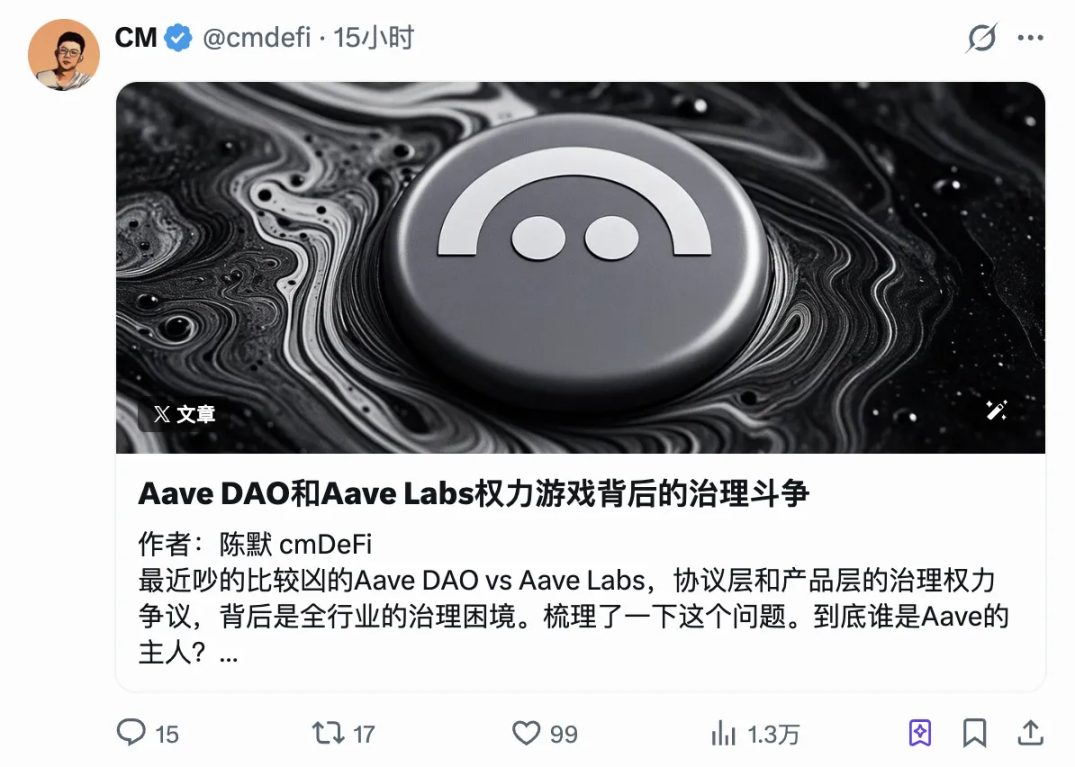
The debate has been very heated recently. I wrote an article about it, which I recommend reading. Behind this lies the governance dilemma faced by the entire industry.
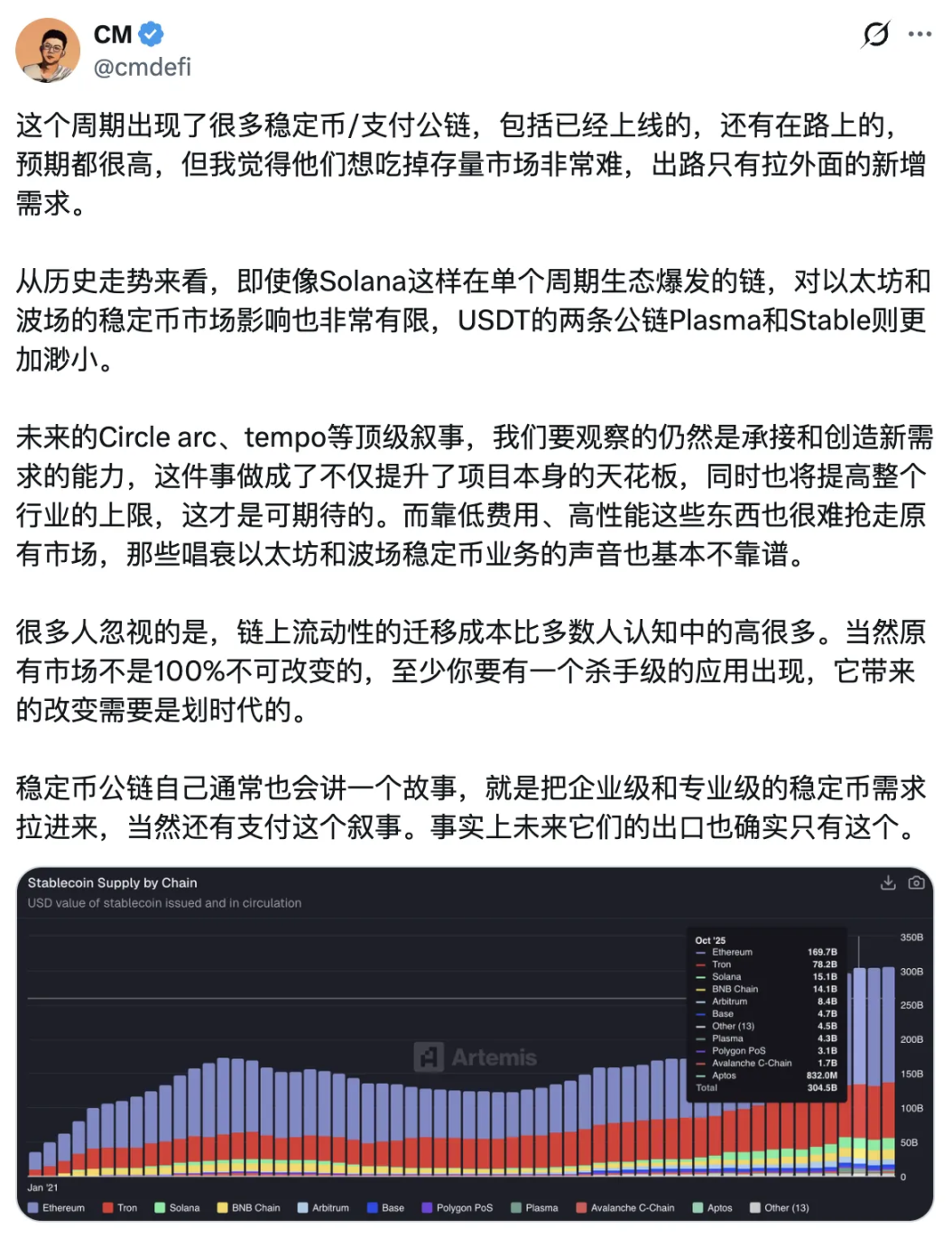
This sector is currently in a somewhat awkward position, and the market's interpretation is also problematic. When Plasma was first launched, many people thought it would disrupt the business of other public chains and...
While USDT has taken away a significant share, its actual impact on Ethereum and Tron is minimal. Even with substantial token rewards, it hasn't gained a large market share. The real narrative in this sector is opening up the stablecoin market outside the traditional crypto space. Given the current environment of stablecoin compliance legislation, stablecoin startups have a perfect storm of opportunity. However, we haven't seen any company successfully achieve this yet, and it's undoubtedly very difficult. I believe this will be the key factor testing a stablecoin's L1 offering going forward, rather than constantly churning out the existing stablecoin market.DTCC's asset tokenization plan has been approved by the SEC, which has once again drawn market attention to this track. From a policy perspective, the SEC is taking a very open and supportive approach to promoting this, with documents, detailed rules, and standards in place.
DTCC (Depository Trust & Clearing Corporation) is a leading global financial market infrastructure provider, handling over 90% of global U.S. stock, bond, and Treasury transactions.DTCC (Depository Trust & Clearing Corporation) is a leading global financial market infrastructure provider, handling over 90% of U.S. stock, bond, and Treasury transactions.
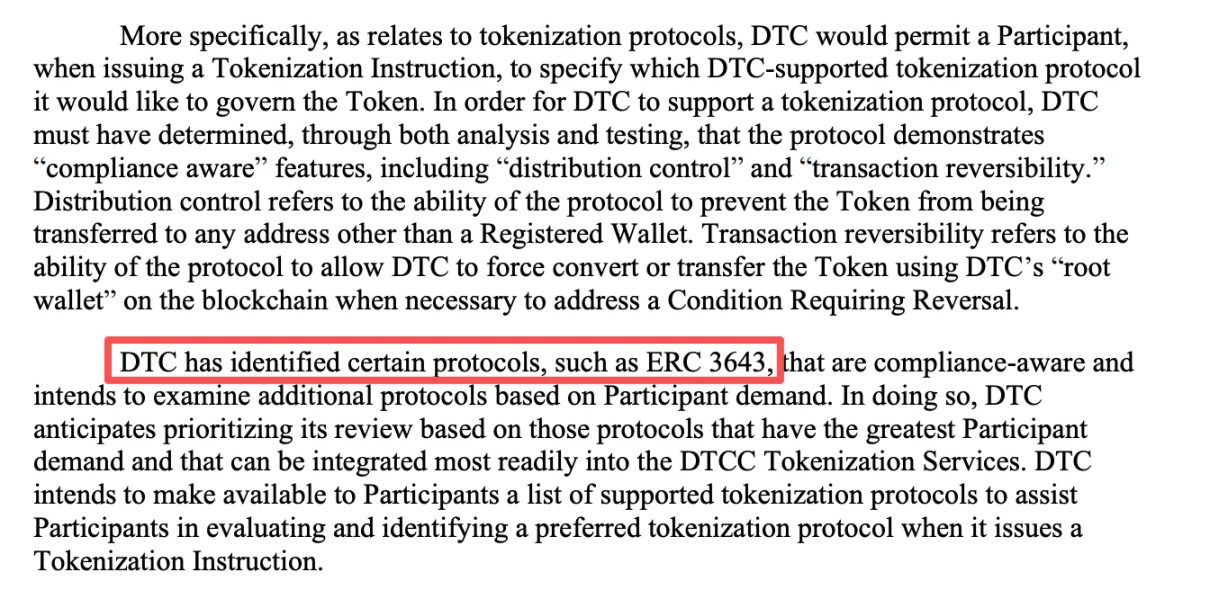
First, here are some criteria for a "compliant blockchain" as defined in the SEC's no-objection letter: (excerpt) Reliability and Resilience: The blockchain network must demonstrate high reliability and resilience, including assessments based on availability, performance, and a history of outages to prevent operational disruptions. Compliance Function Support: Only DTCC participants can register wallets and bear full responsibility for wallet activity. The network must support compliance-aware functions, including distribution controls (preventing transfers to unregistered wallets) and transaction reversibility (allowing DTCCs to enforce conversions or transfers via the root wallet to handle "reversal conditions" such as erroneous entries, lost tokens, or malicious activity). Observability: Even with privacy features (such as zero-knowledge proofs), the network must allow DTCCs to observe all token transfers directly or through supporting technologies. Wallet Screening: The DTCC is required to screen registered wallets to ensure compliance with the Office of Foreign Assets Control (OFAC) requirements. The source file link is here → Click to Read I think that among existing public blockchains, Ethereum/L2 is still the most suitable, especially since the SEC's original document mentions ERC-3643, which is explicitly mentioned in the SEC letter as an example of a compliance-aware protocol, supporting distribution control and transaction reversibility. Furthermore, the DTCC has previously used Ethereum for a pilot project (Project Whitney in 2020).
Another aspect is the impact on existing RWA projects. Many market interpretations are negative, but there are misunderstandings here. My personal interpretation is still leaning towards positive.
Firstly, this serves institutional clients (mainly targeting DTC participants and their clients, who are typically financial institutions such as banks, brokers, and asset management companies), and has no direct relationship with retail investors. Therefore, it does not conflict with existing stock tokenization products like Ondo (the market interpretation on this point is incorrect). For institutional clients, it improves settlement speed and efficiency, opens up the possibility of 24/7 trading, and enables some automated management through smart contracts (reducing human intervention).
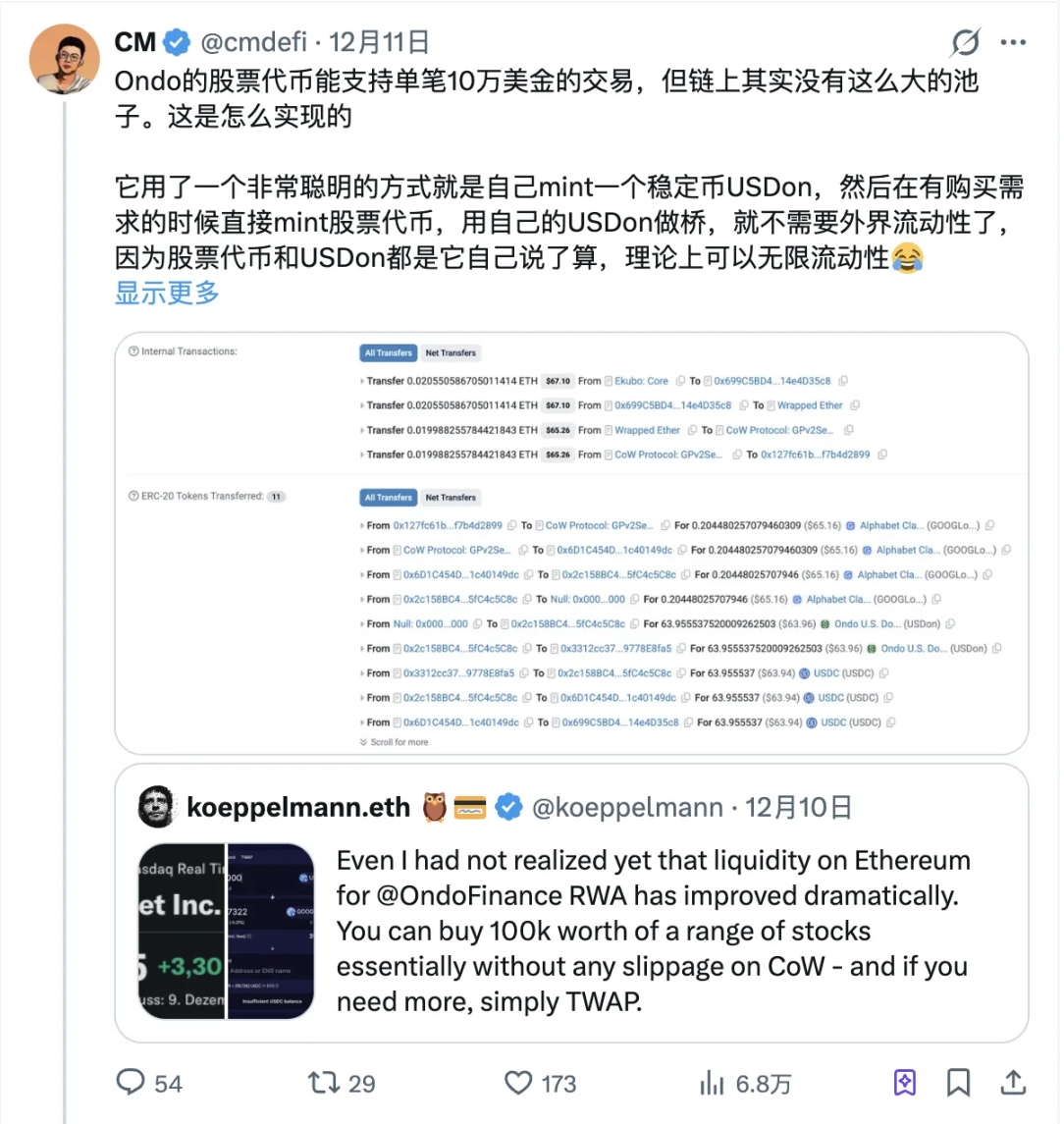
From a retail investor's perspective, faster and lower-cost institutional settlements could lead brokers (such as Robinhood or Fidelity) to lower fees or commissions, passing the cost on to retail investors. Retail investors trading through institutional products (such as ETFs or mutual funds) might experience faster order execution and better price discovery. Similarly, they could theoretically benefit from using products like Ondo, as it also relies on the execution efficiency of off-chain institutions. Therefore, this relationship is delicate. The SEC has begun to support stock tokenization in its attitude and has started to advance the technology, but it hasn't clearly defined how to regulate "grey area" businesses like Ondo, which can benefit from existing policies. It's estimated that in the short term, it will remain largely unregulated. Things might change as the scale grows; we'll see then. In the current context, my interpretation is positive. (This month, the U.S. Securities and Exchange Commission (SEC) officially concluded its two-year investigation into Ondo Finance and confirmed that it would not bring any charges against it.) 6. Ondo's stock tokens can support single transactions of $100,000 on-chain. There isn't actually such a large pool on-chain. How is this achieved? It uses a very clever method: it mints a stablecoin, USDon, and then directly mints stock tokens when there is a demand for purchase, using its own USDon as a bridge. This eliminates the need for external liquidity because it controls both the stock tokens and USDon, theoretically allowing for unlimited liquidity. Conversely, when someone sells, it first destroys the stock tokens, then converts them into USDon based on the Oracle quote, and finally exchanges them for the on-chain assets the user wants. Regarding USDon, its collateral consists of highly liquid assets such as US dollars and US Treasury bonds, held in a regulated brokerage account. On the blockchain, it's housed together with USDC in a Swapper contract, using USDon as the intermediary asset during transactions. For example, to purchase NVDAon, the user inputs USDC → the swapper converts it to USDon → the USDon mints NVDAon – all completed in a single transaction. The swapper is a smart contract pool holding liquidity for both USDon and USDC. If liquidity is sufficient, the conversion can be completed instantly at a 1:1 ratio. For larger amounts exceeding liquidity thresholds, waiting is required, or transactions can be performed in batches. The liquidity of this contract is maintained by Ondo itself. Theoretically, Ondo can increase the supported single transaction size by injecting more USDon (or the corresponding USDC) into the Swapper. The only remaining issue is that if demand increases, high-frequency trading might expose the Swapper's bottlenecks, which will test on-chain performance and Ondo's ability to rebalance and manage the Swapper. While Ondo currently offers the optimal implementation and best liquidity, it has little to do with the ONDO token, and its ability to scale and address regulatory issues remains uncertain. It currently operates in a "grey area." However, if you're willing to embrace the narrative of stock tokenization, Ondo is unavoidable.For users with over 200 million rewards, they need to deposit and hold HLPe or USDe in HyENA for at least 2 consecutive weeks. The deposit amount requirement is 1 USDe for every 2 million rewards. Based on the minimum reward of 200 million, that's 100 USDe.
In addition to depositing, users need to make a transaction of any size in HyENA.
The rewards are issued in uENA (the ENA version on Hyper). The first batch will begin in late December, with a two-month window lasting until the end of February. During these two months, you can choose any two consecutive weeks to deposit. This is essentially a forced traffic redirection to HyENA. Ethena highly values its Perps business (after all, it's very profitable). [Image of a testnet launched on tempo] Stripe and Paradigm co-incubated and developed the service, with partners including Anthropic AI, Coupang, Deutsche Bank, DoorDash, Lead Bank, Mercury, NuBank, OpenAI, Revolut, Shopify, Standard Chartered, and Visa. Tempo aims to address the pain points of existing blockchains in the payment field, such as high fees, latency, and uncertainty, making stablecoins a mainstream payment tool.
These long-awaited reimbursements will be financed through the sale of Mt. Gox's remaining assets, including 142,000 BTC, 143,000 BCH, and 69 billion yen (about $625 million)
DavinNorth Korean hackers, posing as journalists, escalate cyber threats by targeting nearly 1,500 South Korean officials in a sophisticated phishing campaign, compromising crypto accounts, and deploying mining malware, prompting urgent calls for enhanced cybersecurity measures.
 Jasper
KuCoin, a leading cryptocurrency exchange, introduces KuCard, a Visa-powered crypto debit card that transforms digital assets into everyday spending power.
 Joy
JoyNetflix director Carl Erik Rinsch diverts $4 million from Conquest series budget to invest in Dogecoin, yielding a $27 million windfall, prompting a $14 million dispute with Netflix.
JasperBinance admits guilt, settles $4.3 billion charges for neglecting illicit transactions, including child pornography, prompting CEO resignation and condemnation from US Treasury Secretary Yellen.
 Hui Xin
This incident follows a string of exploits related to Justin Sun, who just saw Poloniex suffer a $100 million hack this month.
DavinXapo Bank, under CEO Seamus Rocca's leadership, strategically navigates Latin America's evolving crypto landscape, capitalizing on grassroots adoption in countries like Argentina and Mexico by offering secure access to digital assets, addressing financial challenges, and revolutionizing remittances through stablecoins.
JasperKraken's co-founder, Jesse Powell, recently discussed the enduring struggles within the cryptocurrency industry amidst emerging threats to its reputation. He referenced Binance's historic $4.3 billion fine settlement with the U.S. Department of Justice and the U.S. Securities and Exchange Commission's (SEC) recent lawsuit against Kraken, illustrating the volatility faced by industry players.
JoyFTX founder Sam Bankman-Fried faces denied bail in the midst of legal turmoil following a fraud conviction.
Hui XinAlready, Italy, Croatia, Poland, Portugal, Slovenia, Luxembourg, and Romania have committed to the Europeum plan, with Belgium slated to host the project's headquarters.
 Brian
Brian