The hidden winner of SpaceX's IPO is actually it.
A controversial venture capital investment made a decade ago is evolving into one of the most profitable bets in Silicon Valley history.
 JinseFinance

Source: Republic
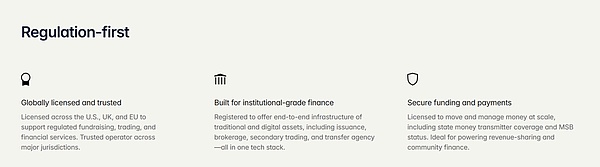
This means that MSX's Pre-IPO zone is a structural innovation built on a mature compliance framework. You will enjoy services at the same level as the world's top brokerages: all unicorn equity assets are connected through the same compliance channels as Robinhood, the existing shares behind the mapped tokens are real, and they are held in custody by a regulated third party, with a legal and asset support foundation. Ultimately, when tokenization technology meets compliant private equity platforms regulated by the US SEC, the equity of unlisted giants will no longer be the exclusive domain of top venture capitalists. Third, what does this mean for ordinary users? We also firmly believe that the Pre-IPO products launched this time will bring structural changes to ordinary users in three dimensions. First, it "equalizes" the entry threshold, bidding farewell to entry tickets that often cost millions of dollars. As mentioned above, the starting price in the traditional private equity market is usually hundreds of thousands or even millions of dollars, while tokenization can fragment the previously unattainable unicorn stocks, allowing eligible ordinary users on the Maitong MSX platform to sit at the same table as top venture capitalists with a very low threshold and equally share the future growth premium of SpaceX or ByteDance in the primary and secondary markets. Secondly, it's about "source-leveling" valuation advantages, avoiding the emotional tax of the secondary market. It's well known that the surge on the first day or in the early stages of an IPO is often accompanied by a huge emotional bubble, and ordinary retail investors often enter at high prices. Participating in the pre-IPO stage means capturing the closest possible valuation range. In short, you can finally position yourself at a low valuation stage before the company goes public, instead of becoming a bagholder in the post-IPO frenzy. Finally, it's about "restructuring" the liquidity structure, breaking the illusion of N-year lock-up periods. The most troublesome aspect of traditional private equity investment is the 5-10 year exit lock-up period. To address this pain point, Maitong MSX plans to be the first to launch high-quality pre-IPO targets with short-term redemption mechanisms, and will continue to explore more technical paths to improve asset liquidity, potentially completely reconstructing the exit logic of the primary market. In conclusion, the launch of the "Pre-IPO" zone marks a significant step forward for MSX's US stock tokenization strategy, expanding from "secondary market asset trading" to "primary market share distribution." Amid the global trend of asset tokenization, Pre-IPO tokenization has become a widely discussed key area for the next stage of industry discussion. As one of the earliest trading platforms globally to deeply cultivate US stock tokenization, MSX has consistently focused on one thing: enabling ordinary people to share in the growth dividends of the most scarce high-quality assets of this era, from breaking down barriers to US stock trading to dismantling the walls of private equity. Just as five years ago, ordinary people couldn't imagine instantly buying and selling US stocks through an on-chain wallet; before today, you might have similarly found it difficult to imagine becoming a "shareholder" of SpaceX or ByteDance with extremely low barriers to entry. In 2026, we hope to work with everyone to slowly push open that once tightly closed iron gate.
A controversial venture capital investment made a decade ago is evolving into one of the most profitable bets in Silicon Valley history.
JinseFinanceElon Musk, SpaceX, XAI, Artificial Intelligence: A SpaceX Investor's Perspective on the XAI Acquisition (Golden Finance) - Never doubt Musk's storytelling ability.
JinseFinanceJinse Finance launches its daily cryptocurrency and blockchain news bulletin, "Jinse at 8 AM," issue 2909, providing you with the latest and fastest news on the digital currency and blockchain industry.
JinseFinanceJinse Finance launches its 2900th issue of "Jinse Morning 8," a daily news report on the cryptocurrency and blockchain industry, providing you with the latest and fastest news on digital currencies and the blockchain industry.
JinseFinanceProjects like Ventuals, Zoshi, and FreeStock are exploring different paths to tokenizing private equity.
JinseFinanceReporters from "China Business Journal" learned that on May 7th local time, TikTok and ByteDance filed a lawsuit in U.S. federal court, seeking a ruling that the "Restricting the Emergence of Security Threats that Risk Information and Communications Technology (RESTRICT) Act," which aims to ban TikTok, is unconstitutional, and to prevent the enforcement of the law. In the lawsuit, TikTok stated, "This is the first time in Congress's history that a law has been enacted to impose a permanent, nationwide ban on a specific speech platform."
 Miyuki
Step into an exceptional evening of profound discourse, networking, and inspiration with Coinlive at The Social Pre-Party on 11 September!
 Catherine
The small satellite no bigger than a coffee mug is made from off-the-shelf parts and can be a tamperproof platform to secure blockchains and other Web3 protocols.
 Cointelegraph
The Science DAO, a decentralized fundraising platform that offers pre-IPO investment options in breakthrough technologies and projects, debuted on May ...
 Bitcoinist
Chandra Duggirala, Portal’s executive chairman, explained that the tokenization of traditional assets sparks the merging of the Bitcoin ecosystem with mainstream finance.
Cointelegraph