Prisma Finance's $540K on the Line as Hacker Presses for Team Reveal
The decentralised borrowing protocol has disclosed that 14 accounts have yet to retract the affected smart contract, which led to the exploitation of $11.6 million last week.
 Kikyo
Kikyo

Author: KarenZ, Foresight News
The crypto industry is never short of black swan events such as hacking attacks and lost private keys, but what happened on the evening of February 6, 2026, at Bithumb, South Korea's second-largest crypto exchange, is enough to be etched into the annals of the most absurd blunder in crypto history, a veritable "ceiling of exchange bewilderment."
On the evening of February 6, Bithumb made a fatal operational error in distributing event rewards, mistakenly sending a total of approximately 620,000 Bitcoins to 695 users. At the time, with a unit price of $66,000, the total value was a staggering $40.92 billion—enough to instantly bankrupt this leading exchange. Fortunately, as of now, the platform has recovered 99.7% of the mistakenly sent BTC, temporarily preventing a full-blown crisis.
This "epic" fatal operational error was by no means an accident.
This fatal operational error, which can be described as "epic," was by no means a coincidence.
From the initial mistake and market turmoil to the emergency cleanup, every step starkly exposed the weaknesses in Bithumb's internal management and risk control. A Terrifying 35 Minutes According to two official announcements from Bithumb (first released at 00:23, updated at 04:30) and a Yonhap News Agency report on February 7th, the timeline of this blunder is clear and astonishing. Imagine this: Bithumb's operations team was running a "Random Treasure Chest" event, planning to award 2,000 to 50,000 Korean won (equivalent to between $1.37 and $34.16 USD) to 695 participating users. However, the employee responsible for the operation mistakenly switched the unit from "Korean Won" to "Bitcoin" when entering the reward amount. The originally planned reward of 620,000 Korean won was ultimately changed to 620,000 BTC, of which 249 users actually opened the treasure chest and received the mistakenly sent reward.
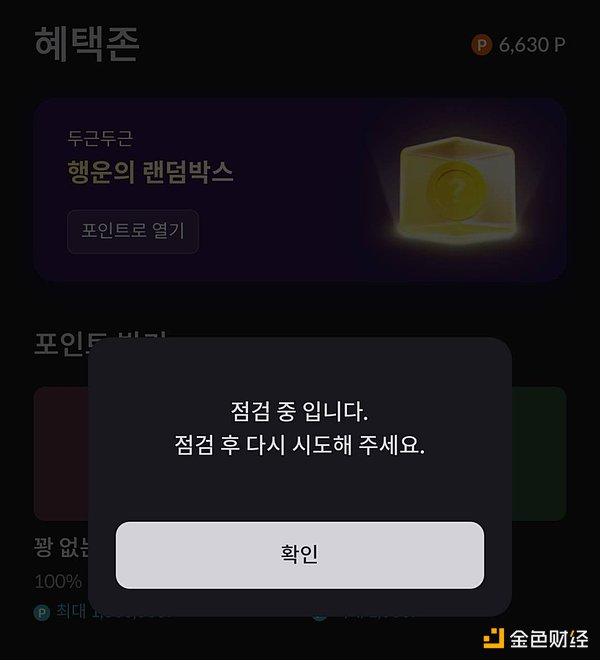
Event Treasure Chest Page (Source: Definalist)
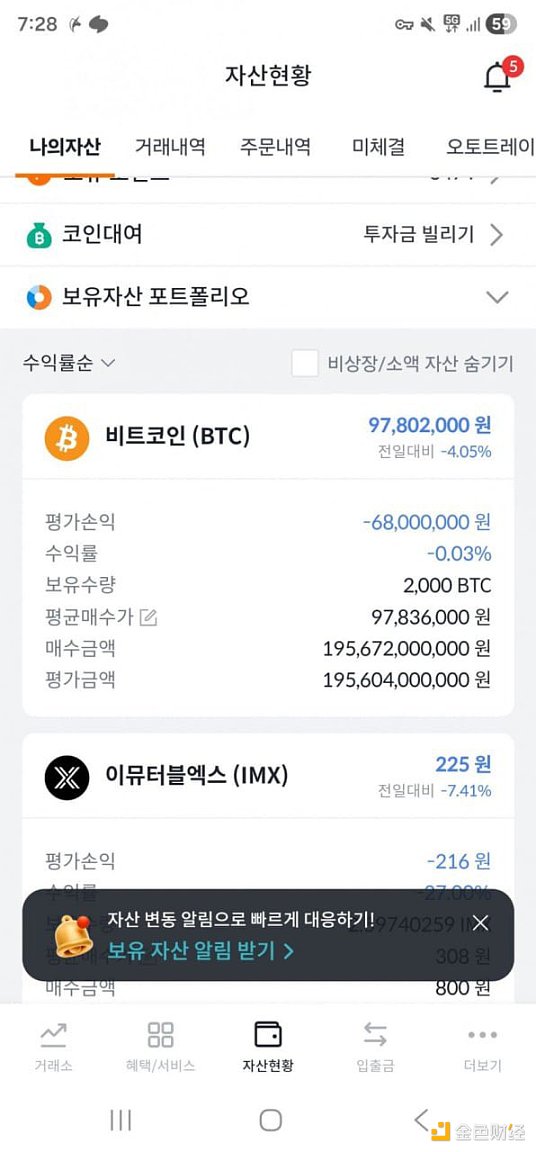
Screenshot of receiving 2000 BTC (Source: Definalist)
The timeline's progression appears more rushed and passive:
February, Korean time
At 19:00 on February 6th, the rewards were officially distributed; at 19:20, Bithumb internally discovered the error in the reward distribution, by which time some users had already begun selling their "windfall"; at 19:35, the exchange urgently initiated a trading and withdrawal freeze; at 19:40, the accounts of all affected users were frozen, the entire process taking 35 minutes. The market chain reaction triggered by the error was immediate. Some users who received the mistakenly sent BTC chose to sell immediately, causing the price of Bitcoin on the Bithumb platform's BTC/KRW trading pair to drop by as much as 10% compared to other markets around 19:30 on February 6th, reaching a low of $55,410. Fortunately, Bithumb officially announced that the market price returned to normal within 5 minutes, and its "Domino Liquidation Prevention System" functioned normally, preventing a chain reaction of liquidations due to price anomalies. Meanwhile, as of the time of the announcement update, Bithumb had recovered a total of 618,212 BTC through its internal abnormal transaction control system, representing 99.7% of the mistakenly issued BTC. Regarding the assets (Korean Won and other cryptocurrencies) corresponding to the 1,788 BTC that had already been sold by users, 93% has been recovered. The remaining unrecovered portion is approximately 125 BTC, and no evidence has been found that any BTC has been transferred to other exchanges or personal wallets. Behind the basic error: Bithumb repeatedly emphasized in its announcement that the incident was unrelated to external hacking attacks or system security vulnerabilities, but was solely due to an operational error. Furthermore, user assets were unaffected, and the exchange's trading and deposit/withdrawal services have returned to normal. However, this explanation clearly failed to quell market skepticism—how could such a massive amount of BTC be mistakenly issued without bypassing the exchange's multiple verification mechanisms? Was this due to individual employee negligence, or a systemic loophole in internal management? It's important to understand that 620,000 BTC is no small amount, representing approximately 2.95% of the total BTC supply. At the time, at a market price of $66,000, this equated to a total value of $41 billion. The fact that such a huge sum of money was issued without any multiple verification steps speaks volumes about the chaotic state of its internal management. Such basic errors are never the fault of a single employee, but rather a concentrated manifestation of deficiencies in the company's internal management system, imperfect processes, and weak risk control awareness. The Reserve Controversy: If this basic error is a "management stain" on Bithumb, then the reserve controversy sparked by this incident may crush market trust. As the mis-issuance incident unfolds, a core question has been widely raised in the market: How much BTC does Bithumb actually hold? Why was it able to mistakenly issue far more BTC than its publicly disclosed reserves in one go? Bithumb's latest financial report (Q3 2025) shows that Bithumb maintains excess reserves in Bitcoin and other listed crypto assets, with a Bitcoin reserve ratio (the ratio of actual Bitcoin holdings to users' book assets on the platform) of 100.46%. However, the specific holding quantities are kept confidential. However, according to Yonhap News Agency, Bithumb held 42,619 bitcoins as of the end of the third quarter of 2025. According to the latest data from CryptoQuant, as of February 7, 2026, Bithumb's bitcoin reserves were 42,304. In comparison, Binance held 658,855 bitcoins, and Upbit held 179,523. So where did Bithumb's 620,000 BTC, far exceeding its reserves, come from? In response to market skepticism, Bithumb stated in an official announcement that the number of tokens held in its wallets is 100% consistent with the number displayed on the user interface through strict accounting management, and emphasized that it conducts quarterly asset audits by external accounting firms and publicly discloses the audit results. Unrecovered and sold-off BTC will be replenished using the company's own assets to ensure user assets are unaffected. Regulatory Intervention + Decreased Trust This erroneous issuance incident not only triggered market panic and disputes over reserves but also attracted the attention of South Korean financial regulators. Yonhap News Agency reported that South Korean financial authorities have clearly stated they will launch an on-site inspection of Bithumb, focusing on investigating the incident's occurrence, the recovery of the mistakenly issued BTC, and whether any illegal or irregular activities occurred. For Bithumb, regulatory intervention is undoubtedly adding insult to injury. Even more serious is the collapse of user trust. The core competitiveness of cryptocurrency exchanges lies in users' trust in the security of their assets. This series of mishaps—"incorrect unit input, complete loss of verification, mystery surrounding reserves, and passive emergency response"—has directly exhausted the trust users have built up over a long period, and the platform's reputation and market share face an irreversible decline. Bithumb's Latest Response On the afternoon of February 7th, Bithumb issued an apology for the accidental Bitcoin distribution incident, stating that it would take full responsibility for the incident and compensate users who panicked and accessed the platform during the relevant period. Bithumb stated that after the incident, it reported it to all relevant departments and is fully cooperating with the investigation by the State Financial Regulatory Commission. To prevent similar incidents from happening again, Bithumb has implemented the following corrective measures: Strengthening the Asset Verification System: It will strengthen the verification of customer and company assets during payment processes based on events or company policies. Improving the Multi-Payment System: It will improve certain previously missing processes to ensure that customer asset transfers and reward payments require at least two payment steps, thereby preventing similar incidents from recurring.Enhanced AI System for Detecting and Automatically Intercepting Abnormal Transactions: Once abnormal transactions or data are detected, the system will immediately activate the "Security Assurance" system, operating 24/7 to prevent incidents from occurring at the source.
External Expert System Audit: A comprehensive system assessment of Bithumb will be commissioned from a global security expert organization, and the results will be published publicly and transparently.
Furthermore, Bithumb will assume full responsibility. Since the second announcement, there have been no direct customer asset losses due to the overpayment incident. However, due to the price crash, some transactions detrimental to customers (panic selling) were confirmed during the incident. Bithumb believes these transactions fall within its responsibility to protect customers and plans to provide full compensation, including additional compensation, to affected customers. As of 16:00 on February 7, 2026, the estimated customer losses are approximately 1 billion Korean Won.
The company plans to compensate for any additional losses. 1. Special Compensation for Panic Selling: Users who sold at low prices during the event period (February 6, 2026, 19:30-19:45) will receive compensation equal to the full selling price plus an additional 10%. (Automatic payment within one week after data verification.) 2. Compensation for All Bithumb Users During the Event: All users who accessed Bithumb services during the event period will receive 20,000 Korean Won (approximately US$13.66) in compensation within one week. 3. No Transaction Fees for All Users: Transaction fees for all trading instruments will be reduced to 0% for seven days. (To be announced later)
4. Establishment of a 100 billion won "Customer Protection Fund": A special fund worth 68 million US dollars will be established to immediately salvage customer assets in the event of an incident.
The accidental issuance of 620,000 BTC, seemingly an absurd and low-level human error, is actually a concentrated outbreak of internal management loopholes, opaque reserves, and weak risk control awareness within cryptocurrency exchanges.
The lesson from Bithumb is straightforward and cruel: in the context of rapid industry expansion, if the most basic process control, asset verification, and risk warning are abandoned, even the largest exchanges can collapse instantly due to a single "fingertip mistake." However, since the FTX collapse, exchanges such as Binance, Bybit, and Bitget have successively implemented periodic proof-of-reserve (PoR) disclosure.
For ordinary users, this serves as a crucial reminder: crypto assets are inherently high-risk. When choosing a platform, the priority should always be "transparency, compliance, security, and robust risk control" far outweighing "high returns and generous promotional subsidies."
The decentralised borrowing protocol has disclosed that 14 accounts have yet to retract the affected smart contract, which led to the exploitation of $11.6 million last week.
KikyoHe contends that existing meme coins are characterised by volatile price fluctuations and lack intrinsic value.
 Catherine
Pendle Finance rallied the community and collaborated with Twitter officials to reclaim control of their compromised Twitter account.
KikyoHe contends that existing meme coins are characterised by volatile price fluctuations and lack intrinsic value.
CatherineCriminals have escalated their tactics in preying on the elderly through intricate crypto scams.
CatherineAs stipulated in the settlement, Google has already commenced the process of enhancing its disclosures regarding the data collected during "private" browsing.
CatherineIn an email correspondence with ABC News, SBF expressed his endeavour to rectify matters from behind bars.
KikyoTwo generative AI platforms aim to broaden their user base and increase revenue through enhanced accessibility and advertising.
CatherineThe purge is designed to address the issue of excessive historical data storage.
KikyoAuthorities in Gangnam nabbed 10 individuals suspected of orchestrating a fraudulent USDT OTC transaction to pilfer money.
Catherine