Author: Ji Zhenyu; Source: Tencent News "Qianwang"
As many people expected, the relationship between Musk and US President Trump has completely broken down. On June 5, the conflict between the two was completely public. They shouted at each other on social platforms, and both sides made personal attacks without reservation. Musk said, "If it weren't for me, Trump would not have become president at all, and the other party has no gratitude at all"; while Trump said, "Musk has gone crazy" and threatened to stop the government's contract project with Tesla.
The trigger for this ugly mutual attack was Musk's public dissatisfaction with the "Big and Beautiful Bill" proposed by the Trump administration. According to this bill, the US government will continue to take fiscal expansion measures to further expand the fiscal deficit. But in the eyes of many people, the conflict between the two sides has been accumulating for some time, and June 5 was just a concentrated public outburst. The core is that Musk believes that his efforts have not been rewarded.
When the conflict between the two became public, Tesla's stock became the most direct victim. Investors chose to sell Tesla shares due to concerns about the company's prospects, causing the company's stock price to fall by more than 17% during the trading session and close down more than 14% on the day, with a market value of more than $150 billion evaporated.
The Musk-Trump alliance may be the most special and influential relationship in modern American politics. One is the world's richest man and the other has been elected president of the United States twice. The alliance formed by the two powerful figures benefited from the US election last year. Trump was successfully elected president, and Musk also gained fame and fortune and served in a government position. It was once called a great "bet" by the outside world. However, such an alliance lasted less than half a year before it collapsed, and the American political and business landscape will face new dramatic changes.

The political and business farce reached its peak with the mutual insults
Less than a week after leaving the Department of Government Efficiency (DOGE), Musk publicly expressed his disappointment with the "Big and Beautiful Bill" proposed by the Trump administration.
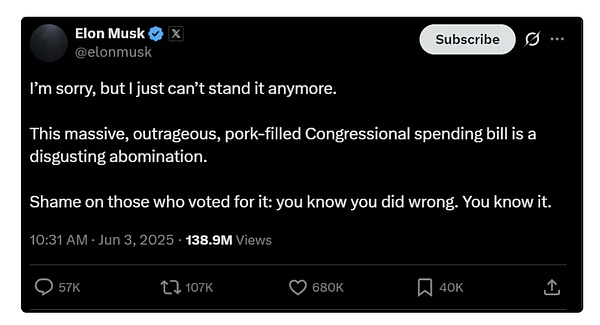
Then, Trump accused Musk of changing his attitude towards legislation after resigning from his position as a senior White House adviser on June 5.
"I'm very disappointed because he (Musk) knows more about how this bill works than almost anyone in this room." Trump said.
Trump believes that the reason Musk is dissatisfied is the clause in the bill that cancels the electric vehicle tax credit, which is extremely unfavorable to Musk's Tesla.
"He suddenly has an opinion because we have to cut subsidies for electric vehicles," Trump said.
He also said Musk was unhappy with his rescinding his ally's nomination to head NASA. Although Trump acknowledged that Musk supported him in the campaign, he also added: "I think I can win Pennsylvania without him."
Musk, for his part, did not show any weakness and completely turned against Trump. He posted tweets directly attacking Trump almost non-stop that day.
"Without me, Trump would lose the election, the Democrats would control the House, and the Republicans would only have a narrow advantage in the Senate of 51:49."
"So ungrateful," Musk said in a tweet.
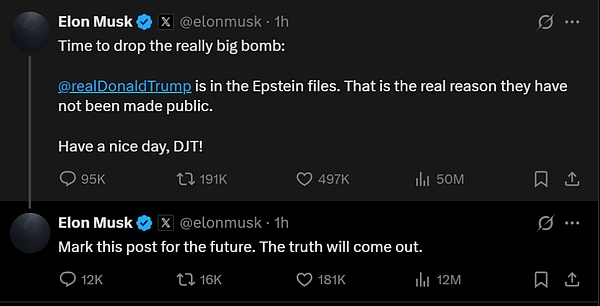
He also said that Trump's speculation that he opposed the bill was a complete "lie." Later, he released another "blockbuster", "Trump is also on Epstein's list, which is why he did not make it public."
After Trump threatened to cut off government subsidies and contracts to Musk, Musk immediately stated that he would immediately retire SpaceX's Dragon spacecraft project.
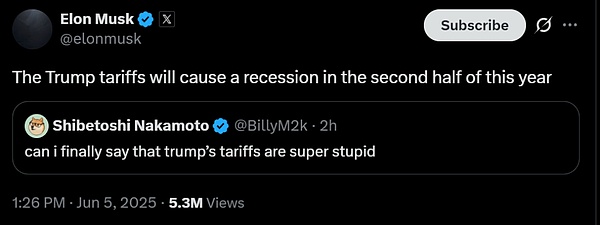
Musk also directly criticized Trump's tariff policy, saying that the policy would cause the US economy to directly enter a recession in the second half of this year.
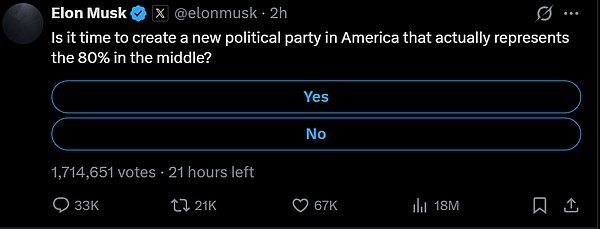
He also directly launched a vote on the X platform, proposing the establishment of a new political party that truly represents 80% of the American middle class. The vote received more than 1.8 million responses, of which more than 82% agreed with his proposal to establish a new party.
As this political and business farce continued to climax, Tesla became the hardest hit area in the US capital market that day. As the contradictions between the two sides continued to escalate and the quarrels became more and more intense, Tesla's stock price was ruthlessly sold by investors. Tesla once fell by more than 17% that day. As of the close of the day, Tesla's stock price fell by more than 14%.
The fierce quarrel between Trump and Musk on that day became the only focus of the market, and the incident continued to ferment after the US stock market closed that day.

From close allies to enemies
The relationship between Trump and Musk may be the most important and influential political and business relationship in the United States in modern times.
During Trump's two terms as president, the relationship between the two has undergone multiple rounds of changes. After Trump was first elected president in 2016, Musk once entered his advisory circle and was invited to join Trump's "Economic Advisory Committee" and "Manufacturing Jobs Initiative Group." He has met with Trump several times to offer advice on issues such as infrastructure, manufacturing and technological development. Musk's attitude at the time was "not about the person, but about the issue." He emphasized that his cooperation with the president was to "promote sustainable energy and technological development" rather than out of political support.
In June 2017, Trump announced that the United States would withdraw from the Paris Climate Agreement, and Musk immediately announced his resignation as a White House adviser. He publicly stated: "Climate change is real," "I have tried my best to persuade the president, but failed." Since then, Musk has gradually distanced himself from the Trump administration, especially in areas such as environmental protection, immigration and technology policies.
In the later period of Trump's first presidential term, Musk had almost no public interaction with him, but occasionally made indirect comments on his policies on social media.
In 2020, Musk strongly opposed California's lockdown policy, calling it "fascist." Although Trump also advocated an open economy, the relationship between the two did not get closer.
In 2021, after Biden took office as US President, he often mentioned the development of electric vehicles by General Motors and Ford, but avoided talking about Tesla, which angered Musk. Musk has repeatedly mocked Biden on X (formerly Twitter), even saying that he was "controlled by a teleprompter." During this period, he began to be more friendly to the Republican Party and publicly stated that he used to be a supporter of the Democratic Party, but now he is more inclined to the Republican Party. In 2022, he also tweeted that he "plans to vote for the Republican presidential candidate in 2024."
In 2024, the new US presidential election kicked off. Many media broke the news in 2024 that Trump had tried to win Musk's support and even discussed potential roles such as "Secretary of the Treasury" and "Technology Advisor." Musk did not confirm these details at the time, but admitted that he had met with Trump privately. Musk emphasized that he would not directly fund a candidate, but called for "restoring freedom of speech, reducing taxes, and curbing regulation," which was interpreted by the outside world as support for the Republican position. Musk supports restricting illegal immigration and criticizing big government, forming a consistent position with Trump.
When the 2024 presidential election was tense, Musk repeatedly stated that he would not return to the Democratic Party and was strongly dissatisfied with Biden. Trump praised Musk as a "smart businessman" at multiple rallies. Musk's interest in political influence has increased significantly, and he has promoted conservative candidates in multiple constituencies.
Subsequently, Musk's support for Trump became public, and he became one of Trump's most solid allies in the campaign. He gave speeches at rallies many times, and the relationship between the two became closer and closer.
After Trump finally won the US presidential election for the second time, Musk was generally regarded as the "big winner", and Tesla also ushered in a wave of "election market", with its stock price rising by more than 130% from August last year to the end of last year. Musk then served as the head of the Department of Government Efficiency (DOGE), responsible for cutting government spending.
During his tenure, Musk and Trump still showed a close relationship in public. Musk often appeared in the White House, but the Republican Party had more and more opinions about Musk, and Musk's position in the government became more and more awkward.
After 130 days in office, Musk announced his resignation from the government, but there were internal sources that Musk had hoped to continue the position, but was rejected by Trump.
The relationship between the two then began to take a sharp turn for the worse. On June 5, the conflict broke out and became public. The fuse for the breakdown of their relationship was Musk's strong criticism of Trump's "Big and Beautiful Act", which expanded tax breaks, increased border enforcement and military spending, but cut Medicaid, food aid and clean energy tax credits. Musk's core point is that the bill further expanded the deficit and increased the US debt burden.
The House of Representatives passed the multi-trillion-dollar Republican bill by one vote last month, and Musk hopes to leverage similar opposition from members of Congress to push for major changes to the bill.
The Senate is currently reviewing the bill, with the goal of getting it to the president's desk before July 4. Republicans have a 53-47 majority in the Senate, and two Republican senators are explicitly against the bill: Rand Paul of Kentucky and Ron Johnson of Wisconsin. Mike Lee of Utah and Rick Scott of Florida have reservations, while Lisa Murkowski of Alaska, Susan Collins of Maine, and Josh Hawley of Missouri have doubts about other parts of the bill. If two more of them defect, the bill could die in the Senate.
Johnson said Musk's statement boosted the confidence of the opposition:
"I think it really worked - at least for me, it reinforced our position that we have to deal with this matter. I didn't want to be that 'grain of sand', but now I have to be the sand that irritates the pearls."
The Congressional Budget Office's estimate released on Wednesday showed that the bill would increase the deficit by $2.4 trillion over the next decade.
The outcome of this round of dispute between Musk and Trump has been closely tied to whether the bill can be passed, which also highlights the tension between business interests and political decisions in the US policy-making process. But there is no doubt that this once seemingly powerful alliance will cause greater shocks in the US political and business circles for a longer period of time after it falls apart.


 Anais
Anais