Tao Zhu, Jinse Finance
Strategy hasn't bought any BTC in the past week. According to Bitcoin Treasuries data, Strategy's last BTC purchase was on March 23rd.
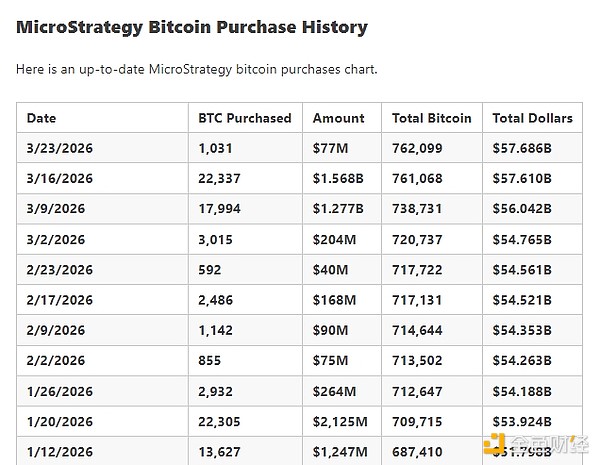
On the surface, Strategy hasn't bought BTC, but in fact, Strategy's fundraising is being strengthened, preparing for the next purchase at any time.
I. Strategy's Preferred Stock Plan
On March 13th, Strategy's perpetual preferred stock Stretch ($STRC) instant offering (ATM) raised a record amount.
I. Strategy's Preferred Stock Plan
On March 13th, Strategy's perpetual preferred stock Stretch ($STRC) instant offering (ATM) raised a record amount.
Real-time tracking data showed that the trading volume reached 7.3 million shares that day, all of which met the activation threshold, equivalent to 471% of the average daily trading volume. This transaction marked the ninth consecutive day of ATM issuance, almost double the previous day's volume, and the proceeds were enough to purchase approximately 4,038 bitcoins. On that day, the STRC share price remained stable at $100, with investors valuing the lower volatility of preferred stock compared to Strategy common stock (MSTR). STRC is a perpetual preferred stock with a face value of $100, whose proceeds are directly used to accumulate bitcoins, while providing a stable, high-yield income stream. The preferred stock offers a floating monthly dividend (currently yielding 11.5% annualized) and has a built-in adjustment mechanism to ensure the trading price is close to par value. This “digital credit” structure attracts fixed-income investors and allows Strategy to expand its Bitcoin holdings without selling existing Bitcoin. On March 26, Strategy Perpetual Preferred Stock (STRC) completed a new round of fundraising, raising enough funds to purchase 141 BTC. Currently, approximately 40% of Strategy (MSTR) shares are held by retail investors, while retail ownership of STRC is as high as 80%. Michael Saylor stated that if Bitcoin only rises by 2% annually, Strategy has the capacity to pay dividends indefinitely on its perpetual preferred stock—Stretch ($STRC). II. STRC is Continuously Generating Funding for Strategy In February of this year, Strategy CEO Phong Le stated that the company was adjusting its strategy, no longer issuing common stock to fund its Bitcoin purchases, but instead issuing more preferred stock. “Last year, Stretch and its perpetual preferred stock raised a total of $7 billion, representing 33% of the entire preferred stock market. For the remainder of this year, we expect structured products to become a major part of our offerings. We will begin transitioning from equity capital to preferred stock capital.” Strategy describes STRC as similar to a short-term, high-yield savings instrument. As a carefully designed “digital credit” tool by Strategy, STRC is a perpetual floating-dividend preferred stock with a face value of $100, its core mechanism directly targeting the goal of “non-dilution Bitcoin accumulation.” First, STRC achieves a closed-loop funding model: 100% of the proceeds from its issuance are used for Bitcoin accumulation, without consuming the company's existing cash flow. Second, it attracts ordinary investors with a high interest rate of 11.5%, essentially absorbing global retail investor cash flow through STRC—bypassing traditional financing systems and directly connecting to retail investor pools. Finally, Strategy has no obligation to repurchase the shares on any specific date, and the funds can be used permanently for Bitcoin holdings, completely different from bonds with maturity pressure. For investors, STRC is also more like a leveraged channel for BTC: its returns come from the profitability of Strategy's BTC assets, making it a high-interest product that indirectly bets on BTC. This is suitable for investors who are optimistic about the long-term appreciation potential of BTC but do not want to directly hold BTC and bear its drastic price fluctuations, while seeking stable cash flow returns.
III. Is Strategy's BTC Buying Model Sustainable?
As STRC becomes Strategy's core financing tool, a key question arises: Is Strategy's model of financing BTC purchases through high-yield perpetual preferred stock sustainable?
Since July of last year, Strategy officially issued STRC stock and conducted an initial public offering, and this model has continued for nearly a year.
In the long run, the key to the sustainability of the current BTC buying model lies in whether STRC can maintain a continuous buying demand. Once the price of STRC falls below its $100 par value, the company needs to increase dividends to stabilize demand. This also means that if market demand weakens, Strategy's financing capacity will decrease, and its ability to buy BTC will be weakened. As a result, Strategy will stop increasing its BTC holdings or use other methods to raise funds.
Secondly, due to STRC's annualized return of 11.5%, Strategy is incurring extremely high financing costs. Although Saylor once suggested that an annual increase in BTC of over 2% would be sufficient, the current crypto market has been sluggish for some time, and there's no guarantee that the market will rebound. Whether Strategy can consistently profit in this highly volatile crypto market remains to be seen. Thirdly, because Strategy's balance sheet is highly concentrated in BTC, a sharp drop in BTC prices would severely shrink Strategy's assets, while STRC would still have to pay interest, further reducing Strategy's assets, increasing dividend pressure, and raising leverage. In a downtrend, STRC would amplify Strategy's sensitivity to BTC prices. Finally, Strategy is currently in a rolling financing phase, and investors are concerned about whether new financing can cover existing costs. The Financial Times points out: ...This self-reinforcing cycle is at the heart of the Strategy model: issuing securities on favorable terms, using the proceeds to buy Bitcoin and pay for previous investments, and then doing so again relying on market confidence. Whether funds can continue to flow in and whether market sentiment will continue to provide support are all influencing factors. In summary, whether Strategy can currently achieve sustainable financing depends on two important factors: the price trend of BTC and the financing capacity of STRC. Strategy is both a major holder of BTC and a representative of BTC exposure. While STRC gives Strategy the ability to expand its BTC position almost infinitely, this ability itself is built on the market's continued willingness to pay for its "high-yield promise." If investors one day stop paying, then Strategy's self-reliant, stagnant model may need to change.


 Catherine


