Written by: imToken
2026 is becoming a crucial turning point for the deep convergence of Crypto and AI.
Over the past two years, we have witnessed AI's transformation from an "auxiliary tool" to an "autonomous economic participant." AI agents are no longer just chatbots answering questions; they are beginning to autonomously initiate transactions, call APIs, manage asset portfolios, and even hire other agents to complete tasks.
But all of this is predicated on these agents needing identity, payment channels, reputation records, and a verifiable execution environment.
And these are precisely the problems that blockchain excels at solving.
These are precisely the problems that blockchain excels at solving.
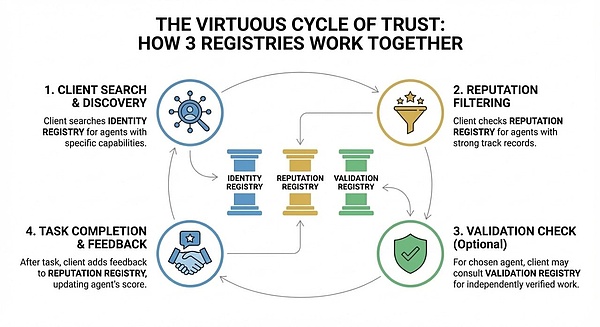
... As we've discussed before, the Ethereum Foundation established the Decentralized AI (dAI) team in September 2025, and Vitalik Buterin published a systematic AI strategic framework in early 2026. A series of protocol standards surrounding agent identity, payment, and execution are already running on the mainnet. Meanwhile, new public chain ecosystems like Solana are building AI infrastructure along their own paths. Therefore, this article attempts to outline the complete landscape of current crypto AI protocols, focusing on the Ethereum ecosystem and supplementing it with important developments from other public chains. I. Vitalik's AI Blueprint: Ethereum to be the "Trust Layer" of the AI World In February 2026, Vitalik Buterin published a systematic post on X, specifically revising his "Crypto × AI" cross-framework proposed two years prior. In his article, he re-examined the ideas he proposed two years ago, arguing that the accelerated push towards general artificial intelligence often resembles the unrestricted speed and scale challenged when Ethereum was created. He explicitly opposes simplifying AI development into an "AGI race," instead advocating that Ethereum should be a directional guide for the AI world. In other words, his real concern is not how to make AI spiral out of control faster, but how to ensure that AI expansion is built on verifiable, auditable, and constrained infrastructure. Overall, Vitalik's framework comprises four core pillars. First is trustworthy AI interaction tools. He advocates using tools such as local large language models (Local LLMs) and zero-knowledge proof payment mechanisms to allow users to use AI services without exposing their identity and raw data. This attitude goes beyond mere abstract expression. In April 2026, Vitalik publicly shared his local LLM usage solution. After testing multiple hardware setups, he chose to run the 35 billion-parameter open-source model Qwen3.5 locally on a computer equipped with an NVIDIA 5090 GPU, performing all calculations locally. His goal was to improve inference speed to a level usable in daily use and minimize reliance on cloud models. Of course, the symbolic significance of this event outweighs its practical significance, but it demonstrates that, at least in his view, the truly worthwhile direction for AI is not just stronger models, but more controllable models. Secondly, there's the economic coordination layer of AI. This includes Ethereum's ability to support inter-agent payments, security deposits, dispute resolution, and reputation building through smart contracts, enabling programmable economic relationships between machines. Thirdly, there's AI as the interface for Web3; for example, local AI assistants can help users draft transactions, audit smart contracts, and interpret formal verification proofs, becoming a bridge for ordinary people to enter the complex on-chain world. Finally, there's the AI-enhanced governance system, such as using AI to upgrade prediction markets, quadratic voting, and public fund allocation mechanisms, finding a balance between automation and human judgment. In summary, the core concept of this framework can be summarized in one sentence: Ethereum isn't about accelerating AI, but about enabling AI to operate in a verifiable, auditable, and decentralized environment. So how exactly will this be achieved? II. From Identity Protocols to Payment Protocols, to Execution Protocols, and to Verifiable AI If Vitalik's framework is the macro blueprint, then the recent wave of protocol evolution in the Ethereum ecosystem has begun to push this methodology into specific technology stacks. The first infrastructure node most noteworthy is ERC-8004. As Ethereum's standard for identity, reputation, and verification designed for AI Agents, it was spearheaded by the Ethereum Foundation's dAI team, in collaboration with Google, Coinbase, and MetaMask, and encompasses almost all three key entry points: AI, transactions, and wallets. As its official name suggests, Trustless Agents, its core logic isn't about complex algorithms, but rather about giving AI verifiable identities, reputations, and proofs of ability on the blockchain. In short, its design is very restrained, focusing on only three things: **Identity Registry:** Based on the ERC-721 standard, each AI Agent is "NFT-ified," meaning it can be viewed, referenced, and integrated into other protocols like a wallet address; **Reputation Registry:** Think of it as the "Yelp" of the AI world, allowing users who have actually interacted with the Agent or other Agents to submit feedback. These reviews can be linked to on-chain payments or escrow transactions, ensuring that reputation isn't a fabricated narrative but a historical record built on real economic activity; Verifying the registry: For high-value or high-risk tasks, historical reputation alone is insufficient. Therefore, ERC-8004 reserves a third-party verification interface, allowing endorsements of the Agent's capabilities or execution process through trusted execution environments, zero-knowledge proofs, and other methods. If identity answers the question "Who is the Agent?", then payment infrastructure, represented by the x402 protocol, answers the question "How does the Agent transact?". As is well known, x402 is an open HTTP payment protocol jointly initiated by Coinbase and Cloudflare. Its basic principle is ingenious: it revives the long-dormant 402 status code (Payment Required) in the HTTP protocol. When an agent attempts to access a paid service, the server returns a 402 status code and a payment request. The agent then completes the payment with stablecoins to gain access. The entire process is embedded in the HTTP request, requiring no account registration, no credit card, and no human intervention. In other words, it's a payment system designed for machines, not humans. It's worth noting that earlier this month, the Linux Foundation officially took over the x402 Foundation and accepted the x402 protocol contributed by Coinbase. The official statement is very clear: x402 aims to embed payments directly into HTTP interactions, allowing AI agents, APIs, and applications to exchange value like data. The author believes the importance of this news has been greatly overlooked. On one hand, there's the potential for x402's penetration and significant influence in AI and internet payments; on the other hand, there's the impressive lineup. While these giants have consistently been the ones promoting x402, this time the effect is clearly greater than the sum of its parts. Furthermore, x402's V2 version is also working to expand payment methods, including not only supporting on-chain stablecoins but also being compatible with traditional ACH (Automated Clearing House) and bank card networks, thus bridging the gap between AI Agents and the real-world financial system.

Finally, besides identity and payment, the third piece of the puzzle that Ethereum recently added is the execution layer.
In April 2026, Biconomy and the Ethereum Foundation's Improve UX direction jointly promoted ERC-8211, attempting to solve the most realistic bottleneck of AI Agents in the DeFi world. For example, complex on-chain operations are often not a single call, but a multi-step, dynamic, and easily failable execution chain.
We can essentially understand it as a "smart batch processing" mechanism specifically designed for AI agents and complex DeFi operations. In traditional on-chain operations, completing a complex DeFi strategy often requires multiple independent transactions: withdrawing funds from a lending protocol, exchanging tokens, and then depositing them into another protocol. Each step requires separate signature and confirmation, which is cumbersome for human users and a bottleneck for AI agents requiring high-frequency autonomous operations. The ERC-8211 solution allows multiple blockchain operations to be combined and executed in a single transaction. Each step dynamically parses the actual value during execution and must meet predefined conditions before proceeding to the next step. For example, an agent can complete the following in a single signed transaction: withdrawing funds from Aave → exchanging the received amount on Uniswap → depositing the exchange result into Compound—all executed atomically without the need to write new smart contracts. Looking at these three together, Ethereum's recent trajectory is quite clear: ERC-8004 answers "Who are you and why should others trust you?", x402 answers "How do you pay for services?", and ERC-8211 answers "How do you efficiently complete complex operations?". In other words, what the AI Agent economy truly lacks is not just a smarter, larger model, but an open, composable, and scalable protocol stack; and this is precisely what Ethereum excels at. III. Beyond Ethereum: Solana, DePIN, and Decentralized Computing Of course, even though Ethereum holds a leading position in standards setting and trust infrastructure, the AI crypto ecosystem is far more than just one chain. A more accurate statement is that Ethereum is vying for dominance in the standards and trust layers, while other ecosystems are demonstrating different advantages in the execution and computing power layers. Solana is the most typical example. Its growing presence in the agent payment discussion stems from the fact that AI agents' requirements for the blockchain are not based on ideological correctness, but rather on "low latency, low cost, and sufficient stability." Solana's official description of the x402 directly highlights its millisecond-level finality and extremely low transaction costs as key selling points for machine payments. This explains why Solana is better suited for high-frequency, small-amount agent interaction scenarios requiring immediate feedback. Meanwhile, the Agent toolchain surrounding Solana is also maturing rapidly. The official Solana Agent Kit GitHub allows Agents on any model to autonomously execute over 60 Solana actions, covering multiple scenarios such as transactions, token issuance, lending, airdrops, Blink, and cross-chain operations, and is being reused by numerous on-chain projects and developers. Therefore, from today's perspective, the division of labor in crypto AI is becoming clearer. Ethereum is more like providing the underlying abstraction for protocol standards, identity reputation, and trusted execution, while Solana holds a real advantage in high-frequency payments and low-friction interactions. The value of decentralized computing networks will also be repriced as more Agents enter production environments. Overall, looking back from April 2026, the landscape of encrypted AI protocols has begun to take shape: Identity Layer: ERC-8004, as the Ethereum-led Agent identity standard, has expanded to multiple chains such as Base; Payment Layer: x402 has grown from an experimental project at Coinbase to a global standard governed by the Linux Foundation; Execution Layer: Standards such as ERC-8211 simplify complex on-chain operations for Agents; Verification Layer: Technologies such as zkML, TEE, and cryptographic proofs are beginning to provide verifiability for high-value Agent interactions; Competitive Landscape: Ethereum serves as the standards and trust layer, Solana as the high-frequency execution layer, and Bittensor may also supplement it in terms of computing power and other dimensions, forming a complementary rather than zero-sum pattern; Looking ahead to the second half of the year, Ethereum's new upgrade will most likely drive L1 scaling, native account abstraction, and post-quantum security. The widespread adoption of account abstraction will undoubtedly significantly lower the barrier to entry for Agent wallets; the deep integration of x402 and ERC-8004 may also give rise to a closed-loop Agent economy, encompassing Agent identity registration, service discovery, payment initiation, and reputation accumulation, all completed on-chain. In conclusion, Ethereum and blockchain are not meant to accelerate the arrival of AI, but rather to ensure that when AI arrives, the world does not spiral out of control. In the Web2 world, AI's identity is defined by API keys from large companies, payments are handled by credit card systems, and trust is backed by centralized platforms. This system barely functions in scenarios with human users, but it's increasingly inadequate in the new paradigm where millions of AI agents need to collaborate autonomously 24/7. Ethereum, as a standard setter, Solana, representing a high-efficiency execution layer, and DePIN, supporting decentralized computing power, may build a completely new infrastructure for the AI Agent economy.