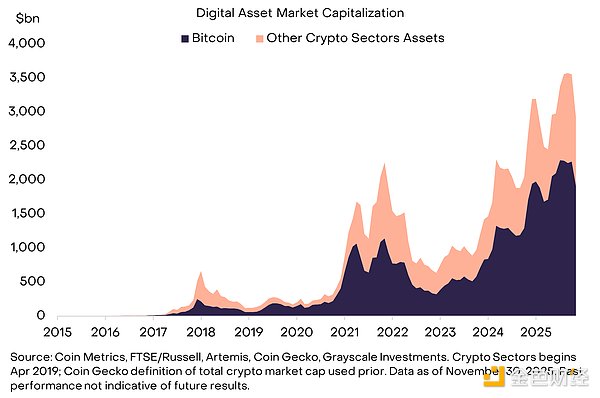
Chart 1: Cryptocurrencies have now become a mid-sized alternative asset class
Since the inception of cryptocurrencies, their valuations have experienced four significant cyclical declines, averaging once every four years (see Chart 2). Three of these cyclical valuation peaks occurred 1 to 1.5 years after a Bitcoin halving event, which also occurs every four years.
The current bull market has lasted for over three years, and the last Bitcoin halving occurred in April 2024, more than a year and a half ago. Therefore, some market participants generally believe that Bitcoin's price may have peaked in October, and 2026 will be a challenging year for cryptocurrency returns. Chart 2: 2026 Valuation Rise Will Mark the End of the "Four-Year Cycle" Theory
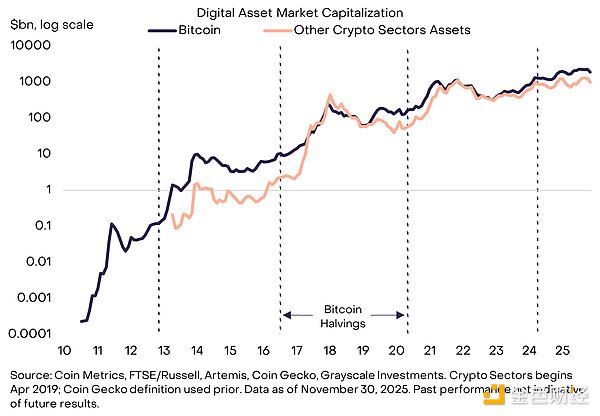
Grayscale believes that the crypto asset class is in a sustained bull market, and 2026 will mark the end of the four-year cycle.
Grayscale believes that the crypto asset class is in a sustained bull market, and 2026 will mark the end of the four-year cycle.
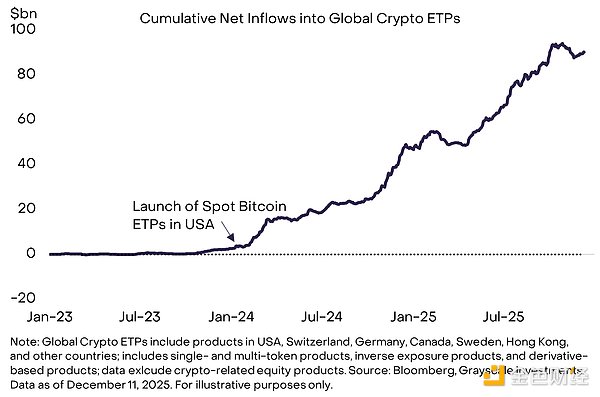
We expect valuations to rise across all six major cryptocurrency sectors in 2026, and we believe Bitcoin's price may surpass its previous high in the first half of 2026. Our optimism is based on two main pillars: First, macroeconomic demand for alternative stores of value will persist. Bitcoin and Ethereum, the two largest cryptocurrencies by market capitalization, can be viewed as scarce digital commodities and alternative monetary assets. Fiat currencies (and assets denominated in fiat currencies) face additional risks due to high and continuing public sector debt and its potential long-term inflationary impact (see Chart 3). Scarce commodities—whether physical gold and silver or digital Bitcoin and Ethereum—can serve as a hedge against fiat currency risk in portfolios. We believe that as long as the risk of fiat currency devaluation continues to rise, portfolio demand for Bitcoin and Ethereum is likely to continue to grow. Chart 3: US Debt Issues Raise Questions About the Credibility of Low Inflation. Secondly, regulatory clarity is driving institutional investment in public blockchain technology. It's easy to forget, but until this year, the US government had pending investigations and/or lawsuits against many leading cryptocurrency companies, including Coinbase, Ripple, Binance, Robinhood, Consensys, Uniswap, and OpenSea. Even today, exchanges and other cryptocurrency intermediaries still lack clear spot market guidelines. The ship has been slowly turning. In 2023, Grayscale won its lawsuit against the U.S. Securities and Exchange Commission (SEC), paving the way for spot crypto ETPs. In 2024, spot Bitcoin and Ethereum ETPs were launched. In 2025, Congress passed the GENIUS Act on stablecoins, and regulators shifted their stance on cryptocurrencies, working with the industry to provide clear guidance while continuing to focus on consumer protection and financial stability. Grayscale anticipates that Congress will pass bipartisan legislation on cryptocurrency market structures in 2026, which is likely to solidify the position of blockchain-based finance in the U.S. capital markets and encourage continued institutional investment (see Chart 4). Chart 4: Increased Funding May Be a Sign of Increased Institutional Confidence. We believe that new capital flowing into the crypto ecosystem is likely primarily from spot ETPs. Since the launch of Bitcoin ETPs in the US in January 2024, global net inflows into crypto ETPs have reached $87 billion (see Chart 5). Despite the early success of these products, the process of incorporating cryptocurrencies into mainstream portfolios is still in its early stages. Grayscale estimates that less than 0.5% of wealth managed in the US is allocated to crypto asset classes. This number is expected to grow as more platforms complete due diligence, refine their capital market assumptions, and incorporate cryptocurrencies into their model portfolios. Beyond managed wealth, some pioneers have already adopted cryptocurrency ETPs in their institutional portfolios, including Harvard Management and Mubadala (one of Abu Dhabi's sovereign wealth funds). We anticipate this list will grow significantly by 2026.
Chart 5: Continued Inflows into Spot Cryptocurrency ETPs
As cryptocurrency prices become increasingly driven by institutional capital inflows, the nature of their price movements is also changing.
In every previous bull market, Bitcoin's price rose by at least 1000% within a year (see Chart 6). This time, however, the maximum annualized increase in Bitcoin's price over the year since March 2024 is approximately 240%. We believe this difference reflects the greater stability of institutional buying in this cycle compared to the retail-driven price surges seen in previous cycles. While cryptocurrency investment involves significant risks, we believe that, as of this writing, the likelihood of a deep and prolonged cyclical decline in price is relatively low. Instead, we believe that a more stable upward trend in price is more likely next year, driven by institutional capital inflows. Chart 6: Bitcoin price did not experience a significant increase this cycle. A favorable macroeconomic environment may also limit some of the downside risk to the token price in 2026. The previous two cyclical peaks both occurred before the Fed's rate hikes (Chart 7). In contrast, the Fed cut rates three times in 2025 and is expected to continue cutting rates next year. Kevin Hassett, a potential successor to Jerome Powell as Federal Reserve Chairman, recently stated in an interview with "Face the Nation": "The American people can expect President Trump to choose someone who can help them get cheaper auto loans and easier access to low-interest mortgages." In general, economic growth and the Fed's generally supportive policies should align with investors' favorable risk appetite and the potential returns of risky assets, including cryptocurrencies. Chart 7: Past cyclical peaks have been associated with Fed rate hikes. Like all other asset classes, cryptocurrency price movements are driven by both fundamentals and capital flows. Commodity markets are cyclical, and cryptocurrencies may also experience cyclical declines at some point in the future. However, we believe this situation will not occur in 2026. The fundamentals remain robust: we expect continued macroeconomic demand for alternative stores of value, and a clearer regulatory environment will drive institutional investor investment in public blockchain technologies. Furthermore, new funds are still flowing into the market: by the end of next year, cryptocurrency ETPs are likely to appear in more portfolios. This cycle has not seen large-scale retail demand, but rather sustained buying of cryptocurrency ETPs from various portfolios. Supported by the overall macroeconomic environment, we believe these conditions will drive the cryptocurrency asset class to new highs in 2026.II. Top Ten Crypto Investment Themes for 2026
Cryptocurrencies are a diversified asset class reflecting a variety of applications of public blockchain technology. The following sections outline Grayscale's views on the ten most important cryptocurrency investment themes for 2026, as well as two "less important" themes. For each theme, we list the tokens we consider most relevant.
Topic 1: Dollar Depreciation Risk Drives Demand for Alternative Currencies
Related Crypto Assets: BTC, ETH, ZEC
The US economy faces debt problems (see Chart 3), which could ultimately weaken the dollar's status as a store of value. Other countries face similar issues, but the dollar is the world's primary international currency, making the credibility of US policy more important for potential capital flows. We believe that a small subset of digital assets can be considered viable stores of value due to their high penetration, decentralization, and limited supply growth. This includes the two largest crypto assets by market capitalization: Bitcoin and Ethereum. Similar to physical gold, their utility stems in part from their scarcity and autonomy.
Bitcoin has a capped supply of 21 million and is entirely programmatically controlled. For example, we can confidently predict that the 20 millionth Bitcoin will be mined in March 2026.
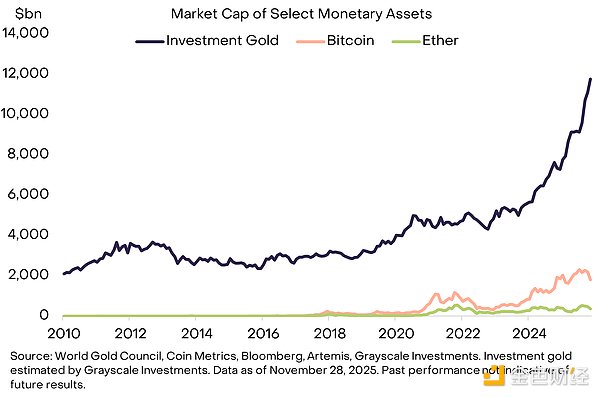
A digital currency system with a transparent, predictable, and ultimately scarce supply is a simple concept, but it is gaining popularity in today's economy due to the tail risk of fiat currencies. As long as macroeconomic imbalances that contribute to fiat currency risk continue to worsen, portfolio demand for alternative stores of value is likely to continue to grow (Chart 8). Zcash, a smaller, decentralized digital currency with privacy features, may also be suitable for investors allocating portfolios to hedge against dollar depreciation (see Theme 5). Chart 8: Macroeconomic Imbalances Can Drive Demand for Other Stores of Value
Topic Two: Clarity of Regulatory Policies Helps Promote the Popularization and Application of Digital Assets
Related Crypto Assets: Almost All
By 2025, the United States has made significant progress in cryptocurrency regulation, including passing the GENIUS Act (for stablecoins), rescinding the SEC's Accounting Notice No. 121 on custody, introducing a common listing standard for crypto ETPs, and addressing the issue of the cryptocurrency industry accessing traditional banking services (see Chart 9).
Next year, we anticipate another significant step forward with the passage of a bipartisan market structure bill. The House passed its version of the bill, the Clarity Act, in July, and the Senate has initiated the process. While many details remain to be finalized, the bill, in general, provides a set of traditional financial rules for the cryptocurrency capital market, including registration and disclosure requirements, crypto asset classification, and insider rules. In practice, a more robust regulatory framework for crypto assets in the U.S. and other major economies would mean that regulated financial services firms could include digital assets on their balance sheets and begin trading on the blockchain. This could also foster on-chain capital formation, enabling both startups and established companies to issue regulated tokens. By further unlocking the full potential of blockchain technology, regulatory clarity should contribute to the growth of the entire crypto asset class. Given the potentially crucial role regulatory clarity can play in driving the development of the crypto asset class by 2026, we believe that the bipartisan disagreement in the legislative process should be viewed as a downside risk. Chart 9: Significant Progress Made in Regulatory Policy Clarity in the US by 2025 [Image 1] [Image 2] Theme 3: The GENIUS Act Will Drive the Expanding Influence of Stablecoins 192);">Related Crypto Assets: ETH, TRX, BNB, SOL, XPL, LINKStablecoins experienced explosive growth in 2025: circulating supply reached $300 billion, monthly trading volume reached $1.1 trillion in the six months ending November, the US Congress passed the GENIUS Act, and a large influx of institutional capital into the industry (Chart 10). We expect to see tangible results in 2026: stablecoins will be integrated into cross-border payment services, used as collateral in derivatives exchanges, appear on corporate balance sheets, and become an alternative to credit cards in online consumer payments. Continued growth in the prediction market may also drive new demand for stablecoins. Higher stablecoin trading volumes will benefit the blockchains recording these transactions (such as ETH, TRX, BNB, and SOL), as well as various supporting infrastructures (such as LINK) and decentralized finance (DeFi) applications (see Topic #7). Chart 10: Stablecoins Usher in a Time of Explosion
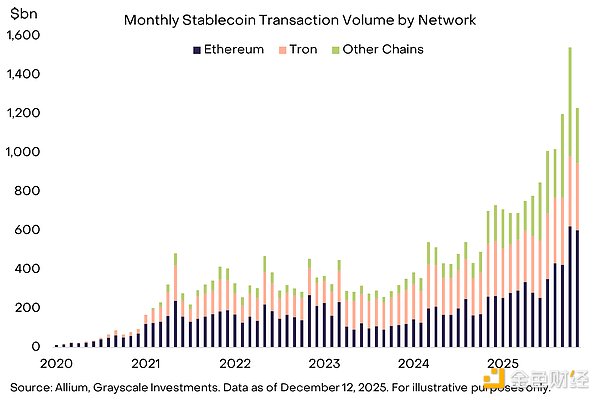
Theme Four: Asset Tokenization at a Turning Point
Related Crypto Assets: LINK, ETH, SOL, AVAX, BNB, CC
Tokenized assets are currently very small: accounting for only 0.01% of the total market capitalization of global stocks and bonds (Chart 11). Grayscale predicts that asset tokenization will grow rapidly in the coming years, thanks to the increasing maturity of blockchain technology and the increasingly clear regulatory environment.
We believe it's not impossible for the scale of tokenized assets to grow by approximately 1000 times by 2030. This growth could bring value to blockchains that process tokenized asset transactions and various related applications. Currently, leading tokenized asset blockchains include Ethereum (ETH), BNB Chain (BNB), and Solana (SOL), but this list may change over time. In terms of related applications, Chainlink (LINK) demonstrates particularly strong competitiveness due to its unique software technology suite. Chart 11: Huge Growth Potential for Tokenized Assets [Image of chart 11: https://img.jinse.cn/7421421_watermarknone.png] Topic 5: Privacy Solutions Are Imperative as Blockchain Technology Goes Mainstream Privacy is an Inevitable Thing Privacy is an inherent part of the financial system: almost everyone expects their wages, taxes, net worth, and spending habits not to be publicly disclosed on a public ledger. However, most blockchains are transparent by default. If public blockchains are to integrate more deeply into the financial system, stronger privacy infrastructure is needed—and this is becoming increasingly clear as regulation pushes for this integration. Investor focus on privacy could benefit projects like Zcash (ZEC), a decentralized cryptocurrency similar to Bitcoin with privacy-preserving features; Zcash saw a significant appreciation in Q4 2025 (see Chart 12). Other key projects include Aztec, an Ethereum Layer 2 protocol focused on privacy, and Railgun, a privacy-focused middleware for DeFi. We may also see increasing adoption of confidential transactions on leading smart contract platforms such as Ethereum (using the ERC-7984 protocol) and Solana (using the Confidential Transfers token extension). More robust privacy tools may also require stronger identity and compliance infrastructure for DeFi. Chart 12: Cryptocurrency Investors Pay More Attention to Privacy Features [Image of chart 12: Chart ... Decentralized AI development platforms like Bittensor aim to reduce reliance on centralized AI technologies; verifiable identity verification systems like World can distinguish between humans and intelligent agents in synthetic worlds; and networks like Story Protocol provide transparent and traceable intellectual property rights as it becomes increasingly difficult to identify the source of digital content. Meanwhile, tools like X402—an open, zero-fee stablecoin payment layer supporting platforms like Base and Solana—enable low-cost, instant micropayments for economic interactions between intelligent agents or between machines and humans. These components collectively constitute the early infrastructure of the “proxy economy,” where identity, computation, data, and payments must all be verifiable, programmable, and censorship-resistant. Although the convergence of cryptography and AI is currently in its early stages and uneven, it has already spawned one of the most compelling long-term use cases in the field, and protocols building true infrastructure are expected to benefit as AI becomes increasingly decentralized, autonomous, and economically active (Chart 13). Chart 13: Blockchain provides solutions to some risks brought by artificial intelligence. [Image of chart 13: Chart ... The growth of stablecoins and tokenized assets is a significant success story, and DeFi lending has also seen substantial growth, with platforms like Aave, Morpho, and Maple Finance performing exceptionally well (see Chart 14). Meanwhile, decentralized perpetual futures exchanges like Hyperliquid have seen continued growth in open interest and daily trading volume, rivaling some of the largest centralized derivatives exchanges. Looking ahead, the increasing liquidity, interoperability, and correlation with real-world prices of these platforms will make DeFi a reliable option for users looking to conduct financial transactions directly on-chain. We anticipate more DeFi protocols integrating with traditional fintech companies to leverage their infrastructure and large user base. We expect core DeFi protocols to benefit, including lending platforms like AAVE, decentralized exchanges like UNI and HYPE, related infrastructure like LINK, and blockchains supporting most DeFi activity (such as ETH, SOL, and BASE). Chart 14: DeFi Scale and Diversity Continue to Grow [Image of chart 14: Chart ... Not all high-performance blockchains today will follow a similar trajectory, but we expect some to. Superior technology doesn't guarantee widespread adoption, but the architecture of these next-generation networks makes them perfectly suited for emerging fields such as AI-powered micropayments, real-time game loops, high-frequency on-chain transactions, and intent-based systems. Among these projects, we expect Sui to stand out with its technological advantages and all-encompassing development strategy (see Chart 15). Other promising projects include Monad (parallelized EVM), MegaETH (ultra-fast Ethereum L2 cache), and Near (an AI-focused blockchain whose Intents product has already achieved success). Chart 15: Next-Generation Blockchains Like Sui Offer Faster, Cheaper Transactions. [Image of chart 15: Chart ... Of these metrics, Grayscale considers transaction fees to be the most valuable fundamental element because they are the most difficult to manipulate and the most comparable across different blockchains (they also provide the best empirical fit). Transaction fees are analogous to "revenue" in traditional corporate finance. For blockchain applications, it may also be important to differentiate between protocol fees/revenue and "supply-side" fees/revenue. As institutional investors begin allocating funds to the cryptocurrency space, we expect them to focus on blockchains and applications with high and/or growing fee revenues (excluding Bitcoin). Smart contract platforms with relatively high revenues include TRX, SOL, ETH, and BNB (Chart 16). Application-layer assets with relatively high revenues include HYPE and PUMP, among others. Chart 16: Institutional Investors May Carefully Examine Fundamentals [Image of chart 16: Chart ... These guidelines regarding liquidity staking services are likely to benefit leading TVL-based liquidity staking protocols like Lido and Jito on Ethereum and Solana. More broadly, the fact that crypto ETPs can be staked will likely make them the default structure for holding Proof-of-Stake (PoS) token investment positions, leading to higher staking ratios and higher reward rates (Chart 17). In an environment where staking is more widely adopted, custodial staking via ETPs will provide a convenient way to earn rewards, while on-chain non-custodial liquidity staking offers composability advantages in DeFi. We expect this dual structure to persist for some time. Chart 17: Proof-of-Stake Tokens Offer Native Rewards [Image of chart 17: https://img.jinse.cn/7421436_watermarknone.png] Two Themes Not Important in 2026 We expect all the investment themes mentioned above to contribute to the development of the cryptocurrency market in 2026. There are two hot topics that we do not expect to have a substantial impact on the cryptocurrency market next year: the vulnerability of quantum computing to cryptography and the evolution of digital asset treasuries (DATs). While these topics will generate widespread discussion, we believe they are not central to the market outlook. If quantum computing technology continues to develop, most blockchains will eventually need to upgrade their cryptography. Theoretically, a sufficiently powerful quantum computer can derive a private key from a public key, and then generate a valid digital signature for paying users' cryptocurrencies. Therefore, Bitcoin and most other blockchains—and virtually everything else in the economy that uses cryptography—will eventually need to be upgraded to accommodate post-quantum era tools. However, experts estimate that a quantum computer capable of breaking Bitcoin's cryptography is not expected until 2030 at the earliest. Quantum risk research and community responses may accelerate in 2026, but we believe this topic is unlikely to impact prices. The situation is similar for DAT. Michael Saylor's pioneering strategy of incorporating digital assets into company balance sheets spawned dozens of imitators in 2025. We estimate that DAT holds 3.7% of Bitcoin, 4.6% of Ethereum, and 2.5% of SOL. Demand for these assets has declined from its mid-2025 peak: the current largest DAT by market capitalization has a price-to-book ratio (mNAV) close to 1.0 (see Chart 18). However, most DATs are not highly leveraged (or even completely unleveraged), so they are unlikely to be forced to liquidate assets during market downturns. DAT Strategy, the largest cryptocurrency investment firm by market capitalization, recently raised a dollar reserve fund to continue paying preferred stock dividends even if Bitcoin prices fall. We expect most DATs to operate similarly to closed-end funds, trading at a premium or discount to their net asset value, with infrequent asset liquidations. We believe these instruments are likely to become a long-term component of the cryptocurrency investment space, but are unlikely to be a major source of new token demand or selling pressure in 2026. Chart 18: DAT Premium Has Narrowed, But Asset Sale Is Unlikely. [Image of DAT premium narrowed but asset sale unlikely] III. Conclusion We anticipate a bright future for digital assets in 2026, primarily driven by macroeconomic demand for alternative stores of value and increased regulatory transparency. Next year, the integration of blockchain finance with traditional finance is expected to further increase, attracting substantial institutional capital inflows. Tokens with clear application scenarios, sustainable revenue streams, and access to regulated exchanges and applications are likely to gain favor with institutional investors. Investors can expect a continuous expansion of the types of crypto assets available through ETPs, with staking functionality receiving as much support as possible. At the same time, greater regulatory clarity and institutional acceptance may raise the bar for cryptocurrency projects entering the mainstream market. For example, cryptocurrency projects may need to meet new registration and disclosure requirements to be listed on regulated exchanges. Institutional investors may also overlook crypto assets without a clear purpose—even those with relatively high market capitalization. The GENIUS Act clearly distinguishes between regulated payment stablecoins (which enjoy specific rights and obligations under U.S. law) and other stablecoins (which do not enjoy the same rights). Similarly, we expect the institutionalization of cryptocurrencies to create a more pronounced differentiation between assets that can access regulated markets and institutional capital and those that cannot. Cryptocurrencies are entering a new era, and not all tokens will successfully transition from the old era to the new.


 Anais
Anais
