Golden Web 3.0 Daily | Crypto Market Structure Bill Expected to Pass This Year
Golden Finance has launched the "Golden Web3.0 Daily" to provide you with the latest and fastest MEME, DeFi, DAO, NFT and metaverse industry news.
 JinseFinance

Author: Jack Inabinet, Bankless Analyst; Translator: @JinseFinancexz
The cryptocurrency market may have finally received its long-awaited outcome—a standardized market structure, thanks to the Digital Asset Market Clarity Act (DAMCA). This bill makes several noteworthy compromises regarding the future direction of cryptocurrencies in the United States, thus winning bipartisan support.
This 278-page bill establishes a regulatory framework that divides the regulatory power over digital assets between the SEC and CFTC, the result of months of intense negotiations between Senate Republicans and Democrats (and industry lobbyists). The crypto community is bound to have a complex reaction to some of its provisions. Paradigm's policy director, Justin Slaughter, called the bill "a major victory for Senate Banking Committee Democrats" and believes it could have passed during the Biden administration.
Today, we will delve into the five key provisions of this bill to better understand the future evolution of the cryptocurrency market structure. 1. Prohibition of Interest-Bearing Stablecoins According to the DAMCA, stablecoin issuers will be prohibited from distributing returns to passive holders. Chapter 4 of the DAMCA (which clarifies the rules for interaction between regulated banking institutions and digital assets) prohibits stablecoin issuers (as defined in the GENIUS Act) from paying interest to holders. While the bill allows stablecoin issuers to offer rewards linked to specific operations (such as account opening incentives and cashback benefits), it's important to note that protecting stablecoin returns has always been a "red line" adhered to by the crypto industry. Strict restrictions on stablecoins could put native crypto issuers at a long-term disadvantage when competing with the banking sector. However, it is noteworthy that several key players in the crypto industry, including Coinbase, surprisingly support the bill's clause prohibiting stablecoins from generating interest, arguing that it is the least favorable clause acceptable without undermining the bill's momentum.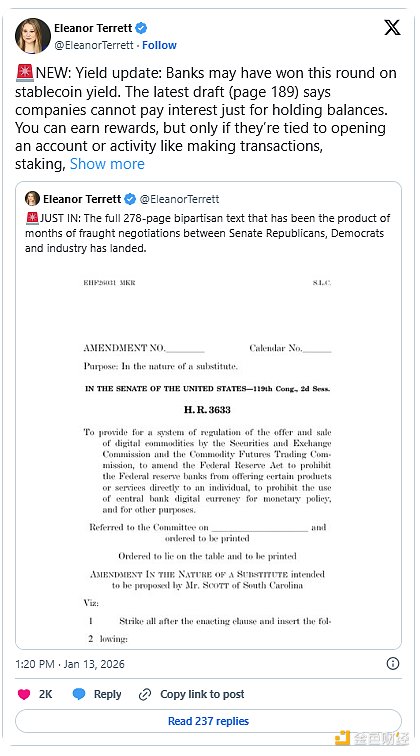
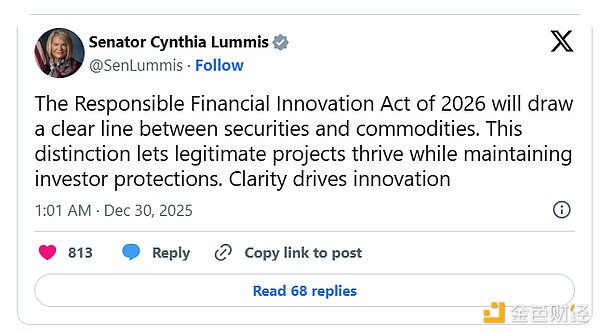
The Responsible Financial Innovation Act (DAMCA) Chapter 1, jointly proposed by U.S. Senators Cynthia Lummis and Kirsten Gillibrand, would amend the Securities Act of 1933 to clarify the criteria for recognizing cryptocurrencies as commodities rather than securities.
Chapter 3 of the DAMCA defines the "decentralized" characteristics of decentralized finance, clarifying under what circumstances crypto projects can be considered truly "decentralized". According to the definition in this section, a decentralized protocol allows users to conduct financial transactions based on "pre-defined and non-discretionary automated rules or algorithms," and the protocol does not rely on any individual other than the user to exercise custody or control over their digital assets. The criteria for identifying a "non-decentralized financial transaction protocol" apply to protocols where any of the following conditions exist: an individual or group can control or modify the application's functionality; the application is not entirely code-based; or an individual or group can restrict, censor, or prohibit user activity. Non-decentralized protocols must comply with the Securities Exchange Act of 1934 and the Bank Secrecy Act, meaning they will face entirely new registration, code of conduct, information disclosure, record keeping, and regulatory requirements. While this section may unify the applicable standards of securities law across different technical fields and protect the public interest, its regulatory scope may also cover non-immutable smart contract protocols (including protocols designed based on multi-signature technology or trusted encryption environments) even those with only minimal operator control. It is noteworthy that Chapter 3 does indeed include an important exemption clause: allowing the protocol's "Security Committee" to take "predefined, temporary, rules-based cybersecurity emergency measures" in response to security incidents such as hacking attacks, without affecting its decentralized state. However, it is also worth noting that Chapter 3 imposes compliance requirements on "web-custodied" crypto wallets that allow users to interact with blockchain technology, mandating that such intermediaries comply with sanctions and anti-money laundering regulations. Confusingly, however, this regulation explicitly does not apply to "any software or hardware wallet that provides digital asset custody services to individuals."
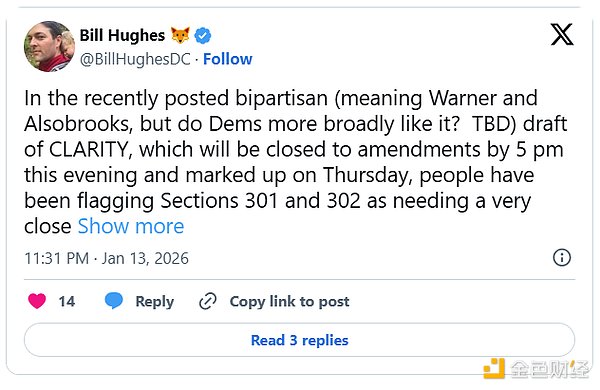
The DAMCA will require the Commodity Futures Trading Commission and the Securities and Exchange Commission to jointly establish a "Micro-Innovation Sandbox" within 360 days of the bill's enactment. This sandbox aims to "allow 10 qualified companies to conduct innovative business testing within the United States," and the testing activities must comply with applicable federal and state securities and commodity laws.
To participate in the Sandbox program, applicants must meet the following criteria: They must plan to conduct legitimate innovative business activities within the United States, and their number of employees must not exceed 25 in any fiscal year, with total revenue not exceeding $10 million. All applications must receive joint approval from the CFTC and SEC to enter the Sandbox. Participants will receive regulatory exemptions, but both commissions may revoke such exemptions at their discretion at any time. When regulatory jurisdiction is involved, Sandbox participants must meet the disclosure requirements of both regulatory agencies. Regulatory exemptions obtained through this program take precedence over any state-level securities or commodity registration requirements. The program accepts only 20 applications annually, and the total funds of selected companies' clients, investors, or counterparties must not exceed $20 million.
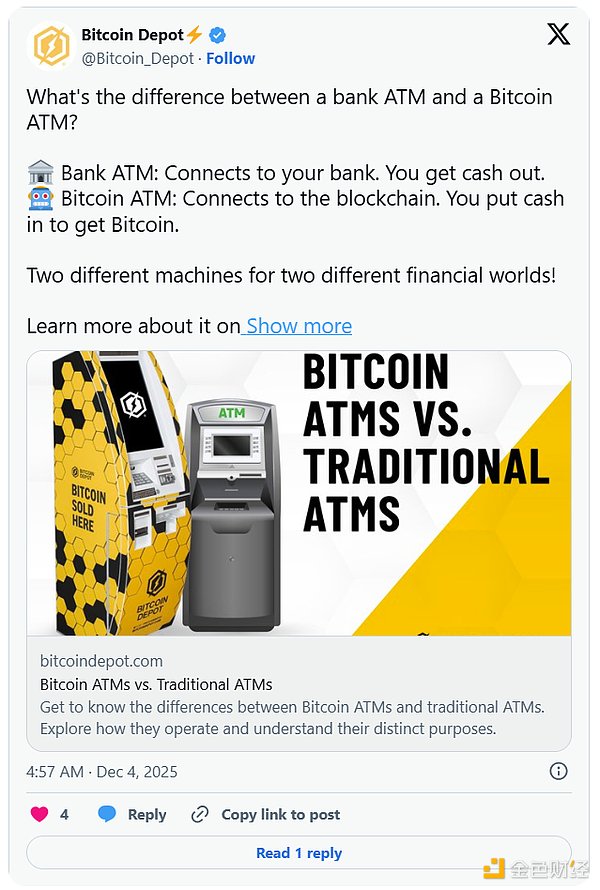
Perhaps most surprising is that the DAMCA (Digital Asset Management Act) devotes considerable space to regulating digital asset terminals (such as Bitcoin ATMs).
According to Section 205 of the DAMCA, digital asset terminals will be classified as "funds transfer institutions," meaning that operators of these cash-to-crypto asset exchange equipment will face a significant regulatory burden.
Operators are required to submit a detailed list of their digital asset terminals to the Secretary of the Treasury every 90 days, including (but not limited to): the operator's legal name, business name, physical address of each terminal, and types of crypto assets supported by the terminal. Before transacting with customers, digital asset terminal operators must publicly display their terms of service and a series of government-mandated consumer risk warnings in an easily readable manner. Digital asset terminals must provide customers with detailed transaction records and implement anti-fraud controls to prevent the transfer of assets to wallet addresses known to be involved in fraudulent activities. The Secretary of the Treasury will also be authorized to set daily deposit and withdrawal limits for digital asset terminals. Before this authority is exercised, digital asset terminal operators may not conduct transactions with "new customers" exceeding $3,500 in any 24-hour period.
Golden Finance has launched the "Golden Web3.0 Daily" to provide you with the latest and fastest MEME, DeFi, DAO, NFT and metaverse industry news.
JinseFinance Coinlive
 Leading Metaverse projects showed sustained activity in Q3. Only a minor decrease in sales for top metaverse projects.
 Beincrypto
The crypto market is seeing another week in the red with Bitcoin, Ethereum, and larger cryptocurrencies trading to the downside over the past 7 days.
 BitcoinistBeincrypto
A provision of the crypto bill delegated oversight of some cryptocurrencies to the U.S. Commodity Futures Trading Commission (CFTC), and the CFTC chief said they were concerned about "vigorous regulation of the market."
 Cointelegraph
Investments in blockchain initiatives have been patchy, but GameFi is one industry that is sustaining development despite the market's decline. ...
BitcoinistThe drawdown in the crypto market has seen new trends emerge in the market. With the recent crash, bitcoin has ...
BitcoinistThe Treasury Department is seeking industry and public input on how to regulate digital assets by March 18.
CointelegraphThe cryptocurrency industry is responding to the best-practices advocacy group’s call for a fair, stable and regulated market.
Cointelegraph