Ethereum vs. Solana: Advantages and Challenges
This article compares Ethereum and Solana, exploring their strengths and weaknesses. We hope that readers will gain a clearer understanding of the uniqueness of each platform.
 JinseFinance

Author: Andrew Throuvalas; Compiler: Vernacular Blockchain
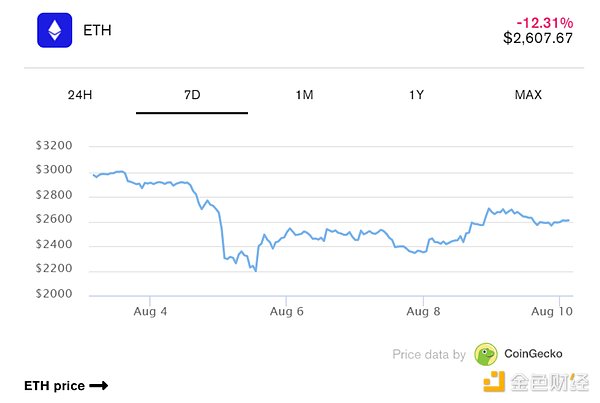
Despite Ethereum’s enthusiastic reception from Wall Street, the price of Ether (ETH) has failed to keep pace with rival cryptocurrencies this cycle.
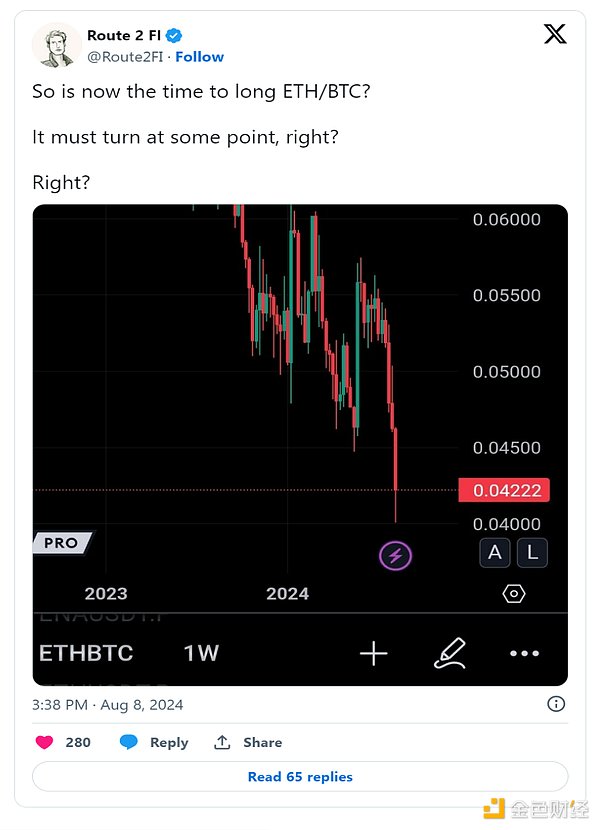
As the cryptocurrency market fell sharply on Sunday, the ETH to BTC exchange rate reached a yearly low of 0.041, according to data from TradingView. Although digital assets, including ETH, have made a solid recovery since then, the ratio remains at 0.043 at the time of writing.
Many can’t help but find this trend unusual. In bull market years, when the dominant digital asset that has received inflows of funds flows from Bitcoin to riskier small-cap assets, it has been common for alternative tokens to surpass Bitcoin. In fact, in Bitcoin’s first quarter rally, alternative tokens like Solana and meme coins like PEPE and WIF have proved this point, but ETH has not.
Financial analyst Wesley Kress wrote on Twitter on Tuesday: "This shift challenges the long-held belief that network effects alone can sustain Ethereum's dominance. Ethereum has performed poorly this cycle, and I think people are realizing it is not the future."
However, some other analysts believe that this pessimistic view is exaggerated. They say time will be Ethereum's best friend, especially if the new Ethereum spot ETF has time to take root.
"There is too much hype about the immediate impact this ETF may have on the price, and right now, there is too much panic," cryptocurrency influencer Crypto Kaleo said on Thursday. He noted that the Ethereum ETF has been live for 12 days, which is exactly how long it took Bitcoin to bottom out and rebound after the launch of its own ETF in January.
In theory, the launch of an ETF is bullish for Ethereum prices because it enables various institutions to buy Ethereum that might otherwise be restricted by regulation.
However, according to Jonathan Bier, chief investment officer at FarsideUK, an ETF may not bring Ethereum the same degree of success as Bitcoin.
“A big part of the success will be driven by people and entities moving their existing [Ethereum Trust] holdings into the ETF,” Bier told Decrypt. Grayscale’s Ethereum reductions may be more severe than Bitcoin’s, he said, because investors need to consider capital gains taxes when selling their Ethereum Trust shares.
“At the same time, Ethereum investors are less loyal than Bitcoin investors,” he added. “Ethereum investors are always looking for the latest thing with the latest technology.”
Throughout the year, Solana has outperformed Ethereum on key metrics related to network activity. In late July, Solana surpassed Ethereum’s total transaction fees for the first time.
Additionally, several market-related on-chain metrics also show investors’ interest in Ethereum wavering alongside Bitcoin. According to CryptoQuant, Bitcoin’s “realized market cap” — a measure of the size of new investor flows into Bitcoin — has increased by $187 billion so far this year, compared to Ethereum’s $127 billion.
“Bitcoin has outperformed Ethereum on certain fundamental network metrics,” Julio Moreno, head of research at CryptoQuant, told Decrypt. “For example, the ratio of the number of transactions in the Ethereum network to the number of transactions in the Bitcoin network also decreases as the ETH/BTC price ratio decreases.”
This article compares Ethereum and Solana, exploring their strengths and weaknesses. We hope that readers will gain a clearer understanding of the uniqueness of each platform.
JinseFinanceMany people still confuse FHE with ZK and MPC encryption technologies, so this article will compare these three technologies in detail.
JinseFinanceSolana’s “Actions and Blinks” simplify transactions and voting operations through browser extensions, while Farcaster on Ethereum enhances social network interoperability and user data privacy protection through decentralized protocols.
JinseFinanceAdvantages and challenges of Solana Actions & Blinks vs. Ethereum Farcaster & Lens.
JinseFinanceThere are two basic approaches to "parallelism": shared memory and message passing. AO's innovation lies in applying message passing to blockchains and smart contracts.
JinseFinanceWhat do you think of the debate between the two founders @zksync and @solana about the future of "single/multi-chain ecology"?
JinseFinanceETH, SOLANA, ETH vs Solana: Ethereum’s unique advantages and future strategies Golden Finance, Ethereum currently has long-lasting advantages that cannot be copied.
JinseFinance NulltxNulltx
Under the Crypto Browser project initiative, Opera’s multichain compatibility aims to ease the introduction of Web3 to more than 380 million mobile and desktop users worldwide.
 Cointelegraph