The value of a blockchain network depends on the scale of economic activity it supports.
For many years, Arbitrum has consistently adhered to this core logic: building a robust application ecosystem, providing development space for new projects, and encouraging innovative attempts within the ecosystem.
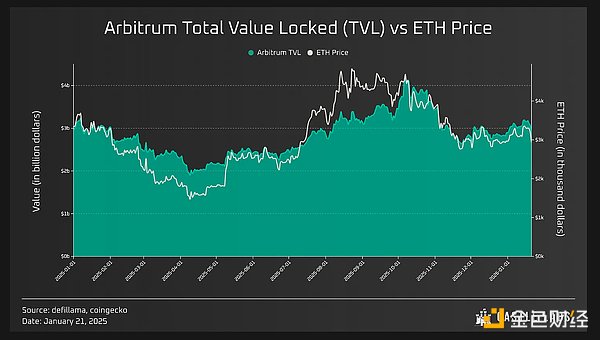
In early October 2025, Arbitrum's Total Value Locked (TVL) reached an all-time high, increasing by 42% from the beginning of 2025. Currently, this metric has fallen back to levels close to its peak.
The reason for this pullback is the October liquidation event, which is well-known to cryptocurrency traders.
Despite the impact of this event, which caused the prices of assets such as Ethereum and Bitcoin to fall by about 38% and 28% respectively from their historical highs, Arbitrum has kept its total value locked at approximately $3 billion, a level not seen before.
Total value locked only gives us a macro-level understanding of the ecosystem. Next, we will focus on the core areas where Arbitrum achieves growth through data:
Establishing deep cooperation with traditional companies such as Robinhood to promote the on-chain issuance of equity assets;
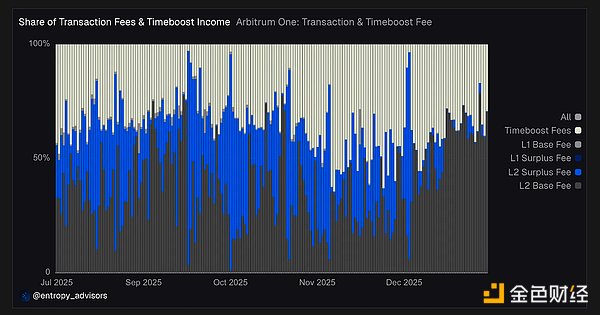
Launching Timeboost
Data source: https://dune.com/entropy_advisors/arbitrum-one-network-overview
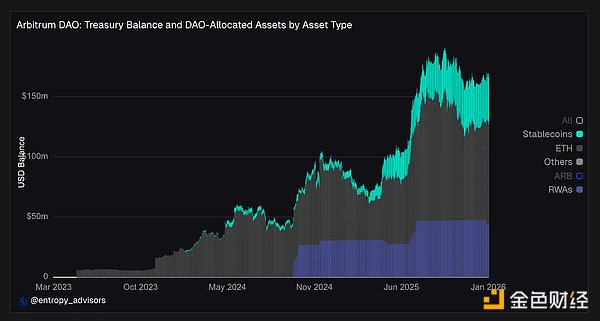
Timeboost's revenue contribution, coupled with the overall growth in network activity, not only increased Arbitrum's revenue scale but also boosted the growth of DAO treasury funds.
The revenue contribution of Timeboost, combined with the growth of overall network activity, not only increased Arbitrum's revenue scale but also boosted the growth of DAO treasury funds.
Data source: https://dune.com/entropy_advisors/arbitrum-dao-treasury
Diversified revenue streams have driven the expansion of treasury funds and asset diversification, while the strategic deployment of funds has further enhanced the activity of the ecosystem. In addition, the DAO grant program has provided support for the implementation and innovative attempts of new on-chain products, and built a platform for the practice of various new ideas.
Data source: https://dune.com/entropy_advisors/arbitrum-rwa-case-study
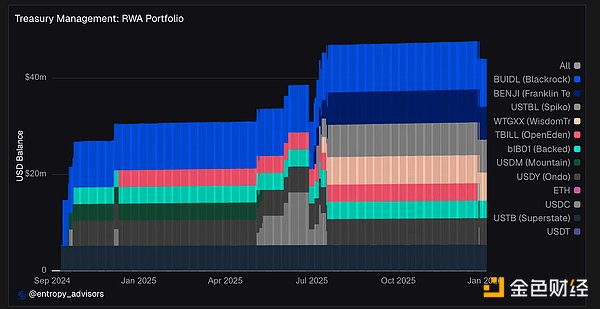
To support the continued growth of the real-world asset sector, Arbitrum DAO has allocated approximately $44 million from the Treasury to invest in various asset-related projects, including BlackRock BUIDL, Franklin Templeton BENJI, and Ondo USDY. These investments are all part of the Stable Treasury Endowment Program (STEP) and have generated $1.78 million in accrued interest to date.
Data source: https://dune.com/entropy_advisors/arbitrum-rwa-case-study
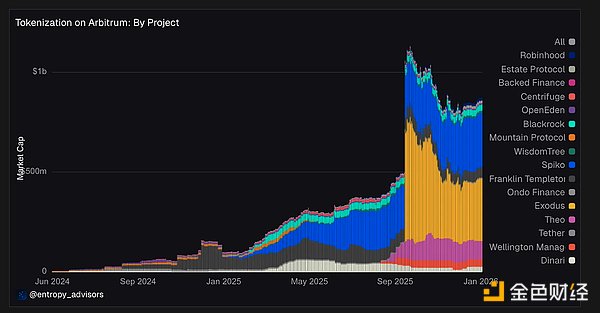
Arbitrum's tokenized equity assets are primarily contributed by Exodus, while the partnership with Robinhood in July 2025 further fueled the growth of this sector: Robinhood completed the tokenization of over 1,900 assets on Arbitrum, with a tokenization scale of $16 million, including key listings such as Google and MicroStrategy options return strategies.
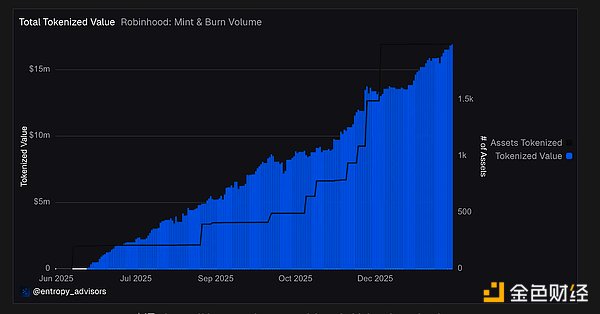
Data source: https://dune.com/entropy_advisors/robinhood-stock-tokens
Furthermore, Arbitrum needs to establish a strong position in alternative assets such as stocks and commodities—assets with a wider audience and a larger corresponding market size.
Tokenization of fund assets is a significant breakthrough, while the on-chaining of highly liquid assets from traditional markets can add a new dimension of value to the network.
As the scale of these assets on-chain expands and the efficiency of transactions and circulation improves, it will naturally drive the prosperity of network economic activities. The DeFi Renaissance Incentive Program (DRIP) aims to activate the entire chain ecosystem. To this end, Arbitrum launched one of its largest incentive programs ever—DRIP—with the core objective of stimulating on-chain economic growth. Unlike previous indiscriminate incentive programs, DRIP precisely targets incentive resources to core assets and leading protocols. This section will detail the program's current implementation results, operating mechanism, covered protocols and assets, and its supporting role in ecosystem development. DRIP is scheduled to officially launch in September 2025, with a total scale of 80 million ARB tokens, implemented in four phases. The first phase is currently underway, starting on September 3, 2025 and ending on February 17, 2026. A total of 24 million ARB tokens have been allocated as incentive funds (including 8 million ARB freely disposable funds). The funds will primarily incentivize lending and borrowing businesses that generate interest on Ethereum and stable assets in leading lending protocols such as Aave, Morpho, Fluid, Euler, Dolomite, and Silo.
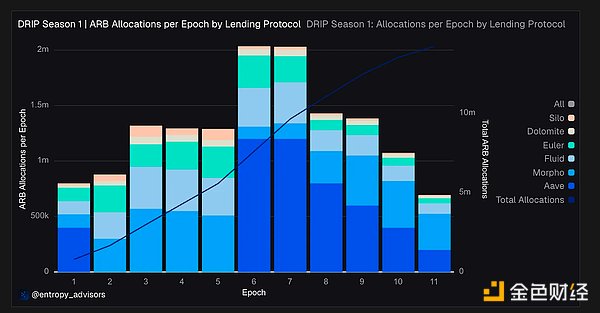
Data source: https://dune.com/entropy_advisors/drip-season-1-arbitrum-network
The first phase plan is divided into multiple cycles (1 cycle = 2 weeks), with each cycle having a clear focus:
Exploration cycle (2 cycles): Conduct market research, analyze the performance of various agreements under incentive mechanisms, and select high-quality agreements;
Performance cycle (6 cycles) (1) Based on the results of preliminary research, optimize the allocation of incentive funds and provide precise support for high-quality agreements;
Phase-off cycle (4): Gradually reduce the scale of incentives to test the lock-up and activity retention capabilities of agreements without strong incentives.
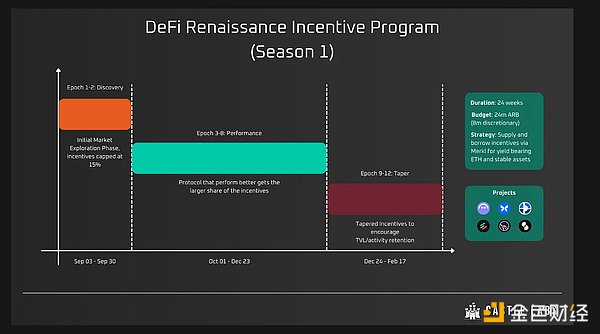
The effectiveness of the DRIP plan
The DRIP plan is a typical case of precisely incentivizing core areas and assets and promoting economic growth. At the outset of the initiative, the market size of incentivized lending protocols was $2.55 billion, which has now increased to $2.91 billion, a 14% increase, and is projected to peak at $3.36 billion by the end of October 2025. It is noteworthy that despite a more than 30% drop in Ethereum's price after the initiative's launch, the market size of incentivized lending protocols remained stable, fully demonstrating the importance of incentive mechanisms for ecosystem stability during market downturns.
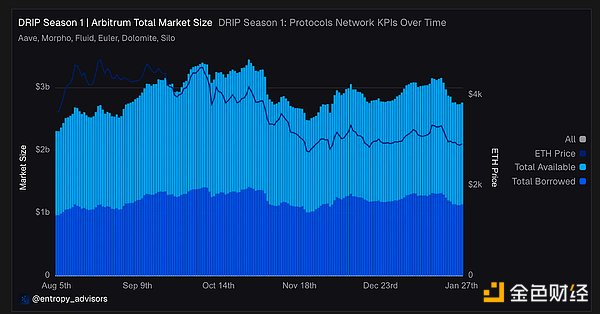
Data source: https://dune.com/entropy_advisors/drip-season-1-lending-protocols
The scale of eligible assets covered by the plan shows a differentiated growth trend: the scale of some assets has declined, while that of others has achieved significant growth.
The scale of eligible assets covered by the plan shows a differentiated growth trend: the scale of some assets has declined, while that of others has achieved significant growth.
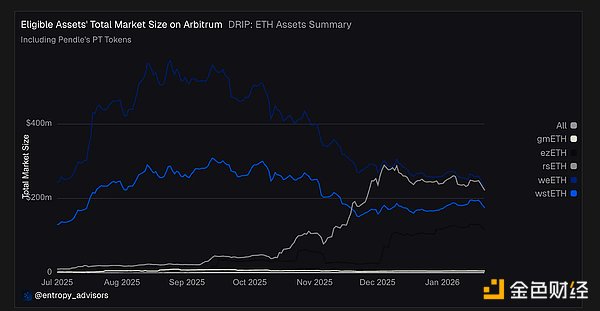
Data source: https://dune.com/entropy_advisors/drip-season-1-eth-assets
Regarding stable assets, the size of most assets backed by USDC has increased, with USDai and thBILL growing from almost zero to $50 million to $100 million.
The growth of these assets is not solely driven by the DRIP program, but is the result of multiple factors, including the development of the protocol itself and the Arbitrum Treasury's funding of projects such as thBILL. [Image source: https://dune.com/entropy_advisors/drip-season-1-usd-assets] The above analysis focuses on the DRIP program and the growth of its core assets and protocols. Next, we will broaden our perspective to the entire Arbitrum ecosystem, exploring its overall development and expansion. Arbitrum Ecosystem Economic Overview Over the past year, the Arbitrum ecosystem has seen the launch of several significant projects, including USDai, a GPU-collateralized stablecoin protocol, and Variational, a perpetual contract exchange based on the Request for Quotes (RFQ) model. Both projects have now become leading projects within the ecosystem. Meanwhile, established protocols such as Morpho and Euler have also been listed on Arbitrum, further strengthening the ecosystem's lending sector. This section will focus on the leading protocols in each sector, analyzing their contribution to Arbitrum's growth and how they enrich the functional systems of their respective sectors.
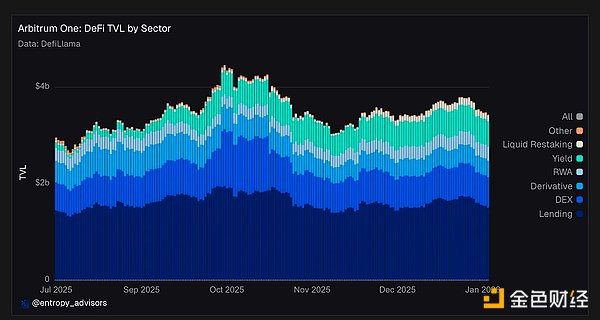
Data source: https://dune.com/entropy_advisors/arbitrum-one-network-overview
Lending Track
Lending is the largest track in the Arbitrum ecosystem, accounting for 45% of the total value locked in the network. This percentage is consistent with the dominant position of this track in other public chains. In terms of locked value and active lending volume, Aave is the largest lending protocol in the ecosystem, followed closely by newly launched protocols such as Morpho.
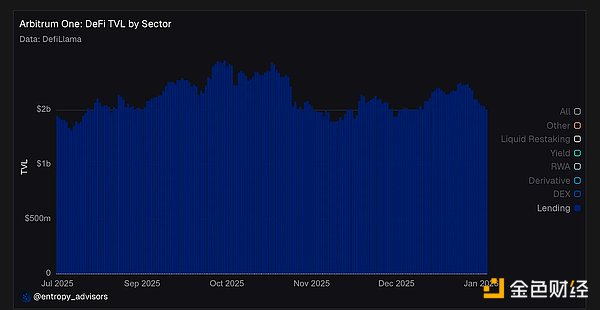
Data source: https://dune.com/entropy_advisors/arbitrum-one-network-overview
Aave
Aave is the largest lending protocol in the ecosystem, accounting for 60% of the total lending volume in the sector.
Data source: https://dune.com/entropy_advisors/arbitrum-one-network-overview
Uniswap
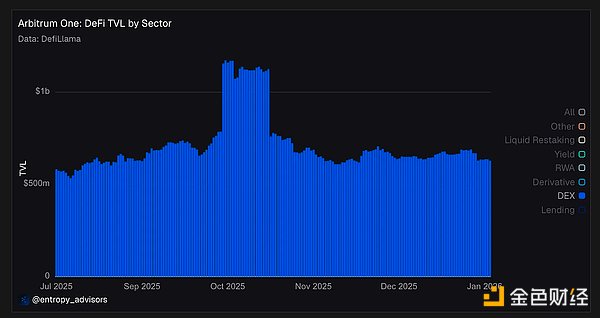
Uniswap remains the leading decentralized trading protocol within the Arbitrum ecosystem, accounting for the vast majority of the total value locked in the sector.
Data source: https://dune.com/entropy_advisors/arbitrum-one-network-overview
Pendle
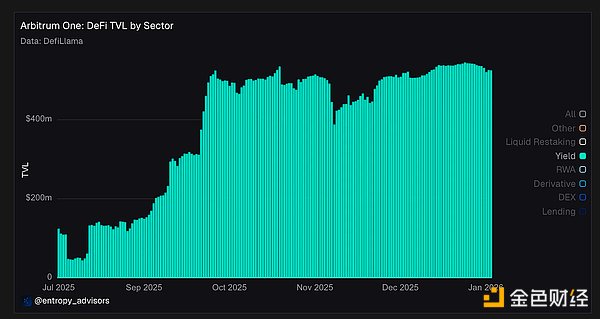
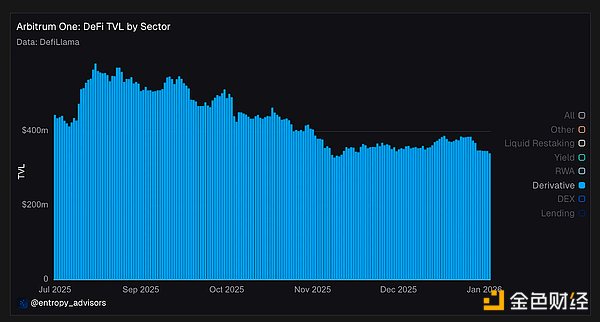
Pendle is the absolute leader in the yield tokenization field. Its core innovation is to split interest-bearing assets into principal tokens (PT) and yield tokens (YT), and to create a secondary market for the "yield curve" of the DeFi market. With this differentiated positioning, it has secured a place in the market. Pendle's total value locked (TVL) in the Arbitrum ecosystem peaked at over $830 million in early Q2 2024. While it subsequently declined, a turnaround occurred at the end of Q3 2025: its partnership with USDai propelled its TVL on Arbitrum to new heights, with USDai-related assets now accounting for over 8% of the protocol's total TVL. Furthermore, Pendle's model boasts extremely high capital efficiency, as its issued tokens can be used as collateral on major lending protocols such as Aave, Fluid, and Euler, further enhancing asset utilization. Arbitrum's derivatives market is undergoing a transformation, gradually upgrading from traditional perpetual contract protocols based on Automated Market Makers (AMMs) to a Request for Quotes (RFQ) model—the latter more efficiently aggregates liquidity and supports more asset classes beyond cryptocurrencies. While established protocols like GMX still dominate in terms of locked value, emerging protocols such as Ostium and Variational are continuously gaining market share and driving trading volume growth thanks to their rich asset classes and optimized user experience. Over the past 30 days, Variational contributed 75% of Arbitrum's ecosystem derivatives trading volume, followed by GMX (7.5%) and Ostium (6.3%).
Data source: https://dune.com/entropy_advisors/arbitrum-one-network-overview
Ostium
Ostium focuses on providing synthetic exposure for real-world assets such as gold, crude oil, forex, and stocks. It uses a quote request model, enabling narrow spreads and deep liquidity similar to those found on exchanges.
The protocol targets non-US investors, providing them with an alternative that eliminates the need for third-party custody and allows access to the US market, thus becoming a core bridge between blockchain and the $30 trillion monthly trading volume of the CFD market. Variational is a derivatives protocol specifically built for the Arbitrum ecosystem, contributing the vast majority of derivatives trading volume within the ecosystem. It operates Omni, a perpetual contract platform for retail users, and Pro, an over-the-counter derivatives platform for institutions. The protocol's core competitive advantage lies in its zero-transaction-fee policy across its coverage of over 500 trading markets (including volatility indices and interest rate swaps). Variational is developed based on a quote request model, aggregating liquidity through the Omni Liquidity Provider Vault (OLP), through which market makers can earn market-making revenue. GMX remains a heavyweight perpetual contract exchange within the Arbitrum ecosystem. Its V2 version introduced segregated liquidity pools and supports more asset classes. GMX V2 employs a multi-asset liquidity pool model, allowing liquidity providers to earn revenue from traders' losses and transaction fees through GM pools. This protocol consistently holds a leading position in terms of locked value and revenue in Arbitrum's perpetual contract market. RWA is poised for explosive growth in Arbitrum's real-world asset sector, with the scale of on-chain tokenized assets continuing to climb. Large institutions such as Robinhood, Franklin Templeton, and BlackRock have chosen Arbitrum to conduct their real-world asset tokenization business. At the protocol level, Spiko, Pleasing Gold, Midas RWA, and Theo are the core forces driving the growth of this track. In 2025, Arbitrum DAO also actively promoted the development of the real-world asset track, further increasing the total value locked within the ecosystem. 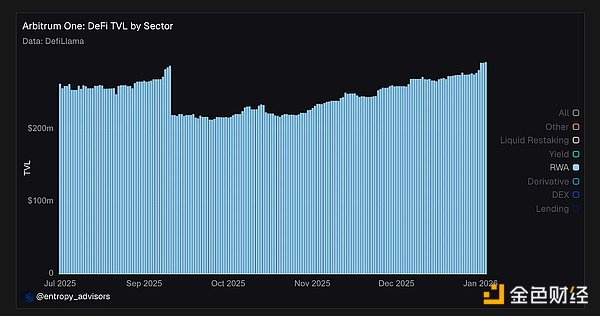
Data source: https://dune.com/entropy_advisors/arbitrum-one-network-overview
Spiko
Spiko is a leading real-world asset issuer within the ecosystem. Within just 12 months of its launch on Arbitrum, its assets under management exceeded $200 million. Its core products are the Spiko US Treasury Bills (USTBL) and Eurozone Treasury Bills (EUTBL) money market funds.
Data source: https://dune.com/entropy_advisors/arbitrum-one-network-overview
USDai
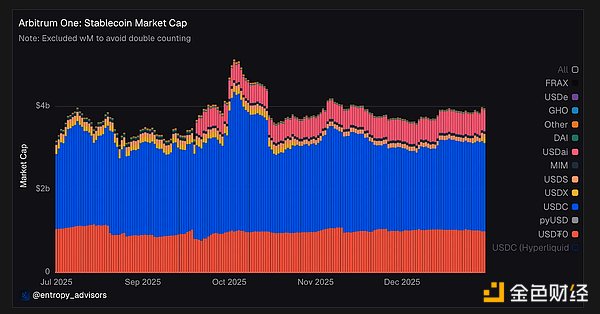
USDai is Arbitrum's native synthetic dollar protocol, introducing the concept of "InfraFi" to on-chain for the first time. The protocol's collateral includes overcollateralized computing power loans, private credit issued to AI and infrastructure operators, and short-term US Treasury bills, providing depositors with stable interest income.
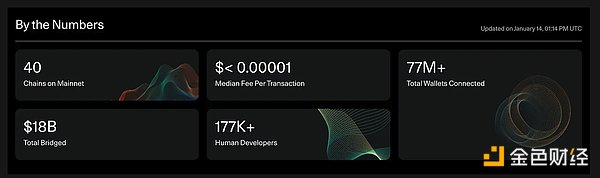
Data source: https://portal.arbitrum.io/chains/metrics?metricsSortField=tvl&metricsSortDir=desc
In addition, the launch of Arbitrum Stylus allows developers to use programming languages such as Rust, C, and C++ that can be compiled to WASM for development. This not only expands the application scenarios of the network but also lowers the development threshold. This means that protocols on non-Ethereum Virtual Machine (EVM) compatible chains such as Solana can be implemented in the Arbitrum ecosystem without rewriting all the code.


 Weiliang

