Source: insights4.vc, Translated by: Shaw Jinse Finance
Stablecoin-linked payment cards have become a major bridge between digital assets and everyday business activities. After experiencing explosive growth in 2025, monthly spending on cryptocurrency bank cards surged from approximately $100 million at the beginning of 2023 to approximately $1.5 billion by the end of 2025, implying an annualized growth of approximately $18 billion, or about 15 times. This is not because merchants "accept cryptocurrency," but rather because stablecoin-backed bank cards facilitate transactions through existing networks. The turning point in 2025 stems from the tighter integration of stablecoins with issuance and settlement processes, primarily driven by Visa and the rise of native full-stack cryptocurrency issuers.
Five Key Takeaways: Stablecoin Cards Have Reached a Significant Scale: Currently, cryptocurrency-backed bank card transactions total approximately $18 billion annually, approaching the volume of on-chain P2P stablecoin transactions ($19 billion). Its year-over-year growth rate is projected to exceed 100% by 2025, far surpassing the relatively flat P2P cryptocurrency payments. Visa Dominates in the Cryptocurrency Sector: Despite both Visa and Mastercard supporting over 130 cryptocurrency card projects, Visa still accounts for over 90% of on-chain cryptocurrency card transactions. Early partnerships with native cryptocurrency issuers (such as Rain and Reap) translated into market share, while Mastercard's early focus on exchange-traded cards led to a decline in transaction volume.
Full-stack issuers are reshaping the economic landscape: Emerging major players like Rain and Reap are disrupting traditional issuance models (sponsoring banks, project managers, payment processors). By directly issuing and managing settlements, they are able to earn more exchange fees, foreign exchange spreads, and reserve gains. Rain achieved significant growth in 2025 after becoming a direct member of Visa (reportedly growing approximately 38 times), with annualized revenue exceeding $3 billion; Reap's annualized revenue is projected to exceed $6 billion, primarily targeting enterprise spending. This vertical model has attracted substantial growth capital (e.g., Rain's $250 million Series C funding round in January 2026, valuing the company at approximately $1.95 billion), the logic behind which is that native cryptocurrency issuers can iterate faster and achieve profitability better than traditional issuers. Stablecoins are used for back-end payments, not final settlement: Due to controversies, compliance issues, and merchant tools, merchants still face limited channels for directly accepting stablecoin payments. Instead, stablecoins are increasingly used for settlement. By the end of 2025, Visa's annualized transaction volume for on-chain stablecoin settlements for issuers reached approximately $3.5 billion (although still only a small fraction of total cryptocurrency card transactions, it is growing rapidly). PayPal's "Pay with Crypto" feature similarly converts cryptocurrency in wallets into merchant payments, aiming to significantly reduce cross-border transaction fees. In short: the user experience remains that of a "regular bank card," while issuers/processors handle value transfers in the background in the form of USDC and other stablecoins.
2026 will be a test of endurance: 2025 saw the launch of pilot projects and partnerships (Visa settlement coverage expansion, Mastercard wallet integration, Stripe's stablecoin acquisition, and PayPal's promotion of PYUSD). The key to 2026 lies in how to transition from pilot projects to scaled-up products amid increasingly stringent regulatory scrutiny. Key swing factors include stablecoin rulemaking (reserve requirements, licensing, disclosure), potential pressure on transaction fees or yields, and whether the economic viability for issuers remains after reductions in incentive subsidies. The basic expectation is that the infrastructure will continue to mature and grow steadily, rather than a sudden shift to entirely cryptocurrency-based merchant payments. For institutional investors, the right framework is the "payments innovation cycle": there is significant room for improvement in cross-border efficiency and accessibility, but this is also closely tied to network gatekeepers and compliance costs. Market Map: Cryptocurrency Card Architecture
Market Map: Cryptocurrency Card Architecture

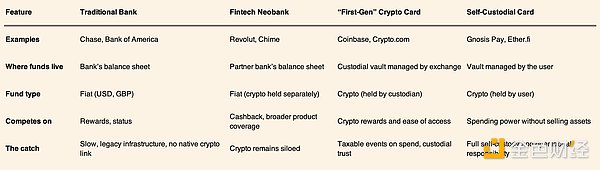
Key Players: Origins, Funding, and Partnerships
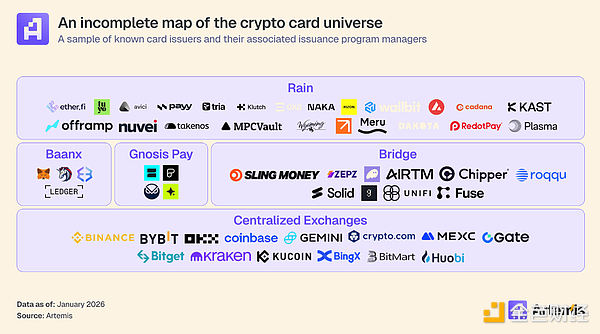
Rain: A Full-Stack Card Issuer and Infrastructure Platform
Founded in 2021, Rain has grown into one of the world's largest stablecoin credit card issuance platforms.
Its core advantage lies in its Visa primary membership, enabling Rain to issue credit cards directly without relying on issuing banks. Furthermore, Rain has developed its own settlement infrastructure, capable of converting stablecoin balances into Visa settlement transactions in near real-time, thus achieving continuous card issuance and settlement processes. Rain primarily operates as infrastructure. Through its API, it allows exchanges, fintech companies, and payment companies to launch bank card projects on its technical architecture. Reportedly, by 2025, the platform's trading volume will grow by an order of magnitude, supporting over 200 partners across more than 150 jurisdictions. Partners include Western Union, whose infrastructure is used to support cryptocurrency remittance and payment processes, and a range of fintech companies in emerging markets. The company has raised over $338 million in funding, including a $58 million Series B funding round led by Sapphire Ventures in August 2025 and a $250 million Series C funding round led by ICONIQ in January 2026, valuing the company at approximately $1.95 billion. Strategic investors include Dragonfly, Lightspeed, and Visa itself, with Visa having designated Rain as a design partner for its stablecoin settlement pilot project. Rain's leadership reflects its emphasis on infrastructure. The CEO possesses traditional banking and CIO experience, which helps the company address regulatory compliance and obtain licenses; the technology team has built multi-chain stablecoin support directly integrated with the card network. From a technology stack perspective, Rain covers issuance, project management, and settlement, enabling it to collect exchange fees and related charges that were previously scattered across multiple intermediaries. Investors increasingly view Rain as a universal payment abstraction layer for stablecoins rather than a consumer-facing fintech brand. Reap: Corporate Stablecoin Cards and B2B Payments Founded in 2018 and headquartered in Hong Kong, Reap initially started as a regional corporate fee payment card provider before transforming into a stablecoin-based settlement platform. Its core product is a Visa-supported corporate credit card, allowing businesses to obtain spending credit by staking stablecoins such as USDC or USDT, effectively integrating fund management with payment functionality. As a major Visa issuer, Reap operates throughout Asia and the Middle East and is expanding into the United States. As of early 2026, Reap reportedly had an annualized credit card transaction volume exceeding $6 billion, ranking among the world's largest stablecoin-backed credit card issuers. Beyond credit card spending, Reap facilitates cross-border payments by converting received stablecoins into local currencies through banking partners, enabling businesses to manage payments to international suppliers without holding multiple fiat currency accounts. The company has raised approximately $60 million, with its 2022 Series A funding round led by Acorn and HashKey being particularly noteworthy. With its growing transaction volume, the company expects to seek further funding. Its operating platform integrates institutional custody and compliance tools and has become an early partner for enterprise-grade stablecoin products, including Circle's enterprise accounts. From an economic perspective, Reap benefits from business credit card transaction fees, fee management software subscription fees, and foreign exchange spreads for cross-border payments. Its market positioning attracts investors looking to participate in the modernization of SME financing through regulated stablecoin channels, combining the operational norms of fintech with the liquidity of cryptocurrencies. Baanx: Cryptocurrency Payment Infrastructure (Acquired) Baanx is a UK-based payments and digital banking services provider that played a significant role in early European cryptocurrency debit card projects. Holding electronic money institution licenses in the UK and EU, Baanx primarily acts as a white-label provider, supporting self-custodial wallets and DeFi applications, including projects in partnership with mainstream wallet providers. The company completed a $20 million Series A funding round in 2024, funded by industry investors. Subsequently, it partnered with regulated banks and BIN providers to issue bank cards, primarily through the Mastercard platform. In November 2025, Baanx and its regulated entities were acquired by a US crypto wallet company for approximately $175 million, highlighting the strategic value of directly embedding bank card issuance into the wallet ecosystem. Following the acquisition, Baanx is transitioning towards vertical integration. It is no longer merely a third-party project manager, but is integrating its infrastructure into a broader wallet-driven system, enabling users to spend directly from self-custodied assets. This acquisition highlights a broader trend: wallet providers are seeking to internalize issuance and compliance processes to maintain full control over their user relationships, rather than outsourcing payment operations. Bridge (acquired by Stripe): Stablecoin API and Issuance Infrastructure. Founded around 2020, Bridge is a developer-centric stablecoin value transfer platform. Its core product integrates custody, exchange, and card issuance processes into a unified API, allowing fintech companies to issue stablecoin-backed credit cards without building direct bank or network integrations. An early notable milestone was its partnership with Visa, supporting Visa cards linked to stablecoins through a unified interface. In early 2025, Stripe acquired Bridge, reportedly its largest acquisition to date. This transaction demonstrates Stripe's strong belief that stablecoins can significantly improve global payments infrastructure. Following the acquisition, Bridge's technology is being integrated into Stripe's issuance, payments, and treasury management products, enabling Stripe customers to hold stablecoin balances, issue bank cards with those balances, or conduct on-chain settlements where appropriate. Bridge sits as an aggregation layer between banking, internet, and fintech applications. Its economic model is primarily API-driven, with revenue tied to usage, conversion rates, and potential foreign exchange savings. Leveraging Stripe's global merchant base, Bridge's functionality can rapidly expand once regulatory conditions allow for wider deployment, particularly in cross-border e-commerce and enterprise payments. Gnosis Pay: A Self-Custed Wallet Integrated with Card Networks Launched in 2023, Gnosis Pay employs a structurally distinct approach. Instead of holding user funds in custody, it directly links Visa debit cards to a self-custodied smart contract wallet. Users retain control of their private keys until a transaction occurs, at which point stablecoins are withdrawn from the wallet for settlement. Initially launched in the UK and EU, the product required customized integration with regulated European card issuers to reconcile self-custody with card network requirements. While transaction volume remains relatively small and primarily targets advanced users, the model holds significant strategic importance. It demonstrates that non-custodial wallets can interface with traditional payment networks without requiring users to use centralized exchanges or custodians. Revenue derives from card issuance fees and shared transaction fees, but the project has both architectural and commercial objectives. This provides a paradigm for the coexistence of custodial and regulated payment infrastructures in the future. Major card issuers and payment networks are closely watching this model, viewing it as a potential blueprint for compliant non-custodial spending. Existing payment platforms: Visa, Mastercard, PayPal, and Stripe. Existing payment platforms have not resisted stablecoins, but rather selectively integrated them into their settlement, issuance, and funds management processes. A common model is controlled rollout: stablecoins are used on the back end, while familiar payment interfaces are used on the front end. Visa: Stablecoins as a Settlement Upgrade Solution. Among all payment card networks, Visa has adopted the most pragmatic and application-oriented strategy, directly integrating stablecoins into its settlement infrastructure. Starting in 2023, Visa enabled USDC settlement for some card issuers in Latin America, and in 2024 expanded the service to Europe and Asia through Ethereum and Solana. By the end of 2025, Visa reported an annualized USDC settlement volume of approximately $3.5 billion, and crucially, launched stablecoin settlement services within the United States with regulated partner banks. This strategy is significant. Card issuers can now settle with Visa using stablecoins instead of through Automated Clearing Houses (ACH) or wire transfers, enabling uninterrupted settlement around the clock and eliminating weekend liquidity gaps. Visa further reinforced this direction through a deeper technological partnership with Circle, including the joint development of Arc—a permissioned blockchain optimized for payments, on which Visa plans to operate its infrastructure directly. Beyond settlements, Visa continues to dominate the cryptocurrency card issuance space, supporting over 130 projects globally. Its philosophy is clear: the success of cryptocurrency cards lies in their seamless integration with existing merchant payment methods without altering consumer payment habits. While stablecoin settlements still represent a small percentage of Visa's total transaction volume, they are operational, regulated, and growing rapidly. This makes Visa the clearest indicator of whether stablecoins are moving from concept to mainstream payment infrastructure. Mastercard: Integration, Standardization, and Merchant Choice. Mastercard's strategy is broader and more modular. After achieving significant success early on with exchange-linked cards, the company shifted its focus in 2023-2024 to infrastructure, compliance frameworks, and merchant-facing solutions. In 2025, the company launched a suite of end-to-end stablecoin features, covering card issuance, wallet integration, and merchant settlement. A key difference lies in merchant choice. Through partnerships with acquiring institutions such as Circle, Paxos, and Nuvei, Mastercard allows merchants to choose to receive payments in stablecoins instead of local fiat currencies. This is seen as a money management and volatility management tool, particularly useful in emerging markets and cross-border e-commerce. Mastercard is also investing in long-term infrastructure through projects such as the Multi-Token Network and Crypto Credentials. The Multi-Token Network is a regulated blockchain environment for banks to conduct tokenized deposits and stablecoin transactions; Crypto Credentials serve as a compliance and authentication layer for blockchain transactions. These initiatives collectively position Mastercard as a payment portal for banks and businesses, not just a pure consumer payments leader. The trade-off lies in the speed of execution. Mastercard has not yet disclosed stablecoin settlement volumes comparable to Visa, indicating that many projects are still in the pilot phase. Its success in 2026 will depend on its ability to translate standards and frameworks into scalable, revenue-generating transaction processes. PayPal: A Publicly-Oriented Closed-Loop Stablecoin Network PayPal's approach differs structurally. By issuing its own stablecoin, PYUSD, and embedding it into its existing network of consumers and merchants, PayPal is effectively building a closed-loop stablecoin payment system running parallel to the debit card payment system. PayPal's "Cryptocurrency Payments" feature allows merchants to accept cryptocurrency payments while receiving either fiat currency or PYUSD, with PayPal handling the conversion and compliance. Transaction fees are significantly lower than typical cross-border credit card fees, making PYUSD more of a cost-optimizing tool for merchants than a cryptocurrency product. PayPal is also expanding PYUSD's reach into payments and remittances, targeting freelancers and international suppliers. Crucially, PayPal controls both ends of the network. With hundreds of millions of consumer accounts and millions of merchants, it can drive stablecoin adoption through default settings rather than behavioral changes. While PYUSD adheres to New York's trust framework and regulatory restrictions remain, PayPal's size, distribution channels, and control over card issuers give it a unique ability to normalize stablecoin settlements without defining it as "cryptocurrency." Stripe: Stablecoins as Developer Infrastructure Stripe views stablecoins as native tools for developers, not consumer products. After returning to the crypto infrastructure space in 2022, Stripe acquired Bridge in 2025, marking a strategic shift towards stablecoin-native payment and fund management tools. Stripe is currently embedding stablecoin functionality into its APIs for payments, wallet balances, and card issuance, primarily in internal testing. Its goal is not to directly promote stablecoins, but rather to allow developers to access them as easily as using bank cards or debit cards. Early pilot projects include using stablecoins for corporate credit card settlements and using USDC for cross-border netting. Given Stripe's scale, even with backend adoption, reliance on correspondent banks can be significantly reduced, improving fund management efficiency. Its key advantage lies in distribution through developers: once stablecoin functionality is widely available, thousands of fintech products can adopt it with minimal resistance. Stripe's development trajectory has clearly moved from the experimental phase to the integration phase, and it is expected to achieve wider productization in 2026.
Prevalent Limitations and Hybrid Models
For existing enterprises, the promotion and deployment of blockchain technology is mainly constrained by compliance, risk management, and consumer protection. No enterprise attempts to send raw blockchain transactions directly to merchants without any recourse. Chargeback, dispute resolution, and anti-money laundering responsibilities still rely on existing mechanisms.
The final result is a hybrid architecture. Stablecoins handle settlement and liquidity transfer, while bank cards, wallets, and trusted interfaces handle user experience and security. Therefore, rather than a new payment method, stablecoin cards are more accurately described as an invisible upgrade to the underlying architecture.
Users still see normal transactions. In reality, value is increasingly being transferred on-chain.
Paradigm Shift: Payment Cards as Bridges, Stablecoins as Settlement Methods
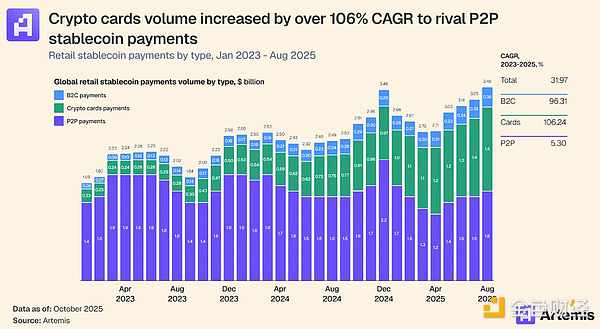
The core argument emerging between 2025 and 2026 is that the widespread adoption of stablecoins will be achieved through existing bank cards and payment infrastructure, rather than by forcing merchants or consumers to change their spending habits. While it has long been predicted that cryptocurrency payments will bypass Visa and Mastercard, global bank card networks still dominate the commercial sector due to their accessibility, trustworthiness, and consumer protection features. Stablecoins address a different set of issues: settlement speed, cross-border friction, and capital efficiency.
Two investors say:
Rob Hadick (Dragonfly) stated in an interview that he expects "institutional use of stablecoins to surpass retail use" and sees B2B payments as a key driver—therefore, Dragonfly focuses on infrastructure building rather than just consumer-facing applications.
Chris Dixon (a16z) believes that stablecoins are the "Whats App of the monetary world," enabling instant, borderless transactions. This means that anyone providing such a transaction interface (potentially a stablecoin card company) will benefit greatly. Investors generally believe that due to the efficiency of stablecoins, their integration into daily life is inevitable, and the current transitional model (stablecoin cards) is a pragmatic choice to invest in this trend as the ecosystem matures. Despite rapid development, stablecoin cards face a series of structural risks that could slow their adoption or create points of failure. These risks involve multiple aspects, including regulation, network, economics, and liquidity. Regulatory bottlenecks: Regulation remains the biggest uncertainty. Major jurisdictions, notably the United States, are discussing specific frameworks for stablecoins that could substantially restrict the stablecoin model, such as limiting banks or trust companies from issuing stablecoins, restricting transaction sizes, or limiting yield-generating projects. Even without new regulations, regulators wield significant influence: the U.S. Securities and Exchange Commission (SEC) can reclassify yield-generating stablecoin projects, the Financial Crimes Enforcement Network (FinCEN) can strengthen its monitoring of cryptocurrency-to-fiat currency transactions, and banking regulators can pressure partner banks to exit the cryptocurrency space. Sanctions compliance further complicates matters, as stablecoins can be frozen at the smart contract level, forcing issuers to continuously monitor settlement processes. Payment card networks may also implement geographic restrictions under regulatory pressure. While existing companies and startups are actively engaging with policymakers, the regulatory outcome in 2026 remains an either-or driver: constructive rules could unlock the potential of stablecoins, while restrictive rules could force companies to scale back operations. Network centralization and platform closure risks: This model structurally relies on a few payment gateways, primarily Visa and Mastercard. Changes to network policies can immediately cripple an entire project, as demonstrated by previous regional suspensions of exchange-linked cards. If a cryptocurrency card issuer experiences significant compliance issues or reputational incidents, the network may increase collateral requirements, tighten limits, or suspend services across a wide area. The concentration of card issuers exacerbates this risk, with a few payment processors supporting dozens of front-end projects. The failure of one card issuer, whether operational, financial, or regulatory, can ripple through numerous consumer-facing brands, making counterparty risk a significant concern. The trade-off between compliance and data privacy: Card-based spending fully integrates stablecoins into the regulated financial system. Transactions require KYC-verified entities and generate detailed metadata, which is retained and shared with regulators. This undermines many privacy features of on-chain transfers and may hinder privacy-conscious users or businesses. Linking wallet addresses to card identities can also broaden the scope of surveillance and analysis. Simultaneously, card issuers and payment processors become high-value targets for cybersecurity. Breach of wallet credentials or personal data can severely damage trust. Vulnerable Unit Economics: Many cryptocurrency card projects rely on high rewards from venture capital, favorable fee rates, or geographic arbitrage. As rewards normalize and regulatory pressures lead to declining fees, profit margins shrink rapidly. Previous cases of major projects cutting rewards demonstrate this sensitivity. Furthermore, foreign exchange costs, potential bank fees for stablecoin withdrawals, fraud losses, and chargeback processing also put pressure on issuers, all of which must be borne by them. Unlike established banks, many cryptocurrency card issuers lack long-term fraud history data or scalable risk teams, increasing their downside risk during periods of growth or stress. Liquidity and Redemption Risks: The system assumes that stablecoins can always be reliably redeemed at face value. However, if market confidence in mainstream stablecoins is lost due to regulatory actions, reserve issues, or technical glitches, settlement can be disrupted, forcing issuers to suspend related projects. Redemption delays or restrictions undermine the promise of instant settlement. Furthermore, when operating costs are in local currency while settlement assets are USD-denominated stablecoins, issuers face currency mismatch issues, resulting in hedging costs. Bank partner risk remains, as issuers still rely on banks for issuance, fiat currency withdrawals, and merchant payments. DeFi Integration and Consumer Protection: Some projects integrate DeFi yield strategies into bank card balances, introducing smart contract risk into consumer payments. If the protocol collapses, regulators will require regulated card issuers to fully compensate users for losses, regardless of whether the losses originated on-chain. This mismatch between experimental infrastructure and consumer protection expectations poses a serious risk pattern if not strictly controlled. Stablecoin Issuer Centralization: On-chain liquidity remains concentrated on USDT and USDC. Disorderly exits or restrictions on either side will force users to migrate rapidly, potentially leading to market volatility and operational stress. Conversely, even a temporary decline in confidence in USDC could cause issuers to halt settlements to avoid asset losses. While decentralization has improved, the concentration risk at the stablecoin layer remains significant. Overall, stablecoins integrate regulatory, network, economic, and liquidity risks into a single system. Individually, none of these risks are fatal, but adverse developments at multiple levels can lead to sudden project closures, margin calls, or a decline in user trust. The sustainability of this model depends not only on growth but also on the effective absorption of these risks as the industry scales. 2026 Outlook Scenario 1: Conservative Scenario – Stable Growth Adoption has increased, but at a slow pace. Stablecoin settlement remains in the pilot phase, not the default setting, as regulators grant only limited authority (e.g., the US framework effectively restricts issuance to banks or trust companies). Banks continue to resist consumer-facing stablecoin yields, dampening their promotional efforts. Each network is making minor expansions to its pilot programs, but the rules remain largely unchanged. Funding continues, but the focus is shifting from aggressively launching new projects to compliance and infrastructure development. The winners are existing companies (Visa, Mastercard) and large-scale full-stack issuers (Rain, Reap), which are able to thrive under restrictions, especially in high-demand emerging markets. Smaller projects and exchange-branded payment cards will be the losers, as they cannot afford the additional costs of licensing and compliance (requirements like MiCA will naturally become a screening criterion), while merchant-side stablecoin payments remain in the pilot phase. Trading volume is projected to increase from approximately $18 billion to approximately $30 billion (annualized) by the end of 2026, with valuations stabilizing. Barring major shocks, this category will remain "significant but still niche." Scenario 2: Basic Situation – Accelerated Integration, Controllable Friction Growth accelerated again as technology and regulatory policies were gradually implemented. Visa and Mastercard expanded their settlement options, allowing more card issuers to join on-chain settlement, and potentially adding a second stablecoin (e.g., PYUSD or Euro settlement options) for specific transaction channels. A cautious yet proactive regulatory environment reduced key frictions: clearer guidance on consumption tax policies and more explicit licensing policies in Asian hubs boosted market reserve confidence. The selective reopening of capital markets, including potential initial public offerings (IPOs) or large strategic transactions, validated the value of the sector. Winners included payment networks and full-stack issuers: payment networks achieved settlement profitability and had the potential to package "stablecoin-supported" services for banks; while issuers like Rain gained corporate distribution channels and expanded partner programs. Large fintech companies with distribution channels (such as Revolut and Cash App) and payment processors (such as Stripe) are quietly capturing cash flows by embedding stablecoin payment gateways into existing products. At risk are banks that fail to adapt to the growth in stablecoin circulation (in this scenario, global stablecoin circulation will reach approximately $500 billion by 2026), and "L1 payment" tokens that lose their voice as stablecoins integrate into the mainstream payment system. By the end of 2026, stablecoin-linked cards will no longer be a fringe case in the cryptocurrency space, but rather an extension of modern fintech, achieving measurable penetration in specific markets. Scenario 3: Accelerated Adoption – Entering the Mainstream Market Favorable policies and a favorable macroeconomic environment have driven this change. Major jurisdictions have provided clear and supportive stablecoin frameworks, including reliable issuance pathways for non-bank issuers and stronger safeguards to mitigate the risk of bank runs. The consistently attractive cash yields have drawn more users and businesses to stablecoins, pushing their market capitalization close to $1 trillion. Major platforms are also joining the fray: large tech and business ecosystems are making stablecoin financing or merchant settlement the default option, and Visa/Mastercard has transitioned from pilot phases to core network integration (stablecoins are considered legitimate settlement currencies in all regions). The application of stablecoins is expanding from back-end settlements to front-end areas such as B2B, payments, and treasury management. The winners will likely consolidate into a few platforms: Visa may maintain its leading position and significantly expand stablecoin settlements; top cryptocurrency-native issuers will become dominant infrastructure or acquisition targets; Stripe is leveraging stablecoins as a cross-border back-end to accelerate merchant adoption. Emerging market consumers will benefit greatly, able to spend as easily as they would with US dollars and participate in global trade. As funds shift, correspondent banks and traditional remittance operators will be losers, and Mastercard could also be affected if Visa's lead evolves into a winner-takes-all scenario. The development of central bank digital currencies (CBDCs) may accelerate again as a policy response, but large-scale consumer-facing CBDCs are unlikely to emerge in most major markets until after 2026. In conclusion, what these scenarios have in common is that stablecoins are injecting new functionality into payments, but they are doing so by working with existing systems rather than completely replacing them. Institutional investors should closely monitor regulatory milestones (each milestone will influence the likelihood of which scenario occurs), network policy changes (any signs of Visa/Mastercard tightening or relaxing cryptocurrency rules are a bellwether), and actual adoption metrics at the consumer and settlement ends. Optimistic scenarios offer substantial growth and potential excess returns for early leaders in the space, effectively spawning a new wave of fintech giants. Pessimistic scenarios do not signify the complete failure of the idea (unless cryptocurrencies are banned globally, the utility of stablecoins is unlikely to disappear), but rather that the path to development will be slower and more bumpy—perhaps taking several years to fully realize its potential, and some early entrants may not survive the transition period. Currently, 2026 appears to be the year stablecoin cards move from proof-of-concept to the daily lives of millions, even if most people are completely unaware of the rapid flow of USDC or DAI in the background when they swipe their cards.


 Catherine


