Author: hyphin, Onchaintimes; Translation: Jinse Caijing xiaozou
The seeds sown last year in a climate of uncertainty are finally beginning to bear fruit. Retail investors have shown their cards to everyone, while private equity has no clue what cards they hold. What outcomes are they betting on? Since the last time Bitcoin traded at the price it is now, private equity has been burned by excessive enthusiasm, and they have been cautious. Will the strategy be different this time?
1, Introduction
Regardless of the market environment, financing will never stop completely, because the creativity engine of the crypto industry is efficient enough to reward those who provide financial support for it. However, enthusiasm depends largely on predictions. It has always been the case that promising conditions tend to attract early capital because the potential returns far outweigh the associated risks. For many onlookers, the increasing number of these for-profit entities either means that the party has already started or that the party is about to start. It is clear that we have been immersed in a bull market for quite some time, and the fortress is within reach. Given this, we can predict that cumulative funding will exceed or at least approach the norm of the previous cycle.
Here is the funding picture for 2024: Monthly cumulative funding for 2024 compared to the four-year average.
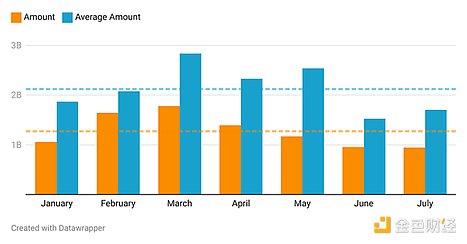
It is safe to say that these optimistic expectations have been tested by reality, as this year's monthly indicators are a long way short of the four-year average. Compared to 2018, 2021, and 2022, these numbers are just a drop in the ocean in the era of zero interest rates and cheap money. While the reported financials are not worth scrutinizing, they do show that the opportunities for obtaining large initial startup funds have significantly decreased as activity seems to have disappeared as we transition to the new normal. However, the number of funding rounds for invested projects is actually higher than average.
Funding frequency in 2024: Monthly funding rounds in 2024 compared to the four-year average.
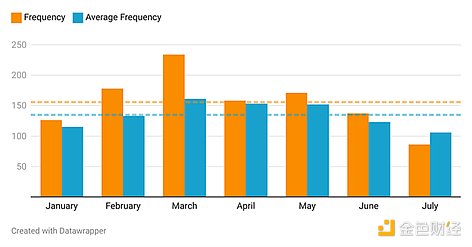
Before the rise in Bitcoin prices to all-time highs, the distribution of funding announcements accelerated significantly, indicating that people were actively involved in launching operations behind the scenes. This surge was largely due to marginalized participants entering the market in large numbers and participating in more rounds than usual. However, activity has slowly tapered off, and Summer has historically been quite quiet.
Funding participation (2021-2024): Create interactive, responsive and beautiful charts - no code required.
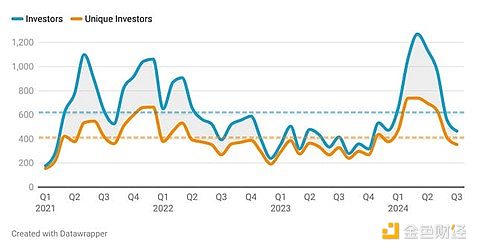
Admittedly, the average check written to founders is certainly not as large as it used to be, which requires developers to be more savvy and manage their burn rate wisely to successfully bring the products they are building to the finish line.
2, sentiment / positioning
With insights into the current financing situation, we can confidently judge that venture capital will have some upside in the unforeseeable future. Although the size of the financing may not convey much confidence, the risk appetite may. Funding can be targeted at different stages of a company's development, each with its own considerations and industry-standard amount ranges.
By classifying investment types by their individual characteristics, we can assign them a rough risk score. This allows us to broadly measure the overall risk tolerance of all established parties, and thus determine the confidence that the trend will continue or turn by quantifying their collective propensity to engage in speculative activities.
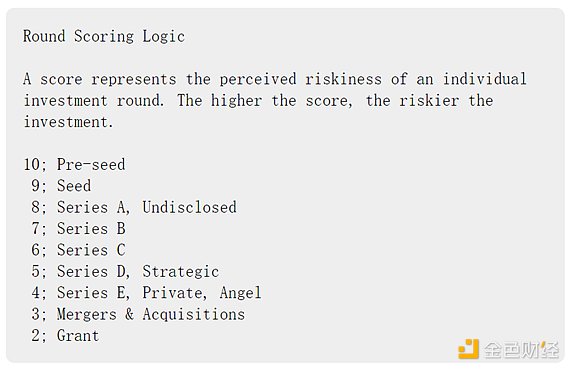
The sentiment shown in our graph will be represented by a composite index, calculated by adding the frequency-based and amount-based weighted scores using the values we determined previously.
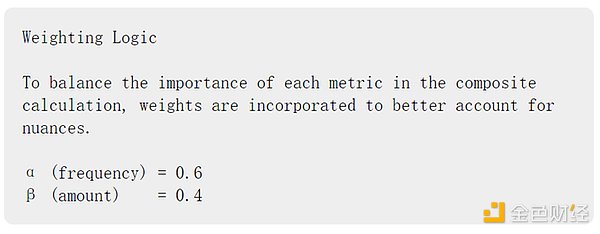
Lower values of the composite index indicate a defensive tendency, while higher values indicate an offensive tendency. Changes between these positions can be determined by whether the composite indicator value exceeds the average (the green dashed line in the figure).
Below is the chart showing funding sentiment (2021-2024): The chart shows risk capital sentiment, based on participation trends in high-risk funding rounds, using normalized values (lower = defensive; higher = offensive). Funding scores are determined by the perceived risk factor of the funding type, which is then used to calculate frequency and amount scores. The composite indicator is the sum of these two weighted values.
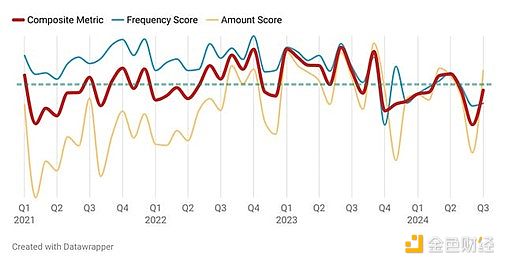
Although a bit of a generalization, the chart provides an interesting perspective on how positioning and investments have evolved over time. In the previous cycle, low funding amounts and high funding frequency scores would have resulted in a relatively mild composite indicator, with large amounts of money primarily flocking to high-valuation series financings. Many well-funded companies made major bets on the industry by investing in infrastructure and institutional products. This sentiment began to shift near the end of this round of gains, with riskier early-stage financings becoming more prominent as investors placed greater emphasis on incubating emerging projects while maintaining conservative commitments. A change in the pace of financing can be seen around the last quarter of 2022, when large individual financings occurred during the FTX debacle and the future of cryptocurrencies was questioned. After the catastrophic capitulation and market bottom formation, private capital took a gamble and significantly expanded financial support for developing companies, which lasted until the fourth quarter of 2023. Subsequently, larger private sales and a series of strategic financings came into focus. This trend has continued for most of this year, resulting in a decline in frequency scores despite record activity. This shows that investors are more cautious in their investment allocations, carefully screening and preferring safer investments.
3、Funding Analysis
This year has been a tough one for most altcoins, with only a few outperforming major assets. Even those receiving discounted tokens are not immune, as the downside potential of more speculative investments has proven to be almost bottomless. Choosing the right niche is more important than ever. To get an overview of fund flows and filter the most popular narratives, we can look at the financing amounts of each category. For consistency, all publicly traded Bitcoin mining companies are excluded. It is worth noting that not all financing has specific values, so the actual composition may be slightly different.
Compared to last year, it is undeniable that investment interest has weakened, and some traditional industries that were previously ignored have gained more traction along with new areas as financiers adopt a broader ecological and infrastructure approach. This further supports the view that risks are being carefully evaluated and exposure to newly formed or re-emerging narratives is limited.
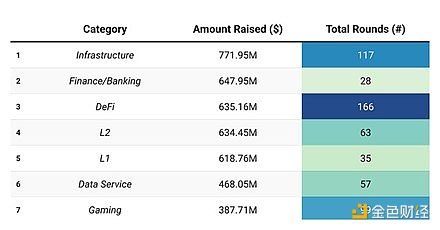
Focusing on the popular part, infrastructure as the backbone of the industry rightfully stands out, with projects like EigenLayer paving the way for new primitives and generating a lot of economic value and activity. Unexpectedly, various trading venues and financial services aimed at expanding existing businesses and launching new products tailored for institutions and ordinary users have also received generous financing. The last time there was a keen interest in this corner of the market was in 2021, when efforts to bootstrap and simplify returns reached an all-time high. For the other projects in the table, the amount of funding either declined or remained relatively stable compared to last year, leaving only a very few noteworthy observations.
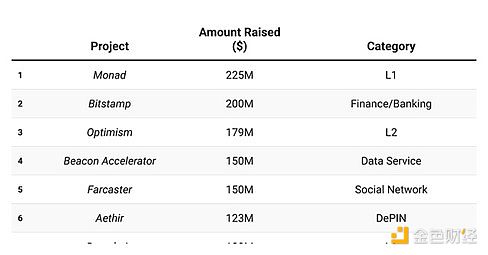
Largest Fundraises in 2024
Below is the largest funding rounds in 2024: ranked by cumulative funding to date and by category.
(1) Resurgence of L1 and L2
The blockchain investment space is back in the spotlight after some high-profile funding rounds. Despite the saturation of the L1 market, companies like Monad ($225M) and Berachain ($100M) received significant liquidity injections, similar to those seen in 2022. Compared to last year, total investments in the sector have nearly tripled. Rollups have also shared in this success, with cumulative funding slightly higher than base chains, due to exciting new developments in the rollup space. While Ethereum L2 solutions, or those that leverage Ethereum’s underlying technology, have been in the spotlight, alternative virtual machines and chain deployments are showing signs of growing interest. Bitcoin and Solana are prime examples.
(2) The Rise of Social Networks
Despite the fact that decentralized social platforms have been around for some time, they have struggled to gain a large user base and attract significant funding. The biggest challenge facing these platforms is converting Twitter users, which remains the real center of discussion in the cryptocurrency space. However, Farcaster, launched in late 2023, has been a huge success, raising $150 million in a $1 billion Series A led by Paradigm after reaching nearly 40,000 daily active users.
(3) Ecosystem Contribution
Ethereum and its recent expansion solutions have been the main center of ecological investment, but their dominance is declining year by year, and emerging ecosystems offer a large number of opportunities that are less common in mature established environments.
Most capital flows are integrated into Ethereum, Bitcoin, and Solana, and other chains find it difficult to compete with them. Compared with the previous year, Solana has improved its position, with a large influx of active users with unique addresses, huge transaction volume, and the popularity of its virtual machine. This is not the case with Bitcoin, which has failed to maintain its momentum and has been caught up by Solana, partly due to the shift in focus of mining operations. Nevertheless, the Bitcoin ecosystem is developing rapidly and is still in its infancy to some extent.
4, Conclusion
Despite Bitcoin's favorable price trend and strong participating institutions, the cumulative financing amount is unexpectedly low, only slightly improved from the previous year. Activity once soared, but has since fallen back below the average, reflecting seasonal patterns. So far, market sentiment has been relatively negative, and venture capital is still cautiously watching. With four months left in the Year of the Snake, Bitcoin still has plenty of time to establish a range and show a clear direction. A clear upside breakout, coupled with altcoins finally being safe to buy again, should give the green light for riskier participation.


 JinseFinance