Authors: Shigeru & CynicCGV Research
Introduction:Prediction markets are transforming from "trading tools" into a frequently cited decision-making signal layer. As data from platforms like Polymarket and Kalshi are continuously used by mainstream media, financial terminals, and AI systems, the market's focus is no longer on the wins and losses of individual bets, but on the consensus itself after capital weighting.Based on CGV Research's long-term tracking of prediction markets, AI agents, compliant finance, and information infrastructure, this article proposes 26 key judgments on the development of prediction markets in 2026 from five dimensions: structure, products, AI, business models, and regulation.
Today, prediction markets are gradually transforming from a "fringe financial experiment" into a foundational layer of information, capital, and decision-making systems.
In 2024-2025, the market witnessed the explosive growth of platforms like Polymarket and Kalshi; in 2026, the market may face the systemic evolution of prediction markets as a "new type of information infrastructure." Based on its continuous research over the past two years on prediction markets, AI agents, crypto finance, and compliance trends, the CGV research team has provided 26 predictions for 2026.
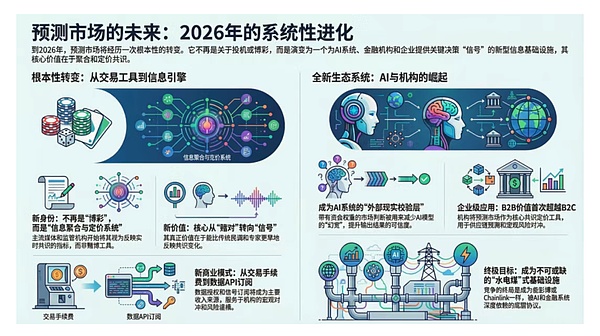
I. Structural Trend Judgment
1. Prediction markets will no longer be defined as "gambling" or "derivatives" in 2026. They will be redefined as: decentralized information aggregation and pricing systems.
By 2025, platforms like Polymarket and Kalshi had accumulated over $27 billion in trading volume. Mainstream media outlets such as CNN, Bloomberg, and Google Finance widely integrated their probability data, citing it as a real-time consensus indicator rather than gambling odds. Academic research (such as analyses from Vanderbilt University and the University of Chicago) showed that predictive markets outperformed traditional polls in predicting political and macroeconomic events. By 2026, with traditional financial giants like ICE investing in Polymarket and distributing its data to global institutions, regulators (such as the CFTC) were expected to further view it as an information aggregation tool, driving a paradigm shift from a "gambling label" to a "decentralized pricing system." 2. The core value of market prediction lies not in "betting correctly," but in "signals." Ultimately, the market pays the price for the ability to anticipate changes in consensus. In 2025, Polymarket and Kalshi predicted probability changes in Federal Reserve decisions and sporting events 1-2 weeks ahead of mainstream economists and polls. Related reports show that their Brier scores significantly outperformed polls and expert predictions; a Brier score of 0.0604 significantly surpassed the "good" standard of 0.125 and the "excellent" standard of 0.1. Furthermore, as trading volume increased, predictions became more accurate, and Brier scores improved. By 2026, with the surge in institutional hedging demand (such as using probability signals to hedge macroeconomic risks), platform data will be more increasingly embedded in financial terminals, and the value of these signals will far exceed trading returns, becoming a real-time "public opinion indicator" for institutions and the media. 3. The prediction market will shift from "event-level" to "state-level" It's not just about "who will win," but "what state the world is in." In 2025, the platform launched continuous state markets, such as "2026 Bitcoin price range" or "economic recession probability," and open interest (OI) rose from a low at the beginning of the year to over several billion US dollars; Kalshi's market share of macroeconomic indicators rose rapidly. By 2026, long-cycle state markets are expected to dominate liquidity, aggregate structural consensus, and provide sustained pricing of world states, rather than being driven by single events. 4. Prediction markets will become an "external reality verification layer" for AI systems. AI will no longer rely solely on data, but will instead consider "judgments weighted by capital." In 2025, benchmark tests on the Prophet Arena showed that AI models achieved accuracy comparable to prediction markets in predicting real-world events; Kalshi and Grok collaborated, and Polymarket generated AI summaries, using capital-weighted probabilities as verification to reduce AI illusions. By 2026, with the maturity of protocols such as RSS3 MCP, prediction market probabilities will widely serve AI world model updates, forming a closed loop of reality-market-model, and improving the credibility of AI output. This is the fundamental difference between prediction markets and social media and news platforms. In 2025, Polymarket data will be integrated with Bloomberg and Google Finance, forming an efficient loop of information input → funding pricing → judgment output; unlike Twitter's unincentivized opinions, the funding mechanism ensures the authenticity of judgments. By 2026, this closed loop is expected to extend to corporate risk control and policy evaluation, generating externality value. Prediction markets, distinct from simple content platforms, will become a new type of decision-making infrastructure. 6. Prediction markets are no longer a niche market in the crypto industry. They will be incorporated into the larger AI × Finance × Decision Infrastructure narrative. In 2025, ICE invested $2 billion in Polymarket, Kalshi was valued at $11 billion, and traditional giants such as DraftKings and Robinhood launched prediction products; total transaction volume exceeded $27 billion, and data streams were embedded in mainstream terminals. By 2026, with accelerated institutional adoption and AI integration, prediction markets are expected to shift from a crypto niche to a core narrative of AI × Finance × Decision, similar to Chainlink's position in the oracle space. II. Product Form Judgment 7. Single-Event Prediction Markets to Enter Maturity in 2026 Innovation lies not in UI, but in structure. In 2025, the overall transaction volume of the prediction market reached approximately $27 billion, with Polymarket contributing over $20 billion and Kalshi over $17 billion. Single-event markets (such as sports events, macroeconomic indicators, and political events) dominated, but the monthly growth rate slowed down later, and adjustments occurred after the year-end peak. Innovation is shifting its focus to underlying structures. For example, the LiquidityTree model of the Azuro protocol continues to optimize efficient liquidity management and profit/loss distribution. By 2026, such infrastructure upgrades are expected to drive single-event markets into a stable depth phase, supporting larger-scale institutional participation. 8. Multi-event combination markets will become the mainstream form. Prediction will no longer be a single point, but rather a joint pricing of a set of related variables. In 2025, Kalshi's "combos" multi-leg trading feature became widely popular, supporting the combination of sports outcomes and macro events, significantly attracting institutional hedging; conditional market experiments (such as event-linked probabilities) further improved pricing accuracy and depth. By 2026, with clearer regulations and accelerated inflows of institutional funds, multi-event combinations are expected to become the mainstream form, enabling complex risk management and diversified exposure, and significantly expanding overall trading depth. 9. The “Long-horizon Market” is beginning to emerge, predicting structural outcomes 6 months, 1 year, or even 3 years into the future. In 2025, Polymarket and Kalshi expanded multiple year-end markets, such as Bitcoin price range and economic indicator predictions, with Open Interest (OI) rising from a low at the beginning of the year to over several billion dollars; similar protocols introduced position lending mechanisms to alleviate capital lock-up. By 2026, the long-horizon market is expected to dominate a portion of liquidity, providing more reliable structural consensus aggregation, and Open Interest is expected to double again, attracting long-term institutional hedging. 10. Prediction markets will be embedded in more non-trading products, research tools, risk control systems, and decision-making back-ends, rather than front-end trading. In November 2025, Google Finance deeply integrated Kalshi and Polymarket data, supporting Gemini AI to generate probability analysis and charts; Bloomberg and other platforms followed suit, exploring signal access. By 2026, this embedding trend is expected to deepen significantly, with prediction probability becoming the standard input layer for macro research, corporate risk control, and decision-making back-ends, shifting from front-end trading to institutional-level tools. CNN and CNBC also signed a multi-year cooperation agreement with Kalshi in December 2025 to embed probability data into financial programs (such as "Squawk Box" and "Fast Money") and news reports. 11. The Value of B2B Prediction Markets Will Surpass B2C for the First Time. Enterprises and institutions need "consensus pricing" more than individual investors. In 2025, the accuracy of enterprise internal application cases (such as supply chain and project management forecasting) will continue to outperform traditional methods; with the surge in institutional hedging demand for macroeconomic and sporting events, the transaction share of B2B scenarios will increase significantly. By 2026, the value of B2B is expected to surpass that of retail B2C for the first time, and institutions will regard prediction markets as a core consensus pricing tool, driving the sector's transformation into enterprise-level infrastructure. The supply chain analytics market size will reach $9.62 billion in 2025 and is projected to grow at a CAGR of 16.5% to 2035. As a "consensus pricing tool," prediction markets can be embedded in AI-driven demand forecasting and risk management systems. 12. "No token issuance, low speculation" prediction markets will go further. In 2026, the market will reward restrained design. In 2025, Kalshi achieved peak monthly trading volume exceeding $500 million and captured over 60% of the market share despite having no native token; Polymarket confirmed the launch of its POLY token in Q1 2026, but low-speculation operations still dominated growth throughout the year. By 2026, restrained design is expected to prevail in terms of regulatory friendliness, genuine liquidity, and institutional trust, and low-speculation platforms will have an advantage in long-term valuation and sustainability. III. AI × Prediction Markets 13. AI Agents Will Become One of the Major Participants in Prediction Markets Not speculation, but continuous participation and automatic calibration. By the end of 2025, RSS3's MCP Server and Olas Predict infrastructure will support AI Agents to autonomously scan events, purchase data, and place bets on platforms such as Polymarket and Gnosis, with processing speeds far exceeding those of humans; Prophet Arena tests show that agent participation significantly improves market efficiency. By 2026, with the maturation of the AgentFi ecosystem and the opening of more protocol interfaces, AI agents are expected to contribute more than 30% of trading volume, becoming the main liquidity providers rather than short-term speculators through continuous calibration and low-latency responses. 14. Human predictions will increasingly become "training data" rather than the main trading entity. Prediction markets will begin to serve models, not humans. In 2025, benchmarks from Prophet Arena and SIGMA Lab showed that market probabilities involving human participation were widely used to train and validate large models, resulting in significant accuracy improvements; the massive amounts of capital-weighted data generated by the platform have become high-quality training sets. By 2026, this trend is expected to deepen, with prediction markets prioritizing AI model optimization. Human betting will serve more as signal input than the core agent, and platform design will evolve around model requirements. 15. Multi-Agent Prediction Gameplay Will Become a New Source of Alpha Prediction markets themselves will become a multi-agent game arena. By 2025, projects like Talus Network's Idol.fun and Olas have already viewed prediction markets as a battlefield for collective agent intelligence, where multiple agents compete to generate prediction accuracy exceeding that of a single model; Gnosis conditional tokens support complex interactions. By 2026, multi-agent gameplay is expected to become the primary Alpha generation mechanism, and the market will evolve into an adaptive multi-agent environment, attracting developers to build custom agent strategies. 16. Prediction Markets Will Inversely Constrain AI's Illusion Problem "Judgments that cannot be bet" will be considered low-reliability outputs. In 2025, Kalshi's collaboration with Grok and the Prophet Arena tests used money-weighted market probability as an external anchor to effectively correct AI biases; related models performed poorly on outputs without market validation. By 2026, this constraint mechanism is expected to be standardized, and "judgments that cannot be bet in prediction markets" will be automatically downweighted by the AI system, improving overall output reliability and anti-illusion capabilities. 17. AI Will Drive Prediction Markets From "Probability" to "Distribution" More than just a number, it will be an entire outcome curve. In 2025, platforms like Opinion and Presagio introduced AI-driven oracles, outputting complete probability distributions rather than single numbers; Prophet Arena showed that distribution predictions are more accurate in complex events. By 2026, the distribution output of AI models will be deeply integrated with the market, providing fine-grained outcome curves, significantly improving the pricing accuracy of long-tail events, and platform UIs and APIs will support distribution views by default. 18. Prediction Markets Will Become the External Interface of the World Model Reality Changes → Market Pricing → Model Updates, forming a closed loop. By the end of 2025, protocols such as RSS3 MCP Server have implemented real-time context streaming, supporting agents to update the world model from market probabilities; Prophet Arena has formed a preliminary feedback loop. By 2026, this closed loop is expected to mature, and prediction markets will become the standard external interface for AI world models. Real-world events will be rapidly reflected in pricing, driving model iteration in reverse and accelerating AI's understanding and adaptation to the dynamic world. IV. Financial and Business Model Judgments 19. Transaction Fees Are Not the Endgame Model for Predicting Markets The real value lies in data, signals, and influence. In 2025, Kalshi achieved significant revenue through transaction fees, but Polymarket, adhering to a low/zero fee strategy, captured dominance through data distribution and influence—its cumulative trading volume exceeded $20 billion, attracting investment from traditional giants like ICE. With the integration of forecast data into mainstream platforms such as Google Finance and CNN in 2025, data licensing and signal subscriptions are expected to become the main revenue source by 2026, contributing more than 50% of platform revenue. Institutions will pay to use real-time probability signals for macro hedging and risk modeling, and platform valuations will shift from trading volume to data asset weighting, driving sustainable business evolution. Prediction signal APIs will become core business products, especially in the financial, risk control, policy, and macroeconomic fields. In 2025, unified APIs such as FinFeedAPI and Dome have begun serving institutions, providing real-time OHLCV and order book data from Polymarket and Kalshi; Google Finance officially integrated probability signals from both in November, allowing users to directly query event predictions. By 2026, with accelerated institutional adoption (as highlighted in the regulatory clarity of Grayscale and Coinbase's outlooks), predictive signal APIs will evolve into standard products, complementing Bloomberg Terminals—institutional paid subscriptions will be used for automated risk control, policy simulation, and hedging against Federal Reserve decisions, etc. The market size is expected to expand from the current billions of dollars to tens of billions of dollars, with leading platforms dominating through exclusive licensing. 21. Content capabilities will become a crucial moat for the prediction market. Explaining prediction results is more important than the prediction itself. In December 2025, CNN signed a data partnership with Kalshi, embedding probability into its reporting and relying on the platform to explain market fluctuations; mainstream media frequently cite Polymarket and Kalshi's consensus changes as "real-time public opinion indicators." By 2026, pure probability providers will be marginalized, and content-based explanations (such as in-depth analysis of consensus dynamics behind the market, long-tail insights, and visual narratives) will become the key competitive advantage—platforms with strong explanatory capabilities will be prioritized by AI systems, think tanks, and institutions, forming a network effect; monetization of influence will surpass transactions, similar to how traditional media builds authority through data interpretation. Prediction markets will become the underlying tools for new research institutions. Prediction markets are not media, but research engines. By 2025, prediction market data has been used for benchmarking by institutions such as the University of Chicago's SIGMA Lab, and its superior accuracy compared to traditional polls has propelled it into macroeconomic research; after integration with Google Finance, users can generate probability charts and analyses through Gemini AI. By 2026, with deeper institutional adoption (such as the capital-weighted consensus emphasized in the outlooks of Vanguard and Morgan Stanley), prediction markets will be embedded with new research frameworks, serving as real-time decision-making engines—serving corporate risk assessment, government policy early warning, and AI model validation—evolving into "research infrastructure," similar to the role of data terminals in the financial sector, driving a comprehensive transformation from front-end trading to back-end tools. V. Regulation and Landscape Assessment 23. In 2026, the regulatory focus will shift from "whether it can be done" to "how it can be used." The emphasis will no longer be on prohibition, but on its uses and boundaries. In 2025, the US CFTC approved Kalshi and Polymarket to operate legally in specific categories (such as sports and macroeconomic events). While election-related markets remained restricted, non-financial events received a clear green light. Several prediction platforms under the EU's MiCA framework entered regulatory sandbox testing. By 2026, with accelerated institutional funding inflows and widespread mainstream media citation (such as CNN and Bloomberg using probability as a standard indicator), the regulatory focus is expected to shift to usage regulations—such as anti-manipulation rules, disclosure requirements, and cross-jurisdictional boundaries—rather than existential bans. This shift will resemble the mature path of the derivatives market, driving the scaling of compliant platforms globally. 24. Compliant prediction markets are more likely to enter from "non-financial uses," such as policy assessment, supply chain, and risk warning. In 2025, Kalshi successfully circumvented political restrictions, shifting its focus to economic indicators and the sports market, achieving a cumulative transaction volume exceeding $17 billion. Its internal enterprise applications (such as supply chain risk prediction) have proven higher accuracy at companies like Google and Microsoft. By 2026, compliant platforms are expected to prioritize expansion from non-financial uses—policy assessments (such as climate event probabilities), enterprise risk warnings, and public events (such as Olympic medal distribution). These areas face the least regulatory hurdle but can attract institutional and government clients. CFTC and EU regulatory trends indicate that this entry point will open the door to the mainstream, avoiding the gambling label. 25. Leading prediction markets won't win based on traffic, but on "being cited." Whoever is cited by AI, institutions, and research systems will be the winner. By 2025, the probabilities of Polymarket and Kalshi had been widely integrated and cited by Google Finance, Bloomberg terminals, and mainstream media (such as Forbes and CNBC), serving as real-time consensus indicators superior to traditional polls; academic benchmarks such as SIGMA Lab further enhanced their authority. By 2026, with the explosive growth in demand from AI agents and research institutions, competition among leading platforms will shift towards the frequency of invocation—being used as an external validation source by models such as Gemini and Claude, or embedded in the risk control systems of institutions such as Vanguard and Morgan Stanley; while traffic is important, the network effect of citations will determine the winners, forming an infrastructure status similar to the Chainlink oracle. 26. The ultimate competition in prediction markets lies not between markets, but in whether they become infrastructure. After 2026, prediction markets will either become as essential as water, electricity, and gas, or be marginalized. In 2025, traditional financial giants like ICE invested in Polymarket, with TVL exceeding billions of dollars, and data streams beginning to be embedded in mainstream terminals; AgentFi and MCP protocols laid the foundation for AI closed-loop systems by the end of the year. By 2026, the essence of competition will shift to infrastructure attributes—whether they become the real-time interface for AI world models, the standard signal layer for financial terminals, and the underlying consensus engine for decision-making systems; successful players will become as indispensable as Bloomberg or Chainlink, while pure trading platforms may be marginalized; this watershed will determine whether the track completely shifts from crypto narratives to global information infrastructure. Conclusion Prediction markets no longer need to prove their "feasibility." The real watershed lies in whether they begin to be used as decision-making signals, not just trading tools. The role of prediction markets changes when prices are repeatedly cited by researchers, institutions, and systematic models. By 2026, the focus of competition in prediction markets will no longer be on popularity and traffic, but on the stability, credibility, and frequency of signal usage. Whether they can become long-term, usable information infrastructure will determine whether they move to the next stage or remain within a cyclical narrative.


 JinseFinance