Public chain Lego: Connecting layer 1 and layer 0 blockchains to reshape the market landscape
What is the origin of Supernova Core, the new consensus engine introduced by Cosmos? Do public chains such as Cosmos still have a chance?
 JinseFinance

A 2025 Artemis research report indicates that the economic scale of stablecoin settlements reached approximately $26 trillion in 2024, reaching the scale of mainstream payment networks. In contrast, the fee structure in the traditional payments sector acts like a "hidden tax": a roughly 3% handling fee, additional foreign exchange spreads, and ubiquitous wire transfer fees.
Stablecoin payments reduce these costs to a few cents or even less. When the cost of transferring funds plummets, business models will be fundamentally reshaped: platforms will no longer rely on transaction fees to survive, but will instead compete on deeper value—such as savings income, liquidity, and credit services. With the entry into force of the US GENIUS Act and the similar regulatory model provided by Hong Kong's Stablecoin Ordinance, banks, card schemes, and fintech companies are moving from pilot projects to large-scale production applications. Banks are beginning to issue their own stablecoins or establish close partnerships with fintech companies; card schemes are integrating stablecoins into their back-end settlement systems; and fintech companies are launching compliant stablecoin accounts, cross-border payment solutions, on-chain settlement with built-in KYC, and tax reporting capabilities. Stablecoins are evolving from collateral within exchanges to standard payment infrastructure. The current shortcoming lies in user experience. Current wallets still assume cryptocurrency expertise; fees vary significantly across networks; and users often even need to hold a highly volatile token before transferring a dollar-pegged stablecoin. "Gas-free" stablecoin transfers, enabled by sponsored fees and account abstraction, will completely eliminate this friction. With predictable costs, smoother fiat currency exchange channels, and standardized compliance components, stablecoins will no longer feel like "cryptocurrency" and will truly feel like "currency." Core Insight: Public chains centered around stablecoins already possess the necessary scale and stability. To become everyday currencies, they also require consumer-grade user experiences, programmable compliance, and imperceptible transactions. As these elements—particularly gas-free transfers and improved fiat-to-currency on-ramps—are gradually refined, the focus of competition will shift from charging for moving funds to the value provided around money movement: yield, liquidity, security, and simple, trusted tools. The following is a quick overview of prominent projects in the stablecoin/payment blockchain space. This article will primarily focus on Plasma, Stable, and Arc, delving into the issuers, market dynamics, and other participants behind them, ultimately providing a comprehensive overview of the "stablecoin rail war." Plasma is a blockchain built specifically for USDT, designed to serve as its native settlement layer and optimized for high-throughput, low-latency stablecoin payments. It entered a private testnet in late May 2025, transitioned to a public testnet in July, and successfully launched its mainnet beta on September 25 of the same year. Plasma was the first public stablecoin payment blockchain to conduct a Transition General Evolution (TGE) and successfully launched into the market, capturing a significant mindshare, setting records for first-day TVL and liquidity, and establishing strong partnerships from the outset. Since its mainnet beta launch, its growth momentum has been undeniable. As of September 29th, Aave deposits on the Plasma chain exceeded $6.5 billion, making it the second-largest market. By September 30th, over 75,000 users had registered for its ecosystem wallet, Plasma One. Currently, according to DeFiLlama data, Aave's TVL on Plasma is $5.7 billion—despite its decline from its peak, it still holds the second-largest position (behind Ethereum's $58.7 billion and Linea's $2.3 billion). Projects like Veda, Euler, Fluid, and Pendle all achieved substantial TVL, thanks to the successful deployment of mainstream DeFi projects on their first day of operation. ▲ source: DeFiLlama Of course, some critics believe their early growth was primarily driven by incentives rather than being entirely organic. As CEO Paul emphasized, relying solely on crypto-native users and incentives is not a sustainable model; the true test lies in future real-world adoption—something we will continue to closely monitor. Plasma's Go-To-Market Strategy focuses on USDT. Plasma prioritizes emerging markets, particularly Southeast Asia, Latin America, and the Middle East. In these markets, USDT's network effects are already strongest, and the stablecoin has become an essential tool for remittances, merchant payments, and everyday peer-to-peer transfers. Implementing this strategic vision requires a robust, on-the-ground distribution strategy: advancing payment corridor by corridor, building an agent network, implementing localized user onboarding, and precisely capitalizing on regulatory timing. This also requires defining clearer risk boundaries than Tron. Plasma views developer experience as its defensive moat and believes USDT needs to offer a developer-friendly interface, similar to what Circle has done for USDC. Circle has invested heavily in making USDC easy to integrate and develop with, something Tether lacks. This presents a significant opportunity for the USDT application ecosystem—assuming the payment rails are properly packaged. Specifically, Plasma provides a unified API across the payment technology stack, freeing developers in the payment space from having to assemble their own infrastructure. Behind this single interface are pre-integrated partners, serving as plug-and-play building blocks. Plasma is also exploring confidential payments—achieving privacy within a compliant framework. Its ultimate goal is clear: "making USDT incredibly easy to integrate and develop with." In summary, this payment corridor-driven market entry strategy and API-centric developer strategy ultimately converge in Plasma One—the consumer-facing front-end, the product that brings the entire initiative to everyday users. On September 22, 2025, Plasma launched Plasma One, a consumer-facing, "stablecoin-native" digital bank and card product that combines the functionality of storing, spending, earning, and sending digital dollars in a single application. The team positioned it as providing the missing unified interface for the hundreds of millions of users who already rely on stablecoins but still struggle with local frictions such as cumbersome wallets, limited fiat exchange access, and reliance on centralized exchanges. Access to the product is being released in phases via a waitlist. Key features include direct payments from interest-earning stablecoin balances (targeted to earn over 10% annualized), up to 4% cashback on purchases, instant, zero-fee USDT transfers within the app, and a card service that can be used at approximately 150 million merchants in over 150 countries. Plasma's core pricing strategy aims to maximize everyday usage while maintaining economic profitability through other elements: simple USDT transfers are free, while all other on-chain operations incur fees. Viewed through the lens of "blockchain GDP," Plasma intentionally shifts value capture from a per-transaction "consumption tax" (i.e., gas fees for basic USDT transfers) to application-layer revenue. The DeFi layer corresponds to the framework's "investment" component: its goal is to foster liquidity and yield markets. While net exports (i.e., USDT on and off cross-chain bridges) remain important, the economic focus has shifted from consumer fees to service fees for applications and liquidity infrastructure. ▲ source: Fidelity For users, zero fees isn't just about saving money; it unlocks new use cases. When sending $5 doesn't cost a $1 fee, micropayments become feasible. Remittances can be sent in full without being deducted by intermediaries. Merchants can accept stablecoin payments without having to cede 2-3% of their revenue to invoicing/billing software and card schemes. Technically, Plasma runs a paymaster compliant with EIP-4337. Paymaster sponsors gas fees for transfer() and transferFrom() calls of official USDT on the Plasma chain. The Plasma Foundation has pre-funded this paymaster with its native XPL token and employs a lightweight validation mechanism to prevent abuse. Stable is a Layer 1 optimized for USDT payments, aiming to address inefficiencies in the current infrastructure, including unpredictable fees, slow settlement times, and an overly complex user experience. Stable positions itself as a dedicated payment layer 1 "built for USDT." Its go-to-market strategy is to establish direct partnerships with payment service providers (PSPs), merchants, business integrators, suppliers, and digital banks. PSPs favor this approach because Stable eliminates two operational challenges: managing volatile gas tokens and bearing transfer costs. Given the high technical barriers to entry for many PSPs, Stable is currently operating as a "service workshop" model—independently completing various integration tasks—and plans to solidify these models into an SDK in the future, enabling PSPs to implement self-service integration. To provide production-grade guarantees, they introduced "Enterprise Blockspace," a subscription service that ensures VIP transactions are prioritized for inclusion at the top of blocks, ensuring certainty of first-block settlement and smoother cost predictability during times of network congestion. Their geographic market entry strategy closely follows USDT's existing usage trajectory, with an "Asia-Pacific First" approach—expanding to other USDT-dominant regions such as Latin America and Africa. On September 29th, Stable launched a consumer-facing app (app.stable.xyz), targeting new, non-DeFi users. The app is positioned as a simple USDT payment wallet for everyday needs (P2P transfers, merchant payments, rent, etc.), offering instant settlement, zero gas fees for peer-to-peer transfers, and transparent, predictable fees paid in USDT. Currently, membership is limited to a waitlist. A promotional campaign in South Korea has initially demonstrated market traction: Stable Pay attracted over 100,000 user registrations directly from its offline booth (as of September 29th). Stable enables gas-free USDT payments using EIP-7702. This standard allows a user's existing wallet to be temporarily transformed into a "smart wallet" in a single transaction, allowing it to run custom logic and settle fees without requiring any separate gas tokens—all fees are denominated and paid in USDT. As shown in Tiger Research's flowchart, the process is as follows: the payer initiates payment; the EIP-7702 wallet requests a gas fee exemption from Stable's paymaster; the paymaster sponsors and settles network fees; and finally, the payee receives the full amount without any deductions. In practice, users only need to hold USDT. ▲ source: Tiger Research In terms of its business model, Stable prioritizes market share expansion over revenue in the near term, leveraging gas-free USDT payments to acquire users and build payment traffic. Long-term profitability will primarily come from within its consumer applications, supplemented by select on-chain mechanisms. Beyond USDT, Stable also sees significant opportunities in other stablecoins. As part of PayPal Ventures' investment in Stable in late September 2025, Stable will natively support PayPal's stablecoin, PYUSD, and promote its distribution, enabling PayPal users to pay "directly with PYUSD" and pay gas fees in PYUSD. This means that PYUSD will also be gas-free on the Stable chain—extending the ease of use of the USDT payment rail that attracted PSPs to it to PYUSD as well.
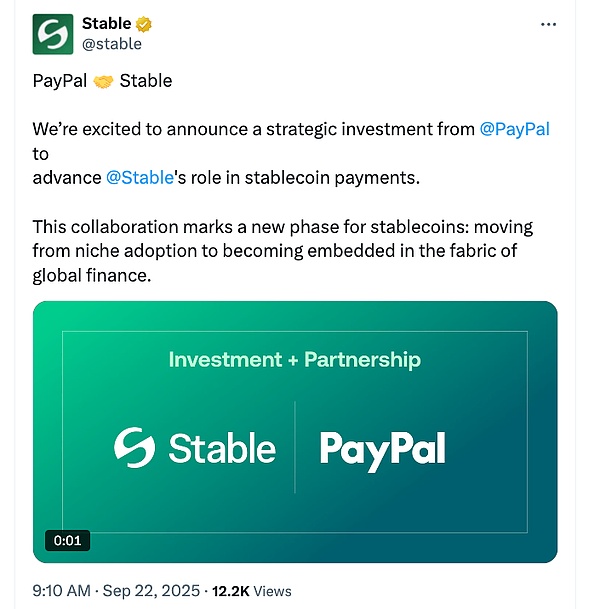
▲ source: https://x.com/PayPal/status/1971231982135792031
Architecture Analysis
Stable's architectural design begins with its consensus layer - StableBFT. This is a custom-developed proof-of-stake protocol based on CometBFT, designed to provide high throughput, low latency, and high reliability. Its development path is pragmatic and clear: in the short term, the focus is on optimizing this mature BFT engine, while the long-term roadmap points to a shift to a directed acyclic graph (DAG)-based design to pursue even higher performance scalability. Above the consensus layer, the Stable EVM seamlessly integrates the chain's core capabilities into developers' daily work. Its dedicated precompiled contracts allow EVM smart contracts to securely and atomically call core chain logic. In the future, with the introduction of StableVM++, performance will be further improved. Throughput also depends on data processing capabilities. StableDB effectively resolves the storage bottleneck problem after block generation by separating state submission from data persistence. Finally, its high-performance RPC layer abandons a monolithic architecture and adopts a split-path design: lightweight, specialized nodes serve different types of requests, thereby avoiding resource contention, improving long-tail latency, and ensuring real-time responsiveness even when chain throughput increases significantly. Crucially, Stable positions itself as L1 rather than L2. Its core philosophy is that real-world commercial applications should not have to wait for upstream protocol updates to launch payment functions. With full control over the validator network, consensus strategy, execution layer, data layer, and RPC layer, the team is able to prioritize the core guarantees required for payments while maintaining EVM compatibility, allowing developers to easily migrate existing code. The result is an EVM-compatible Layer 1 blockchain optimized from the ground up for payments. On August 12, 2025, Circle announced that Arc, its Layer 1 blockchain focused on stablecoins and payments, will enter private testnet in the coming weeks and launch a public testnet in the fall of 2025, with the goal of launching a mainnet beta in 2026. Arc’s core features are that it is run by a permissioned validator set (running the Malachite BFT consensus engine), providing deterministic finality; its native gas fees are paid in USDC; and it provides an optional privacy layer. ▲ source: Arc Litepaper Arc is directly integrated into Circle’s entire ecosystem platform - including Mint, CCTP, Gateway, and Wallet - allowing value to flow seamlessly between Arc, traditional fiat payment rails, and other blockchains. Businesses, developers, and consumers will conduct transactions through applications on Arc (covering payments, foreign exchange, asset tokenization, and more). Asset issuers can mint assets on Arc and act as paymasters to sponsor gas fees for their users. Arc uses a consensus engine called Malachite and employs a permissioned Proof-of-Authority mechanism, with validator nodes being run by known authorities. Malachite is a Byzantine-fault-tolerant consensus engine that applications can embed to achieve strong consensus protocols and finality across many independent nodes. The consensus library, highlighted in green, is the core of Malachite. Its internal round state machine uses a Tendermint-style round mechanism (proposal → pre-vote → pre-commit → commit). Voting daemons are responsible for aggregating votes and tracking quorum. Drivers coordinate these rounds over time, ensuring that the protocol remains consistent even when some nodes are delayed or fail. The consensus library is intentionally designed to be versatile: it handles "values" in an abstract way, making it accessible to different types of applications.
Around the core module are reliability and network infrastructure components marked in yellow. Peer-to-peer and gossip protocols transmit proposals and votes between nodes; the node discovery mechanism is responsible for establishing and maintaining connections. The write-ahead log stores key events locally and persistently to ensure security when a node crashes and restarts. The synchronization mechanism has dual paths for value synchronization and voting synchronization - lagging nodes can achieve data synchronization by obtaining the final confirmed output results (values) or by completing the missing intermediate votes required for ongoing decisions. Arc provides deterministic finality of about 1 second - when ≥2/3 of the validators complete the confirmation, the transaction is immediately and irreversibly finalized (with no reorganization risk); Ethereum Proof of Stake and its second-layer solution reach economic finality after about 12 minutes, and after an initial probabilistic stage of possible reorganization, it transitions to the "economic final" state; Bitcoin presents probabilistic finality - as the number of confirmations accumulates over time, it reaches the "economically secure" state after about 1 hour, but 100% finality can never be achieved at the mathematical level. ▲ source: Arc Litepaper Transaction status changes from “unconfirmed” to 100% finality (no “reorganization probability tail”) once ≥⅔ validators confirm the transaction. This property is in line with Principle 8 of the Principles for Financial Market Infrastructures (PFMI) on ensuring final settlement.
In terms of performance,Arc achieved a throughput of approximately 3,000 TPS and a final confirmation delay of less than 350 milliseconds on 20 geographically distributed verification nodes; and achieved a throughput of more than 10,000 TPS and a final confirmation delay of less than 100 milliseconds on 4 geographically distributed verification nodes. The upgrade plan for the Malachite consensus engine includes: support for a multi-proposer mechanism (expected to increase throughput by about 10 times), and an optional lower fault tolerance configuration (expected to reduce latency by about 30%). Arc also introduced an optional confidential transfer feature for compliant payments: transaction amounts are hidden while addresses remain visible, and authorized parties can access transaction values through a selectively disclosed "view key." The goal is to achieve "auditable privacy"—suitable for banks and businesses that require on-chain confidentiality without sacrificing compliance, reporting obligations, or dispute resolution mechanisms. Arc's design choices focus on the predictability required by institutions and deep integration with the Circle technology stack—but these advantages come with trade-offs: a permissioned PoA validator set concentrates governance and auditability in known institutions, and a BFT system tends to halt rather than fork in the event of a network partition or validator failure. Critics have pointed out that Arc resembles a walled garden or consortium chain for banks rather than a public network with trusted neutrality.
However, this trade-off is clear and reasonable for enterprise needs: banks, payment providers, and fintech companies value deterministic finality and auditability over extreme decentralization and permissionlessness. In the long term, Circle has revealed its intention to evolve to permissioned proof-of-stake, open to qualified stakers under slashing and rotation rules.
With USDC as its native fuel currency, an institutional-grade quote/FX engine, sub-second finality, optional privacy support, and deep integration with Circle's full product stack, Arc encapsulates the foundational capabilities that enterprises truly need into a complete payment rail. Stablecoin Rail Wars Plasma, Stable, and Arc aren't just three competitors in a single race; they're different paths toward the same vision: making the dollar as free-flowing as information. Looking at the bigger picture, the true battleground emerges: the issuer camp (USDT vs. USDC), the distributional moats of incumbent chains, and the permissioned rails that are reshaping enterprise market expectations. The Issuer Camp: USDT vs. USDC We're witnessing two races simultaneously: the battle between public chains, and the battle between issuers. Plasma and Stable clearly prioritize USDT, while Arc belongs to Circle (the issuer of USDC). With PayPal Ventures' investment in Stable, more issuers are entering the market, each vying for distribution channels. In this process, issuers will shape the market entry strategies, target regions, ecosystem roles, and overall development direction of these public stablecoin chains. Plasma and Stable may have chosen different market paths and initial target regions, but their ultimate anchor point should be markets where USDT already dominates. The figure below illustrates global USDT flows in the first half of 2024. Darker countries indicate more USDT being sent overseas; black arrows indicate the most significant flow corridors. The image reveals a hub-and-spoke network, with particularly dense routes across Africa, the Middle East, Asia-Pacific, and Latin America. ▲ source: DeFiying gravity? An empirical analysis of cross-border crypto flows—not from Decrypting Crypto A similar pattern was seen in another study: Tether's USDT performed stronger in regions with more emerging markets, while Circle's USDC was more popular in Europe and North America. It should be noted that this study only covered EVM chains (Ethereum, BNB Chain, Optimism, Arbitrum, Base, Linea) and did not include the Tron network, which has huge USDT usage. Therefore, USDT's actual footprint in the real world is likely underestimated. ▲ source: Decrypting Crypto: How to Estimate International Stablecoin Flows Beyond regional focus, the strategic choices of issuers are reshaping their roles within the ecosystem—and in turn, influencing the priorities of public stablecoin chains. Historically, Circle has built a more vertically integrated technology stack (wallet, payments, cross-chain), while Tether has focused on issuance/liquidity and relied more heavily on ecosystem partners. This divergence is now creating space for USDT-focused public chains, such as Stable and Plasma, to build more value chain components independently. Meanwhile, USDT0 is designed to unify USDT liquidity for multi-chain expansion. Meanwhile, Circle's ecosystem building has been cautious and cumulative: it began with the issuance and governance of USDC, then reclaimed control by disbanding Centre and launching a programmable wallet. Next came CCTP, which shifted its reliance on cross-chain bridges to a native burn-and-mint transfer method, unifying USDC liquidity across chains. With the launch of the Circle Payments Network, Circle connects on-chain value with off-chain commerce. Arc is the latest step in this game. Flank's core pillars are services for issuers and developers—Mint, Contracts, Gateway, and Paymaster (gas fees denominated in USDC)—which reduce reliance on third parties and tighten the feedback loop between product and distribution. ▲ source: Circle Response Strategies of Existing Public Chains Competition for stablecoin trading volume has always been fierce. The dynamic shifts in the market landscape are clearly visible: Ethereum dominated early on, followed by the strong rise of Tron, the sudden emergence of Solana in 2024, and the recent rise of Base Chain. No single chain can maintain its dominant position for long—even the deepest moats face competition for monthly market share. With the entry of specialized stablecoin-focused public chains, competition is bound to intensify, but incumbent giants will not easily cede market share; we can expect them to adopt aggressive strategies in areas such as transaction fees, finality, wallet user experience, and fiat currency exchange integration to defend and expand their stablecoin trading volume.
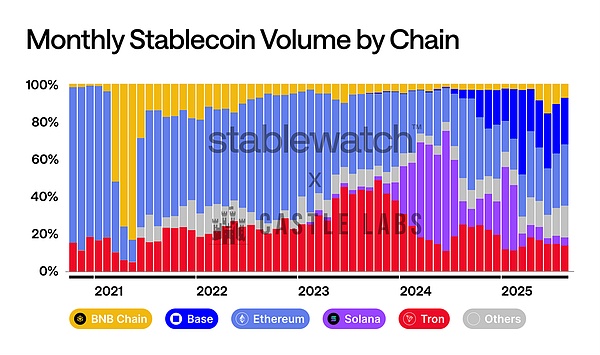
▲ source: Stablewatch
Major public chains have taken action:
BNB Chain launched the "Zero Fee Carnival" event at the end of the third quarter of 2024, and cooperated with multiple wallets, centralized exchanges and bridges to completely waive users' USDT and USDC transfer fees. The event has been extended to August 31, 2025. TRON is moving in a similar direction. Its governance body has approved a reduction in the unit price of network “energy” and plans to launch a “gas-free” stablecoin transfer solution in Q4 2024, further solidifying its position as a low-cost stablecoin settlement layer. TON, on the other hand, takes a different approach, completely hiding its complexity through a Telegram interface. Users experience "zero transaction fees" when transferring USDT to contacts (the actual cost is borne or absorbed by the Telegram wallet within its closed-loop system). Normal network fees are only incurred when withdrawing to an open public chain. The core narrative behind Ethereum's Layer 2 is a structural upgrade, not a short-term promotion. The Blob space introduced by the Dencun upgrade significantly reduces Rollup data availability costs, enabling them to pass on the savings to users. Since March 2024, transaction fees on major Layer 2s have declined significantly. A parallel track, parallel to public chains, is accelerating: permissioned ledgers built for banks, market infrastructure, and large enterprises. The most anticipated newcomer is Google Cloud Universal Ledger—a permissioned Layer 1. Google says it targets applications in wholesale payments and asset tokenization. While public details are limited, its leaders position it as a neutral, bank-grade chain, and CME Group has completed initial integration testing. GCUL is a non-EVM chain developed by Google, running on Google Cloud infrastructure and using Python smart contracts. Far from being a public blockchain, its model is based on trust in Google and regulated nodes. If GCUL is a single cloud-hosted rail, then Canton Network adopts a "network of networks" model. Built around Digital Asset's DAML smart contract stack, it connects independently governed applications, enabling the synchronization of assets, data, and cash across diverse domains with granular privacy and compliance controls. Its roster of participants includes numerous banks, exchanges, and market operators. HSBC Orion (HSBC's digital bond platform) has been live since 2023 and hosted the European Investment Bank's first pound-denominated digital bond, a £50 million issuance using a combination of private and public blockchains under the Luxembourg DLT framework. In payments, JPM Coin has provided value transfer services to institutions since 2020, enabling programmable intraday cash flows on JPMorgan Chase's rails. At the end of 2024, the bank reorganized its blockchain and tokenization product lines into Kinexys. At the core of these efforts is pragmatism: preserving regulatory guardrails and clear governance structures while drawing on the best practices of public blockchain design. Whether implemented through cloud services (GCUL), interoperability protocols (Canton), productized issuance platforms (Orion), or bank-operated payment rails (JPM Coin/Kinexys), permissioned ledgers converge on a single promise: faster, auditable settlements under institutional-grade controls. Stablecoins have crossed the threshold from crypto niche to payment network scale, and the resulting economic implications are profound: as the cost of transferring a dollar approaches zero, the profit margins of charging fees for transferring funds disappear. The market's profit center shifts to the value provided by stablecoin transfers. The relationship between stablecoin issuers and public chains is increasingly evolving into an economic tug-of-war over who captures reserve yields. As we've seen with Hyperliquid's USDH, its stablecoin deposits generate approximately $200 million in treasury yield annually, which flows to Circle rather than its own ecosystem. By issuing USDH and adopting Native Markets' 50/50 split—half going to buy back HYPE tokens through a support fund and half to ecosystem growth—Hyperliquid has "internalized" this revenue. This could be another direction beyond the "stablecoin public chain," where existing networks capture value by issuing their own stablecoins. The sustainable model will be an ecosystem where issuers and public chains share economic benefits. Looking ahead, auditable, private payments will gradually become standard for payroll, treasury management, and cross-border fund flows. This will not be achieved by building a "completely anonymous privacy chain," but rather by concealing the specific amounts in transactions while keeping counterparty addresses visible and auditable. Stable, Plasma, and Arc all adopt this model: providing enterprise-friendly privacy protection and selective disclosure features, compliant interfaces, and a predictable settlement experience, achieving "hidden when confidentiality is required and transparent when it is required." We will see stablecoins and public payment chains introduce more features tailored to enterprise needs. Stable's "guaranteed blockspace" is a prime example: a reserved capacity channel that ensures payroll, treasury, and cross-border payments are settled with stable latency and cost, even during peak traffic. It's like reserved instances for cloud services, but for on-chain settlement. With the emergence of the next generation of stablecoins and public payment chains, this will unlock even more opportunities for applications. We've already seen strong momentum in DeFi on Plasma, with consumer-facing frontends like Stable Pay and Plasma One, but even greater waves lie ahead: digital banking and payment apps, smart proxy wallets, QR code payment tools, on-chain credit, risk stratification, and a new class of interest-bearing stablecoins and the financial products built around them. The era in which dollars can flow as freely as information is upon us.
What is the origin of Supernova Core, the new consensus engine introduced by Cosmos? Do public chains such as Cosmos still have a chance?
JinseFinance"Sui is a public chain with a very clear development direction," said a developer.
JinseFinanceThe chain abstraction is not a set of processes or products, but an end goal with multiple paths to achieve it.
JinseFinanceThe security token offering is made accessible with either fiat (U.S. Dollar (USD)) or stablecoins (USD Coin (USDC)), and it requires a minimum investment of 1 USD/USDC, which is relatively affordable.
 Davin
DavinThey also issued a white paper on deposit tokens this week.
 Ledgerinsights
Jimmy Nguyen, president of BSV Association, hopes that Meta would take an approach that doesn’t store data within their own servers.
 Cointelegraph
Ethereum’s high gas fees have made it impossible for the network to demonstrate its full utility.
CointelegraphIs every chain of blocks a blockchain? What is the fundamental difference between a private network and a public network?
CointelegraphFocused on the sports and entertainment industries, the Chiliz Chain 2.0 blockchain network was birthed in collaboration with decentralized infrastructure protocol, Ankr.
CointelegraphWeb3 development has become a top priority for the blockchain industry as infrastructure providers look to enable the new internet economy.
Cointelegraph