Nigeria's $246,153 Crypto Theft: Recovery Steps and Impact
Exploring the aftermath of Nigeria's $246,153 crypto theft: arrests, recovery efforts, and the broader implications in the digital sphere.
 Hui Xin

Author: Daii
Open your exchange app and look at your "BTC balance". You think that's Bitcoin itself? NO, that's just Bitcoin's "shadow".
Bitcoin is no longer what it used to be. You've heard its story: a total supply of 21 million coins, with halvings constantly reducing the new supply. It's like an incredibly hard "time rock," and you can even measure its rhythm with block height.
But in the real world, Bitcoin that is "traded, pledged, priced, and held" is not the same as on-chain UTXOs.
What is a UTXO? This is the subject of today's article—real Bitcoin, as opposed to shadow Bitcoin. You can think of it as the only truly "cash in your hand" in the Bitcoin world. More precisely, UTXO stands for Unspent Transaction Output. While it sounds technical, its meaning is actually quite practical: In the Bitcoin system, your balance isn't a number written in an account; it's more like a handful of "change." Each UTXO is like a denomination "change slip" or "cash voucher," stating that the money belongs to a specific address, and only the person with the corresponding private key has the right to spend it. When you "pay" Bitcoin, you don't deduct a number from your account. Instead, you hand over a whole set of UTXOs. The system treats these as "used" (no longer exists) and then generates new UTXOs: one part goes to the recipient, and the other part is returned to your address as "change." Therefore, what you truly own on the Bitcoin chain is not "the BTC number displayed to you by a platform," but a set of UTXOs that you can spend by signing with your private key. These are the true entities in the final settlement layer. What you see in exchange accounts, ETF shares, DeFi lending positions, and perpetual contract positions are mostly just "rights or exposures to BTC"—they look like balances, but are essentially just a line of numbers on contracts, vouchers, or platform ledgers. They are not real Bitcoins, but merely shadows of Bitcoin, at best only shadow Bitcoins. If you still find these abstract, let's not argue about the concepts yet, but look at three sets of numbers to reveal the "shadows". The First Ray of Light: The Main Force in Trading Isn't in Spot Trading [Image of a PNG file] In most people's intuition, "spot trading" is the true price, while "contracts" are merely shadows revolving around the spot market. However, when faced with data, this order is often reversed: derivatives are the main form of trading activity. Kaiko's annual review mentions that in 2025, approximately 75% of trading activity in the crypto market occurred in the derivatives market; for Bitcoin, perpetual contracts accounted for about 68% of Bitcoin trading volume. Meanwhile, the average daily trading volume of Bitcoin perpetual contracts is roughly between $10 billion and $30 billion, with some peak days seeing BTC perpetual contract trading volume on a single platform reaching the $80 billion level. (coinglass) This means that, often, the most "crowded" and "intense" place in the market is not the spot market, but the arena of leveraged exposure. The Second Ray of Light: ETFs Transform "Shadows" into Mainstream Financial Assets. If perpetual contracts are "trading shadows," then ETFs are "institutionalized shadows": they encapsulate BTC price exposure as securities, allowing large amounts of capital to enter in a familiar way. Taking Bitbo's ETF tracking data as an example, the total holdings of US spot Bitcoin ETFs reached approximately 1,301,880 BTC (worth approximately $121.27 billion) in early January 2026, of which BlackRock's IBIT held approximately 770,792 BTC. (bitbo.io)
These BTC may indeed be custodied on-chain, but for most holders, what you hold is not a UTXO, but fund units—you own the "right to the financial asset," not "control of the on-chain private key."
The shadow doesn't only occur in centralized finance. There is also a whole industrial system on-chain that "turns BTC into composable assets": WBTC, cbBTC, etc., turning BTC into ERC-20 in the EVM world, allowing it to be lent, used for market making, as collateral, and stacked with yield.
For example, Coinbase's cbBTC, on its official proof-of-reserve page, shows a total supply of approximately 73,773.70 cbBTC as of the morning of January 6, 2026, and provides verifiable information on the corresponding reserves and on-chain addresses. (coinbase.com) WBTC remains another large-scale encapsulated BTC (the supply and demand will fluctuate over time depending on the source; for example, CoinGecko displays publicly available data on its circulating supply/supply). (CoinGecko) You'll find a very "modern" fact: the scarcer Bitcoin is, the more prosperous the credit structure surrounding it becomes. This is because scarce assets are best suited as collateral—they can inject "time value" into the spring of credit expansion. Having read this far, do you have a basic understanding of shadow Bitcoin? However, intuition alone is insufficient, as we cannot make decisions based on feelings. We need to understand the true nature of shadow Bitcoin. 1. What is Shadow Bitcoin? Discussions about "shadow Bitcoin" easily fall into the trap of a vague statement: it seems that anything not on-chain BTC is "fake money." This is inaccurate. A more professional approach is to break down "Bitcoin" into three rights—which one do you actually possess? Ownership (Finality): Can you control UTXOs on-chain using your private key to complete the final settlement? Redemption/Claim: Can you redeem a certain certificate for BTC (or equivalent cash)? What are the redemption path, rules, and priorities? Price Exposure: Do you just want to follow BTC's price fluctuations and don't care about redemption and final settlement? "Shadow Bitcoin," in essence, is: the market uses contracts, custody, securitization, and encapsulation to allow you to obtain redemption rights or price exposure without holding on-chain UTXOs. It's not a single species, but an entire niche. However, you should be familiar with the specter hiding behind Shadow Bitcoin—leverage. Some leverage you apply yourself, some is applied by others, and the lion's share of the profits goes to them, while you receive only a meager return disproportionate to the risk. Next, we will focus on the core concept of "leverage" and break down the "shadow" into layers, like peeling an onion.
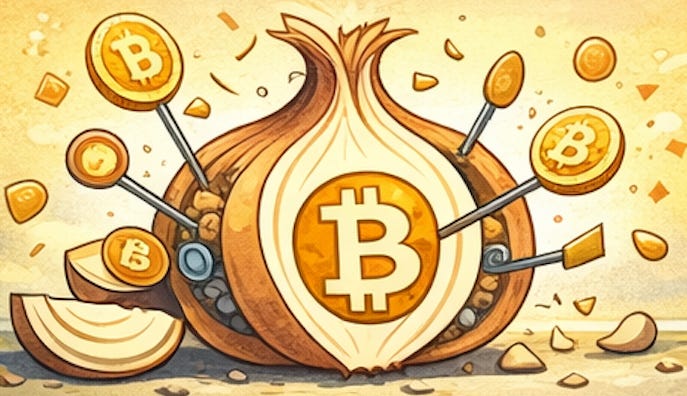
If "shadow Bitcoin" is a series of layers of packaged "rights and exposures," then leverage is what makes these shadows suddenly grow fangs.

You don't need to believe in abstract theories; just look at one extreme event.
In October of the same year, Reuters also reported on another, even more dramatic, deleveraging event: in a panic triggered by a macroeconomic policy shock, over $19 billion in leveraged positions were liquidated, described as one of the largest liquidations in crypto history. (Reuters)
You'll find that the world of explicit leverage is very "rational": large positions will be liquidated, high leverage will be wiped out, and extreme funding rates will eventually revert to normal. It's like a knife—sharp, but at least you can see where the blade is.
The real danger in the era of shadow Bitcoin is never the knife you hold yourself, but the fact that someone has actually put the knife in your hand and signed a waiver for you when you think you are watching the show from the sidelines.

The most dangerous thing about hidden leverage is that it often appears disguised as "returns".

Coinbase's cbBTC reserve proof page, when refreshed on January 6, 2026, showed: reserves of approximately 76,230.31 BTC, corresponding to a supply of approximately 76,219.49 cbBTC, and emphasized a 1:1 ratio.

Taking the prospectus of Blackstone iShares Bitcoin Trust as an example, it clearly states that the trust only accepts subscription and redemption requests from Authorized Participants.
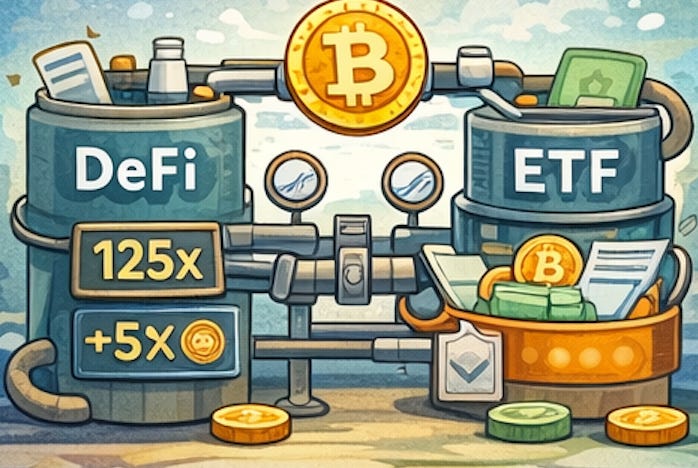
Scarce assets are naturally suitable as collateral.
By now, you probably understand one thing: Shadow Bitcoin is not a "conspiracy," but a structural fact (division of labor).

The biggest cognitive trap in the shadow era is treating all forms of "BTC balance" as the same thing.
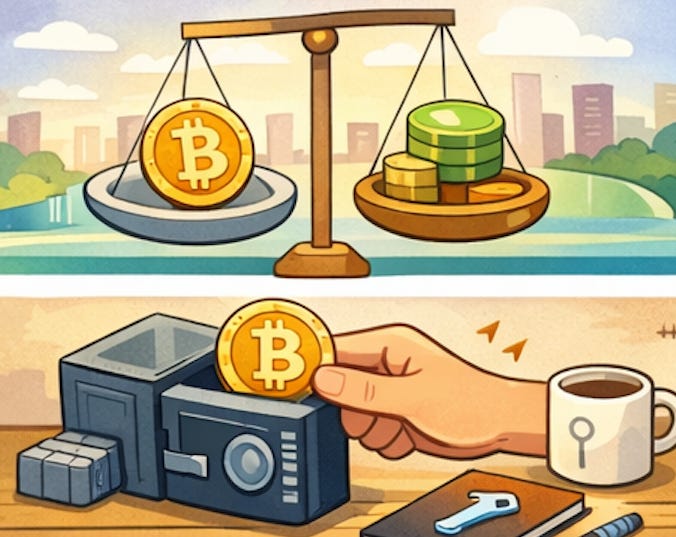

Talking about survival strategies, if it's just about concepts, easily becomes empty rhetoric. Truly effective strategies in the shadow era must be integrated into daily processes, as mechanically as brushing your teeth.
The exit rights of ETFs are clear: you can sell your shares during trading hours, but you generally cannot demand that the fund deliver the BTC directly to you; the creation and redemption of products like IBITs are executed by authorized participants, and ordinary investors trade secondary market shares. (BlackRock)
This means it is suitable as a "price exposure tool," but not as a "final settlement tool." If you think of ETFs as "equivalent to BTC," you have already misunderstood the rights structure.
Wrapped BTC (such as cbBTC, WBTC) offers another exit right: you rely on a custodian or mechanism to redeem the wrapped tokens back to the native BTC. cbBTC's increased transparency lies in its provision of proof of reserves and verifiable addresses, allowing you to see the approximate correspondence between supply and reserves.
(Bitbo) But you still need to remember: transparency doesn't equal risk-free; it simply moves risk from a "complete black box" to "observable but still bearable." When you move to deeper levels like lending, restaking, and structured returns, exit options are often directly tied to market volatility: a sharp market move might cause your position to be liquidated first, or the protocol's liquidity pool to thin out, or the cross-chain bridge to become congested. Ultimately, you'll find yourself not "exiting," but "being exited." This is why I advised you to keep your profit account as a "small position": you're not chasing the biggest generator; you're leaving yourself a way out at any time. Regarding Bitcoin profits, it's actually quite simple: holding is victory, the longer you hold, the greater the victory. You don't need to lose sleep over small gains. Of course, this goes against human nature and will be very difficult. I also find it difficult to completely achieve this. If you're a newcomer, you'll actually have your own advantages; you'll be hesitant to act out of fear. Therefore, I suggest you check out my Zhihu column "Airdrop Reference," which contains two beginner tutorials: buying Bitcoin and sending it directly to a cold wallet.
Shadow Bitcoin isn't a scam; it's a structure: if you pursue liquidity, returns, and convenience, you'll inevitably enter the shadow system. The real danger isn't in the shadow itself, but in forgetting that it's a shadow—mistaking "right of redemption" for "ownership," "promise" for "guarantee," and "annualized return" for "security."
Just remember this:
Returns aren't free; interest is simply the premium you receive for bearing the system's risk.
You can make money in the shadows, but you must adhere to the bottom line: Bitcoin only becomes Bitcoin when the private key is in your hands; otherwise, it's just someone else owing you a promissory note. In the shadow world, the best survival strategy is never about running faster, but about being able to exit at any time. Before evaluating any platform/product, ask yourself: In the worst-case scenario, how many clicks will it take to turn it back into an on-chain UTXO?
Exploring the aftermath of Nigeria's $246,153 crypto theft: arrests, recovery efforts, and the broader implications in the digital sphere.
Hui XinAmidst escalating legal tensions, former Binance CEO Changpeng "CZ" Zhao fights against the US government's efforts to impede his return to the UAE.
Hui XinBRICS nations are spearheading a strategic de-dollarisation movement, challenging the long-standing dominance of the US dollar in global trade and signalling a transformative shift in the traditional financial order.
 Jasper
Former SEC Chair Jay Clayton's surprising endorsement of cryptocurrency, despite past legal clashes with Ripple, prompts Ripple CEO Brad Garlinghouse to question the sincerity of Clayton's newfound support, raising concerns about potential inconsistencies in his evolving stance.
JasperThe move follows the Japanese government's recent revision of the Payment Services Act on June 3, 2023, which aims to regulate stablecoins.
 Davin
DavinKimsuky, a North Korean hacking group, employs tactics to target South Korean officials in a cryptocurrency theft scheme, prompting a surge in cybersecurity measures.
Hui XinNorse Atlantic Airways takes a bold step towards greener skies, leveraging AI robots for aircraft maintenance to reduce fuel consumption, recycle glycol, and expedite inspections by 90%.
JasperThe Japanese National Tax Agency (NTA) reveals an increase in crypto tax violations, with 548 cases identified out of 615 inquiries in the fiscal year 2022. Although the average undeclared income per case dropped to $206,000, the cumulative value rose to $126.5 million, prompting calls for tax system reforms in Japan amid criticisms of the current structure's impact on firms holding coins.
 Jixu
JixuThe announcement comes as part of broader leadership changes, with economist Osvaldo Giordano heading the ANSES and engineer Horacio Marín taking charge of YPF from December 10.
DavinBNB Chain recently unveiled insights shedding light on its DappBay platform. At the forefront of the Red Alarm list is Genesis Universe, an NFT-based game on BNB Smart Chain. Despite its play-to-earn mechanism, caution is advised due to its presence on the Red Alarm list, highlighting operational uncertainties.
 Joy
Joy