Author: chelson Source: X, @chelsonw_
First, the conclusion: The next three years will be a major bull market led by institutions, representing the formal and comprehensive entry of crypto and blockchain technology into Wall Street balance sheets, and the final realization of mass adoption through a top-down revolution.
Crypto's Mass Adoption will not be the decentralization revolution originally envisioned by Satoshi Nakamoto, but rather a top-down upgrade of global financial infrastructure.
Retail investors are the tide, institutions are the sea.
The tide may recede, but the sea will not.
Looking back at 2025: Why is this bull market the "Year of Institutions"?
Reasons first: Almost all BTC/ETH funds come from institutions; retail investors are all speculating on MIME and Altcoin.
In 2025, all major cryptocurrencies hit new all-time highs: BTC 126k, ETH 4953, BNB 1375, Sol 295.
1. The Explosion of ETFs and Institutional Channels (such as DAT)
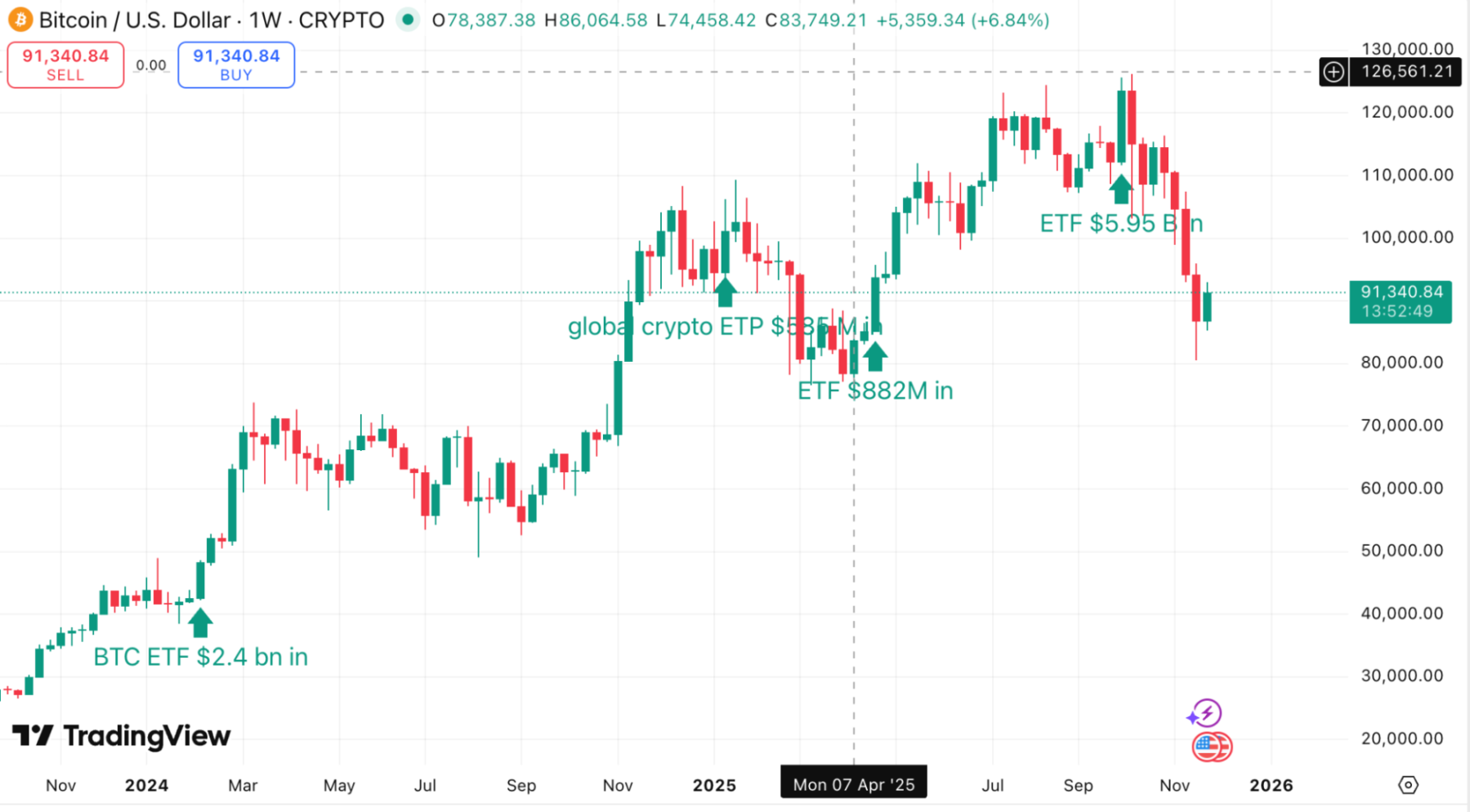
2024-2025 ETF Large Inflow Events
2024–2025 Net Inflow of Digital Asset Funds: $44.2 Billion, while ETF holdings of spot BTC reached 1.1-1.47 million BTC (accounting for 5.7%-7.4% of the total circulating supply)
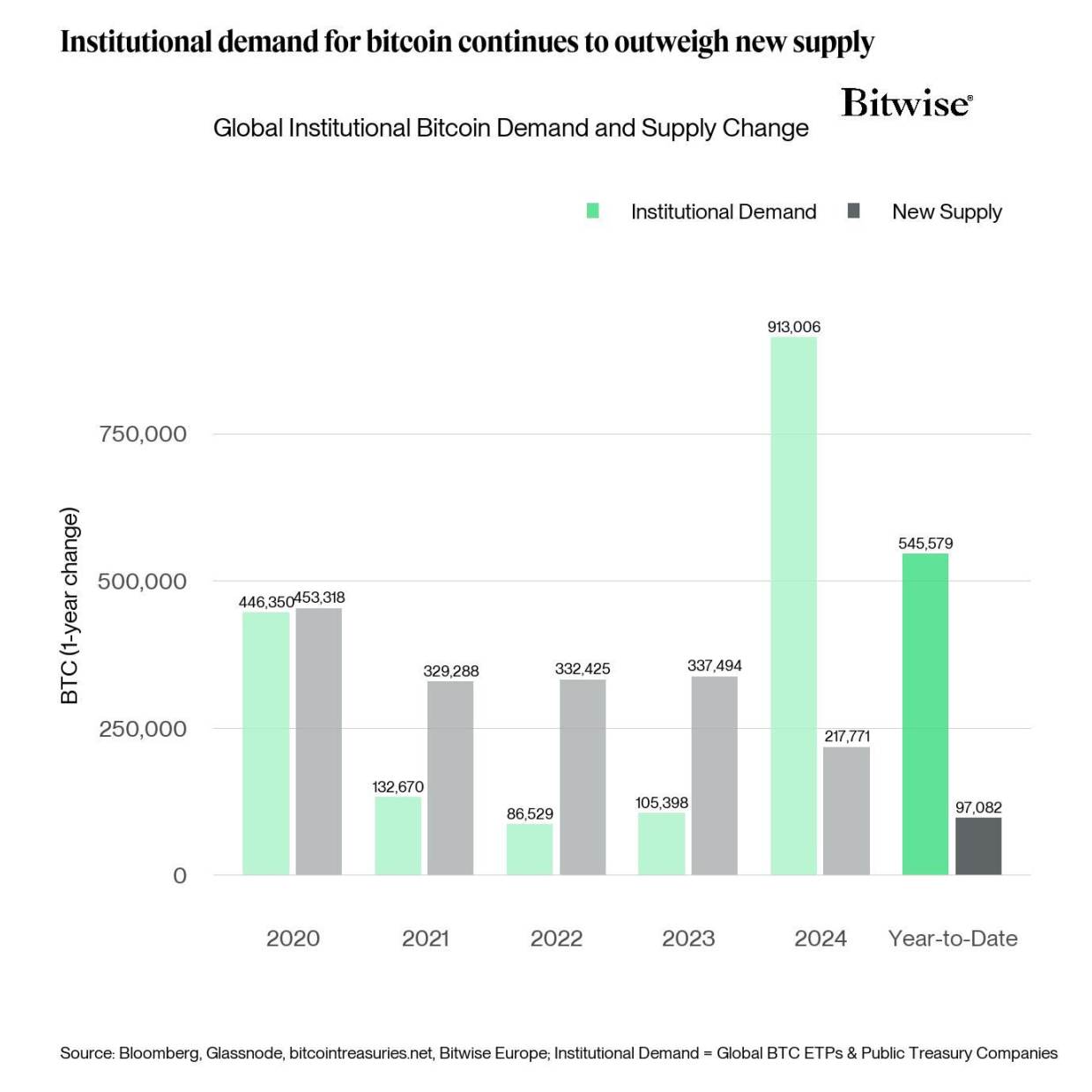
2020-2025 Institutional Demand and Supply of BTC: A Summary, Supply and Demand Reversal Began in 2024
Core data from Bitwise:
As of 2025, institutional demand for BTC...
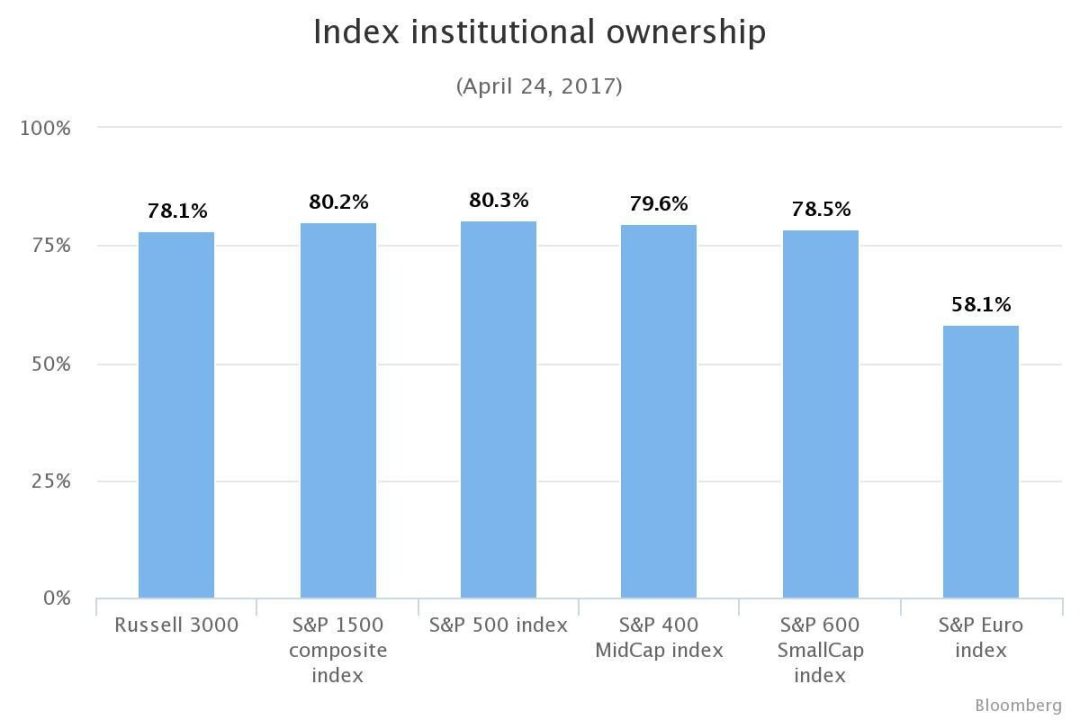
Institutional Equity Asset Share Ratio (2017 Data)
When the underlying infrastructure of crypto absorbs more than $400T (trillions) of traditional assets (for comparison, the current market capitalization of BTC is 1.8T), the inflow scale will no longer be the billions of retail investor sentiment of the past.
Every 1% adjustment in asset allocation = trillions of dollars of capital migration = BTC market capitalization doubles.
Every 1% adjustment in asset allocation = trillions of dollars of capital migration = BTC market capitalization doubles.
Long-term impact on mainstream assets
Simply put, BTC is becoming more like gold, and ETH is becoming more like equity
BTC: Institutional reserve asset
ETF holdings continue to rise, liquidity is constantly decreasing
Prices will become increasingly institutionalized, trend-driven, and a slow bull market
BTC becomes a true "digital gold," and central banks around the world begin to hold it in reserves
ETH: "Equity asset" of the global on-chain economy
Unlike BTC's "commodity-like asset," ETH has attributes closer to "equity":
ETH inflation/deflation hybrid, trending towards deflation
ETH staking rewards are "dividends" from the on-chain economy
ETH's value is positively correlated with the overall on-chain GDP
ETH's pricing logic comes from "network size × usage"
ETH's long-term value = global on-chain economy market capitalization × ETH's tax rate model.
This is stronger than tech giants' stocks because it is "equity at the level of financial infrastructure."
How will the role of retail investors be fundamentally changed?
In short, retail investors have shifted from being narrative creators to price followers (this only applies to mainstream sectors; meme speculation is another matter). They no longer create bull markets; they merely ride the wave. Market characteristics dominated by institutions: More stable trends (long-term funds) Weaker influence of sentiment Thinner liquidity (buying and selling orders dominated by whales) Therefore, retail investors must adjust their strategies: From sentiment trading → Trading with large funds From finding 100x coins → Finding structural long-term sectors From short-term trading → Cross-cycle trading Where are the opportunities for VCs and entrepreneurs?
The most certain tracks for VCs in the next three years:
1. Enterprise-grade blockchain
Simply put, nobody wants their pension funds and bank deposits on Ethereum or Solana, so there needs to be a solution tailored to enterprise needs.
Enterprise-level requirements include: Privacy (public chains cannot achieve this) Compliance (KYC, AML, etc.) Controllability (governance can be upgraded and revoked) Low cost & stability Therefore, institutions cannot use public chains for core business, but instead use enterprise-level blockchain solutions (although they sound like consortium blockchains) such as Hyperledger Fabric and R3 Corda. Institutions will not run core business on Ethereum, but will buy BTC/ETH on ETFs, DAT, and RWA. Assets reside on public blockchains, business operations reside on enterprise blockchains, and the bridging is accomplished by DeFi – this is the architecture of the future. 2. Bridging + ZK (private ↔️ public) Cross-chain Cross-market Cross-regulatory region/country Cross-asset (RWA ↔️ public chain assets) Enterprise-level blockchains need to communicate with public chains, thus requiring bridging as a bridge from institutional private chains to public chains. ZK technology may be a potential technical solution, but I'm not an expert in this area and won't comment further. 3. MPC, Custody, Asset Management Tools The growth of companies like Fireblocks, Copper, and BitGo will be exponential. 4. RWA & Settlement Layer (This is a trillion-dollar opportunity, similar to an on-chain version of the SWIFT network. It involves payments and is very complex; I'll write a separate article about it later.) Conclusion: The next major bull market will not be a victory for Crypto, but a victory for Wall Street. In the next three years, you will see: JPM, BlackRock, and Citi's on-chain scale surpasses most L1 cryptocurrencies. Retail investors' influence on mainstream coin prices will drop to an all-time low. Trillions of dollars will be on-chain through ETFs, RWAs, and enterprise blockchains. Web3 will transform from a narrative economy into a global financial infrastructure. The mass adoption of cryptocurrencies has already occurred, but it's not replacing central banks; rather, it's an upgrade revolution for financial infrastructure. In conclusion: Retail investors are dead; institutions must rise. Instead of fantasizing about 100x returns, understand the logic of capital. The next bull market will be priced by institutions, driven by companies, and determined by infrastructure. Opportunities for retail investors still exist, but the methods have changed. Understand structural trends and position yourself where institutions are headed.


 Weatherly


